


For most hiking in persistent rain, I would choose a rain poncho over an umbrella because it gives much more body coverage, protects your backpack and leaves both hands free. For warm weather, short showers and exposed sunny trails with little wind, I often prefer a hiking umbrella because nothing beats it for ventilation and it can provide useful shade as well as rain protection.
Ponchos and umbrellas are two of the most breathable ways to deal with rain while hiking, but they work in completely different ways. A poncho puts waterproof fabric over you and usually your backpack, while an umbrella creates a small moving roof above your head.
I’ve used both systems and don’t think either one wins in every situation. The biggest factors are wind, temperature, vegetation and whether you need your hands free.
If you’re deciding which actual models are worth buying, I’ve compared the best waterproof ponchos for hiking and the best hiking umbrellas separately.
Rain Poncho Vs Umbrella: Quick Comparison
| Feature | Rain Poncho | Hiking Umbrella |
|---|---|---|
| Body coverage | Excellent | Moderate |
| Backpack coverage | Usually excellent | Partial |
| Ventilation | Excellent | Exceptional |
| Wind performance | Moderate to poor | Poor |
| Hands free | Yes | Not normally |
| Sun protection | Some | Excellent with suitable canopy |
| Dense vegetation | Better | Poor |
| Quick showers | Good | Excellent |
| Persistent rain | Excellent | Good in calm conditions |
| Hot weather | Excellent | Best |
What Is a Hiking Rain Poncho?
A hiking poncho is essentially a large waterproof outer layer with a hood and enough fabric to hang around the sides of your body. The better backpacking designs are also large enough to fit over a loaded rucksack.
That backpack coverage is one of the main reasons I like them. Instead of having waterproof clothing for myself and another rain cover over the bag, I can throw one large waterproof layer over everything.
The loose shape also creates far more ventilation than a conventional waterproof shell. Warm damp air can escape underneath the sides instead of having to travel through waterproof fabric.
Some hiking ponchos go a step further and unfold into rectangular tarps. Sea to Summit’s current Nylon Tarp Poncho, for example, is specifically designed to accommodate a large backpack and convert into a two-person shelter. :contentReference[oaicite:1]{index=1}
What Is a Hiking Umbrella?
A hiking umbrella takes the opposite approach. Instead of wrapping waterproof material around your body, it keeps the rain away from you in the first place.
Modern trekking umbrellas are much lighter than ordinary large umbrellas. Six Moon Designs’ current hiking range runs from about 6 to 8.9 oz, and its Silver Shadow Carbon weighs just 6.8 oz while still having a roughly 37-inch canopy. :contentReference[oaicite:2]{index=2}
That means carrying an umbrella no longer automatically means adding half a kilogram of unnecessary equipment to your backpack.
The other major advantage is sun protection. Reflective hiking umbrellas can create portable shade on exposed trails, which makes them particularly popular on hot long-distance routes.
Advantages of Rain Ponchos Vs Umbrellas
More Body Coverage
A poncho covers far more of your body than an umbrella.
Most hiking ponchos protect the head, shoulders and torso and extend somewhere around the thighs or knees. That means a large proportion of the water that would otherwise hit your clothing never reaches it.
An umbrella mainly protects the area directly beneath the canopy. In vertical rain that can include your head, shoulders and upper torso, but your arms and lower body remain much more exposed.
Better Backpack Protection
This is one of the biggest reasons I would choose the poncho for prolonged rain.
A properly sized backpacking poncho can completely cover the pack, including much of the awkward gap between your shoulders and the rucksack.
An umbrella can certainly shelter part of a backpack, especially if you angle it correctly, but the lower and outer parts of a large pack may still get wet.
If I am carrying camping equipment through hours of rain, the poncho gives me more confidence.
Both Hands Stay Free
With a poncho I can continue using trekking poles, navigating, opening gates, eating or climbing without needing to hold my waterproofing above my head.
An umbrella normally occupies one hand.
There are hands-free mounting kits that attach hiking umbrellas to backpack straps, and they can work very well on suitable trails. But they add another piece of equipment to set up and don’t completely eliminate the problems umbrellas have in wind or vegetation.
Better Around Trees and Vegetation
An umbrella is quite a large rigid object once opened.
That isn’t much of an issue walking across an exposed desert trail, but underneath low branches it can become incredibly irritating. I have enough trouble getting my backpack through some gaps without adding a three-foot-wide canopy above my head.
A poncho stays much closer to the body and moves through woodland more naturally.
Some Ponchos Double as Tarps
This doesn’t apply to every poncho, but it is a genuine advantage of rectangular backpacking designs.
I can use one piece of waterproof material as rainwear while walking and then pitch it as an overhead shelter around camp.
For an ultralight backpacker trying to make every piece of equipment perform more than one job, that’s difficult for an umbrella to compete with.
Advantages of Hiking Umbrellas Vs Ponchos
Nothing Is More Breathable
An umbrella doesn’t need breathable fabric because there is basically nothing surrounding your body.
That means sweat and body heat escape normally.
Even a very open poncho creates some kind of microclimate underneath it. An umbrella simply gives you a roof while leaving the rest of your body exposed to the air.
On hot humid days, this can feel absolutely glorious compared with wearing waterproof clothing.
They Are Incredibly Quick to Deploy
This is where an umbrella wins easily.
Rain starts. Umbrella opens. Done.
With a poncho I have to pull it from the pack, find the head opening, get it over myself and usually make sure it has settled properly over the backpack.
That doesn’t take long, but if showers are appearing and disappearing every fifteen minutes, repeatedly putting a poncho on and taking it off becomes annoying.
For intermittent summer showers, the umbrella is brilliant.
You Get Portable Shade
This is probably the most underrated benefit.
A reflective hiking umbrella can block direct sunlight as well as rain. Six Moon Designs currently rates its Silver Shadow models at UPF 50+, with reflective upper surfaces specifically intended to reduce solar exposure. :contentReference[oaicite:3]{index=3}
If I am crossing an exposed area with no natural shade, carrying my own little patch of shadow can make a massive difference.
A rain poncho does technically block sun from your torso, but wearing another layer in hot sunshine rather defeats the point.
You Can Work Underneath It
I still like this point from the original article because it is genuinely useful.
An umbrella isn’t merely clothing; it is a tiny portable shelter.
If I want to check my phone, look at a map, eat lunch or get something sensitive out of my backpack, I can hold the umbrella over the task.
A poncho keeps me dry but doesn’t automatically create a dry working space in front of me.
And yes, an umbrella is considerably better at keeping a sandwich dry.
They Can Be Extremely Light
The old assumption that umbrellas are heavy isn’t really true anymore.
Six Moon Designs currently sells a full-size Rain Walker SUL at around 6 oz / 170 g, while the Silver Shadow Carbon is around 6.8 oz / 193 g. :contentReference[oaicite:4]{index=4}
That puts a proper trekking umbrella into the same general weight conversation as ultralight rainwear.
Which Gives Better Waterproof Protection?
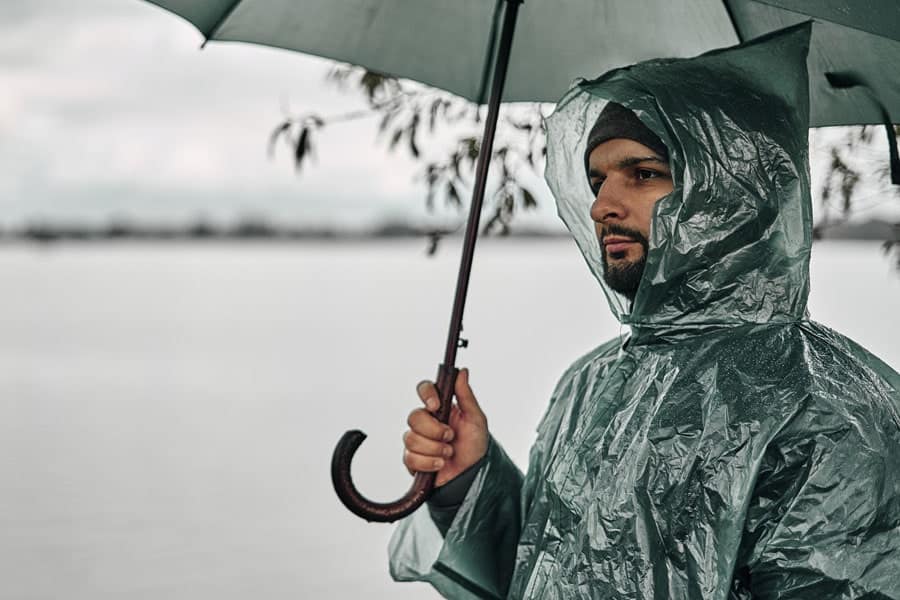
I wouldn’t say an umbrella is inherently more waterproof than a poncho.
A good poncho can be made from genuinely waterproof fabric with taped seams and can withstand prolonged heavy rain. A hiking umbrella canopy also sheds rain extremely well, but much more of your body remains outside the protected area.
What makes an umbrella feel so effective is that there is no waterproof fabric touching your body and therefore virtually no condensation caused by the umbrella itself.
With a poncho, some moisture can collect underneath from perspiration even though the rain isn’t penetrating through the fabric.
So there are really two different questions:
Which prevents more rain reaching your body? Usually the poncho.
Which eliminates condensation better? Definitely the umbrella.
Which Is Better in Heavy Rain?
For prolonged heavy rain, I generally choose the poncho.
The larger coverage becomes more important as the rain continues. My shoulders, torso, thighs and backpack stay underneath the same waterproof layer rather than relying on the direction of a relatively small canopy.
An umbrella can still work brilliantly in extremely heavy vertical rain. The amount of water falling isn’t really the problem.
The problem is what happens when that rain starts arriving at an angle.
Once wind starts blowing water underneath the canopy, more of your body becomes exposed. That’s where wearable rain protection begins to pull ahead.
Which Is Better in Wind?
Neither ponchos nor umbrellas are at their best in strong wind, but I would choose the poncho.
Umbrellas fundamentally give wind a large rigid canopy to push against. A properly built hiking umbrella can flex and survive much stronger gusts than a cheap city umbrella, but I still have to physically control it.
A poncho will flap around, but side fasteners and a light belt around the waist can make it much more manageable.
Even Sea to Summit says its tarp poncho isn’t designed for very windy conditions and recommends restraining it with a belt or accessory strap when wind becomes an issue. :contentReference[oaicite:5]{index=5}
If the forecast involved genuinely strong exposed mountain wind, I would move away from both systems and wear a close-fitting waterproof jacket.
Which Is Better for Hot Weather?
Umbrella.
This is probably the clearest victory anywhere in the comparison.
There is nothing wrapped around my torso, nothing trapping heat and virtually no rainwear-related condensation.
A reflective hiking umbrella also provides shade when the rain stops, so it can remain useful all day instead of going back into the backpack.
For hot exposed trails, particularly desert hiking, I completely understand why people become evangelical about umbrellas.
Which Is Better for Cold Weather?
Poncho.
A poncho isn’t an insulating layer, but it blocks some wind and places waterproof fabric around much more of the body.
An umbrella leaves the body exposed to moving air.
In warm rain that is exactly what I want. In cold rain, suddenly it isn’t quite so appealing.
For properly cold, windy conditions I would probably choose a waterproof jacket over either, but between these two options the poncho gives more useful protection.
Which Is Better for Backpacking?
This is where the decision gets interesting because both can make a lot of sense.
A tarp poncho can potentially replace several pieces of equipment. It may act as rainwear, backpack cover and an emergency or camp shelter.
An umbrella doesn’t replace as many things, but it gives unmatched ventilation and can provide valuable sun protection.
For long-distance hiking through hot exposed country, I can see the attraction of an umbrella immediately. For general backpacking through mixed terrain where I want one rain system to cover myself and my rucksack, I prefer the poncho.
Which Is Better for Thru-Hiking?
It depends heavily on the trail.
On exposed dry trails with intense sun and relatively little dense vegetation, an ultralight reflective umbrella can earn its weight even when it isn’t raining.
On wetter, more enclosed trails, I lean towards the poncho because it covers more of the body and backpack without creating another rigid object to negotiate through trees.
Some hikers use a hands-free umbrella attachment so they can continue using trekking poles. This makes umbrellas much more viable for long-distance walking, although I would definitely test the setup locally before relying on it for hundreds of miles.
Which Is Better in Woodland?
Poncho.
Umbrellas and low branches are natural enemies.
On wide forestry roads there is no problem, but once the trail becomes narrow and overgrown I get fed up with repeatedly tilting and closing an umbrella to get around vegetation.
A poncho isn’t perfect either because loose fabric can snag on branches, but it occupies far less space above and beside you.
Which Is Better on Open Trails?
Umbrella, provided the wind isn’t strong.
This is the environment where hiking umbrellas really make sense. There are no branches to hit, the canopy can remain fully open, and reflective models provide useful shade when the weather clears.
Desert trails, open moorland in calm weather and wide long-distance paths can all suit an umbrella extremely well.
The more enclosed and technical the route becomes, the more I favour wearable rain protection.
Can an Umbrella Protect Your Backpack?
To an extent.
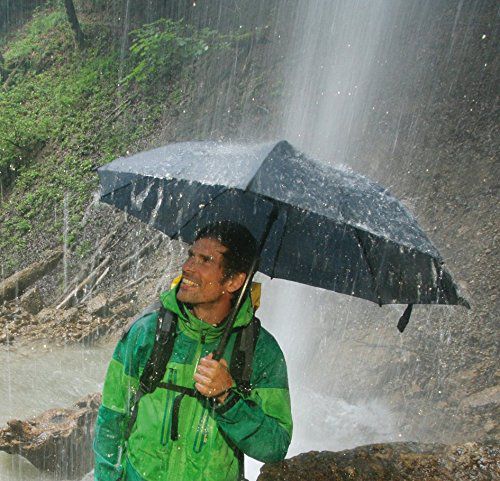
If the canopy is large enough and positioned correctly, it can protect the top and upper rear of a backpack surprisingly well.
But it isn’t the same as enclosing the whole thing underneath a poncho.
Wind-driven rain can still reach the sides and lower sections, so if keeping the backpack dry is important I would use a pack cover or, better still, protect essential equipment inside with a waterproof pack liner.
Can You Use a Poncho and Umbrella Together?
You can, although I normally think it is unnecessary.
The combination gives you an enormous amount of rain protection and the umbrella can reduce the amount of water falling directly onto the hood and upper poncho.
But I’m then carrying two pieces of rain gear when either one would normally be sufficient.
One situation where I can see it making sense is a long hike through extremely hot, changeable weather. The umbrella can handle sunshine and showers throughout the day while the poncho remains packed away for sustained rain.
Can a Hiking Umbrella Be Hands-Free?
Yes.
Several companies now sell straps or mounting systems that attach an umbrella shaft to a backpack shoulder strap.
Six Moon Designs currently sells a dedicated Hands Free Umbrella Kit for exactly this purpose. :contentReference[oaicite:6]{index=6}
That solves one of the biggest objections for trekking-pole users because both hands remain available.
It isn’t quite as simple as wearing a poncho, though. The umbrella still extends above the body and remains vulnerable to branches and gusts.
Which Packs Smaller?
This varies enormously.
Some disposable or ultralight ponchos pack into something barely larger than your fist. More substantial tarp ponchos are bigger.
Full-size trekking umbrellas are long even when closed, but compact folding versions are also available.
Six Moon Designs’ full-size Carbon is around 25 inches long when packed, whereas its current Mini collapses to roughly 10 inches. :contentReference[oaicite:7]{index=7}
So if minimum packed length matters, check the actual product rather than assuming one category always wins.
Which Is Easier to Put On in Sudden Rain?
Umbrella.
There isn’t much competition.
I can have an umbrella open in a couple of seconds without removing anything.
A poncho is still much quicker than stopping to put on waterproof trousers and a jacket, but I need to get the fabric properly over myself and the backpack.
If the forecast is a sequence of five-minute showers separated by sunshine, the umbrella’s convenience becomes increasingly valuable.
Which Is Better for Eating Lunch in the Rain?
Umbrella, and this sounds sillier than it actually is.
I can create a dry little working area underneath an umbrella, get food from my bag and eat without everything immediately becoming wet.
A poncho keeps me dry, but once my hands and lunch come outside the fabric they’re back in the rain.
For short stops in wet weather, that small shelter is surprisingly useful.
Rain Poncho Vs Umbrella: Which Should You Choose?
I would choose a rain poncho when:
- Persistent rain is expected
- I want to cover my backpack as well
- I need both hands free
- I’m hiking through woodland
- The weather is relatively cool
- I want gear that can potentially double as a tarp
- I don’t want to carry separate backpack rain protection
I would choose a hiking umbrella when:
- The weather is hot
- Rain is intermittent
- The trail is open
- Strong wind isn’t expected
- I want maximum ventilation
- I want portable shade as well as rain protection
- I frequently need to check maps, phones or food while it is raining
Rain Poncho Vs Umbrella: My Verdict
If I could only choose one for general hiking, I would take the rain poncho.
It provides more dependable overall coverage, protects the backpack, leaves my hands free and works across a wider range of trails. For a long wet day, those advantages outweigh the umbrella’s incredible ventilation.
But there are conditions where I would deliberately leave the poncho behind.
On a hot, open trail with intermittent rain and strong sunshine, I would take the hiking umbrella. It gives me instant rain protection, creates shade whenever I want it and allows completely unrestricted airflow around my body.
That is why I don’t think umbrellas should be dismissed as something you only carry around town. Proper lightweight trekking umbrellas can be genuinely brilliant hiking gear.
The poncho is the better all-round rain system.
The umbrella is the better hot-weather shelter.
Which one I carry depends on the trail and forecast rather than which one wins on paper.




[…] You could also take an umbrella vs your poncho […]