Sea To Summit Big River 50L Waterproof Backpack Review

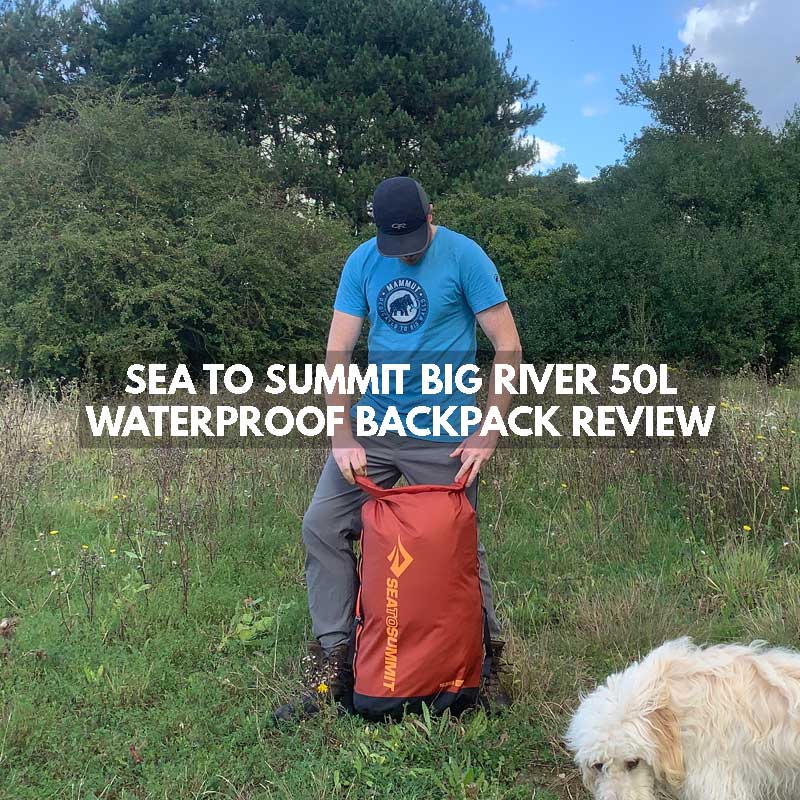
I’ve now been using the Sea To Summit Big River 50L Waterproof Backpack for nearly three years, and it is still going strong. What started out as a waterproof hiking and cycling bag has become one of my favorite packs for paddleboarding as well, and it has repeatedly kept my gear dry when cycling in heavy rain.
I originally reviewed this backpack after only a few months of use. Since then I have had much more time to find out where it works, where it doesn’t, and whether the lightweight construction actually holds up long term.
The short version is that I like it more now than when I first reviewed it. It isn’t a replacement for a framed hiking backpack and it has almost no organization, but if the priority is carrying a lot of gear while keeping it dry, the Big River is exceptionally practical.
Sea To Summit Big River 50L Waterproof Backpack Review
LONG-TERM VERDICT
Best for: Paddleboarding, kayaking, wet-weather cycling, motorcycle travel and carrying bulky gear you need to keep dry.
What I like: Genuinely waterproof in the conditions I’ve used it in, extremely light for 50 litres, tough material and very simple.
Main downside: No frame, pockets or internal organization, so it isn’t the best choice for carrying heavy loads over long hiking distances.
Would I buy it again? Yes. After nearly three years of use, mine is still going strong.
Are you in a hurry? The Sea To Summit Big River is essentially a tough 50-litre dry bag with a backpack harness attached, and that simplicity is exactly why I like it.
There is no frame and virtually no organization inside, so I wouldn’t choose it over a proper backpacking pack for carrying heavy equipment all day. But for clothes, sleeping gear, towels, electronics and anything else I really don’t want getting wet, it works extremely well.
I originally thought kayaking and wet-weather hiking would be its main uses. In reality, two of the things I now use it for most are stand-up paddleboarding and cycling in the rain.
On a paddleboard, the large roll-top opening makes it easy to throw clothes, towels and other gear inside while the 50-litre volume gives you plenty of room without needing multiple dry bags. When cycling in bad weather, I don’t have to worry about putting everything inside separate waterproof liners.

Sea To Summit Big River Specifications
Here are the current specifications of the Sea to Summit Big River waterproof backpack:
- WEIGHT: 1 lb 10.8 oz / 760 g
- VOLUME: 50 liters
- SIZE: Approx. 24 x 14 x 11 in / 60.4 x 34.5 x 28.5 cm
- MATERIAL: Heavy-duty 420D nylon
- HH RATING: 10,000 mm
- FRAME: Frameless
- POCKETS: No internal pockets
One thing worth emphasizing is that 50 litres is a lot of space for a pack that weighs only 760 grams. A conventional 50-litre hiking backpack with a proper frame, padding and organizational features can easily weigh considerably more.
That is the trade-off with the Big River: you get lots of waterproof storage for very little weight, but almost none of the structure or organization of a conventional backpack.
Sea To Summit Big River Features
The Big River keeps its feature list deliberately simple:
- Waterproof Roll-Top Closure: Roll-top design with field-repair buckles and taped waterproof seams.
- Padded Shoulder Straps: EVA foam shoulder harness for carrying the bag as a backpack.
- Removable Waist Strap: 38 mm webbing strap provides some extra stability.
- 420D Nylon Construction: Tough, abrasion and puncture-resistant fabric.
- Reinforced Base: Triple-coated oval base for additional durability.
- External Lash Points: Webbing rails make it easy to attach or secure the pack.
- White Interior: Makes equipment considerably easier to see inside the bag.
I actually appreciate the lack of features more after using the bag for a few years. There aren’t many zippers, pockets or complicated components to fail. It is basically a tough waterproof compartment with straps.

My Long-Term Experience
When the bag first arrived, I was surprised by how light it felt. I own several other backpacks around the 50-litre mark, but none combine this amount of space with the same level of waterproofing and such a minimal construction.
Almost three years later, that lightweight design hasn’t turned out to mean fragile.
Mine is still going strong.
I’ve continued using it in bad weather and it has become particularly useful for cycling when heavy rain is forecast. With an ordinary backpack I would normally use a waterproof liner or separate dry bags for anything important. With the Big River I can simply pack everything into the main compartment and close the roll top properly.
I’ve also started using it for stand-up paddleboarding, which is arguably an even better use for the bag than hiking. Towels, spare clothes, food and anything else I want with me on the water all fit into one large waterproof compartment.
The fact that it is a backpack also makes getting equipment to and from the water much easier than carrying a normal dry bag in one hand.
This is where my opinion has changed slightly since the original review. I initially looked at the Big River partly as a waterproof hiking backpack. I now think of it primarily as a waterproof adventure and transport pack that can also be used for hiking.
Who Is the Sea To Summit Big River Waterproof Backpack For?
After using it for several years, I think the Big River makes the most sense for people who regularly deal with water or bad weather.
Paddleboarders and kayakers are an obvious fit. The 50-litre version gives you enough room for towels, clothes, food and other equipment, while the backpack straps make carrying everything down to the water straightforward.
Wet-weather cyclists are another group I can personally recommend it for. I use mine when cycling in heavy rain because I know the contents aren’t relying on a rain cover to stay dry.
Motorcyclists can use the external lash points to secure the bag or wear it as a backpack.
Surfers and beach users get a large compartment that keeps clean clothes away from water and sand and can also carry wet equipment home afterwards.
Hikers and backpackers can absolutely use it, but I would choose it specifically when waterproofing matters more than load-carrying comfort.
It can also be rolled down and carried inside a larger backpack, which makes it useful as an oversized dry bag for trips involving boats, river crossings or extremely wet conditions.

Size and Weight
The 50-litre Big River gives you a surprisingly large amount of usable space.
I can fit bulky items such as a sleeping bag, clothes, food and camping equipment inside without much trouble. For paddleboarding, there is more than enough room for towels, spare layers, shoes and supplies.
At 760 grams, it is remarkably light for a backpack of this volume.
That weight makes more sense once you look at the construction. There is no heavy frame, thick hip belt, elaborate back panel or collection of internal pockets.
For comparison, that means the majority of what you are carrying is actual storage space rather than backpack structure.
The roll-top closure also makes the capacity somewhat adaptable. When the bag isn’t full, you simply roll the top down further and reduce the excess volume.

How Much Weight Can It Carry?
This is where I think you need to understand what the Big River is designed for.
It will physically carry a surprising amount of weight, but that doesn’t mean you should treat it like a framed expedition backpack.
I tested mine with a full weekend camping setup weighing around 9 kg including the bag. It handled the load without any problem, but careful packing became important because there is no frame separating hard or oddly shaped equipment from your back.
Sea To Summit currently suggests around 12 kg as a longer-distance carrying limit and up to around 20 kg for shorter carries, depending on the wearer.
Personally, I prefer keeping the load considerably lighter whenever I am going to carry it for a long time.
Around 7–10 kg feels much more appropriate to me.
For paddleboarding or cycling, this matters less because the bag isn’t necessarily sitting on your back continuously for hours in the same way it would on a long hike.
The roll-top design is also useful when carrying smaller loads because you can simply roll the top further down instead of having a half-empty 50-litre backpack flapping around.
Comfort
For such a minimal backpack, the Big River is surprisingly comfortable when packed correctly.
The important words there are packed correctly.
There is no internal frame or heavily padded back panel, so whatever you put against the rear of the backpack effectively becomes the shape of the back support.
Soft, bulky equipment works brilliantly.
A sleeping bag, clothes and towels naturally create a comfortable shape against your back.
Cooking equipment, tools and other hard objects require more thought.
When I originally tested the bag, I discovered that the cardboard insert supplied with the packaging worked surprisingly well as a crude back panel. A thin foam pad would be a better long-term version of the same idea.
The shoulder straps use fairly firm padding and have held their shape well on my bag. The waist strap is simply webbing rather than a padded hiking hip belt, which reinforces the fact that this isn’t designed as a heavy-load trekking pack.
For normal carrying and moving equipment between a car, bike, campsite or water, I find it perfectly comfortable.

Durability After Nearly Three Years
This is the section I can update most confidently now.
When I originally wrote this review, I had only been using the bag for around three months. At the time, the 420D nylon and reinforced base felt tough, but there is only so much you can learn about durability in a few months.
Nearly three years later, my Big River is still going strong.
It has been used for wet-weather cycling, paddleboarding, camping and general outdoor use without giving me a reason to retire it.
The upper bag uses heavy-duty 420D nylon and the base gets an additional abrasion-resistant coating. That reinforced bottom matters because it is the part you repeatedly drop onto the ground.
The oval base is another small design feature I appreciate more with use. It provides a reasonably stable bottom while also making the bag easier to lash down than a perfectly round dry bag.
I obviously can’t promise how long anyone else’s backpack will last, but I no longer need to speculate about whether mine will survive more than a couple of seasons. It already has.
Waterproofing
Waterproofing is the entire reason to buy this backpack, and so far mine has delivered.
The Big River uses a roll-top closure, waterproof taped seams and a 10,000 mm hydrostatic-head fabric.
I’ve repeatedly used mine while cycling in heavy rain and have also taken it paddleboarding. The contents have stayed dry in the conditions I’ve subjected it to.
The important distinction is between a waterproof dry backpack and a bag designed for prolonged submersion.
I treat the Big River as something designed to keep rain, spray and water out when the roll top is properly closed. I don’t deliberately leave it submerged underwater.
For paddleboarding, that is exactly what I need. If the board gets splashed or the bag gets wet, I’m not worrying about towels and clothes soaking up water.

Adjustability
The harness is much simpler than what you would find on a conventional backpacking pack.
The shoulder straps can be adjusted for length and there is a removable webbing waist strap to stabilize the load.
You don’t get an adjustable torso system, thick lumbar padding or a structural hip belt designed to transfer a large amount of weight onto your hips.
For the loads I generally carry in this bag, that hasn’t bothered me.
The roll-top also gives you another type of adjustment that normal backpacks don’t always provide. If the bag is only partly full, you can roll the opening down several additional times to reduce the overall volume.
That makes the 50-litre version surprisingly usable even when you aren’t carrying anywhere near 50 litres of gear.
What the Sea To Summit Big River Dry Backpack Doesn’t Have
The Big River is deliberately basic.
There is no rigid internal frame, no conventional zipped compartments and no internal organization.
That is both its biggest weakness and part of what makes it good.
If I want a backpack for carrying 15 kg of hiking equipment all day, I want a frame, padded hip belt, ventilated back panel and lots of adjustment.
If I’m loading towels and clothes onto a paddleboard or cycling through torrential rain, I would rather have one large waterproof compartment with almost nothing to go wrong.
You need to decide which of those jobs you are actually buying a backpack for.
If you want lots of pockets and organization, don’t buy this.
If you want lightweight, tough, waterproof storage that you can comfortably carry on your back, the simplicity makes much more sense.
What I Like Most After Long-Term Use
The thing I like most about the Big River is that I keep finding reasons to use it.
I originally wanted it to replace an old 18-litre waterproof Alpkit backpack that I had used for hiking in heavy rain and cycling to work. The extra capacity of the 50-litre Big River has made it useful for far more than that.
It can carry a complete change of clothes and towels for paddleboarding, swallow bulky camping gear, protect everything during a wet bike ride and still roll down small enough when it isn’t full.
I also appreciate how little there is to break.
There are no waterproof zippers to eventually fail and no complicated frame or adjustment system. The bag relies on a tough fabric body, taped seams and a simple roll-top closure.
After several years of ownership, that simplicity has become one of its biggest selling points for me.
Is the Sea To Summit Big River Dry Backpack Worth It?
Yes — and I’m more confident saying that now than I was when I first reviewed it.
After nearly three years, mine is still going strong and has ended up being useful for more activities than I originally expected.
I wouldn’t buy the Big River as my only hiking backpack. If I were regularly carrying a heavy load over long distances, I would still choose a conventional framed backpack.
But that isn’t really what this bag is trying to be.
For paddleboarding, kayaking, cycling in heavy rain, motorcycle travel and any trip where keeping bulky gear dry matters more than carrying lots of weight, I think it is excellent.
The 50-litre model hits a particularly useful middle ground: large enough for plenty of clothing and equipment without becoming enormous, but still only weighing 760 grams.
Most importantly, mine has actually held up.
A few months of testing can tell you whether a product initially works. Nearly three years of continued use tells you much more about whether it was worth buying.
I would buy the Big River again.
VIEW ON SEA TO SUMMIT
Thanks for reading this Sea To Summit Big River 50L Waterproof Backpack review. If you have any questions about the bag or want to know how mine has held up in a particular situation, let me know below.