Sea To Summit Ultra-Sil Nano Poncho Review


The Sea to Summit Ultra-Sil Nano Tarp Poncho is still one of my favourite pieces of lightweight rain gear. It is ridiculously small, weighs next to nothing, covers both me and my backpack, and can double as a tarp. Despite the very thin 15D fabric, I don’t find it especially noisy or crinkly compared with some other ultralight ponchos I have used.
I have used this poncho in wet, humid conditions both over and underneath a backpack, and that contradiction pretty much sums up my long-term view of it.
It isn’t luxurious rainwear.
It is a highly functional piece of ultralight gear that disappears into your pack until the weather turns bad.
Sea to Summit currently still sells the Ultra-Sil Nano Tarp Poncho. The current version is made from 15D Ultra-Sil Nano nylon, has taped seams, accommodates a large backpack and converts into a two-person tarp or groundsheet.
QUICK VERDICT
Best for: Lightweight hiking, backpacking, travel and emergency rain protection.
What I like: Extremely light, tiny packed size, properly waterproof, excellent ventilation, covers a backpack and doubles as a tarp.
What I don’t like: The loose cut can flap around in wind, and the 15D fabric needs more care around sharp branches and rock.
Would I still buy it? Yes. I keep reaching for it because it is so light, compact and useful.
Sea to Summit Ultra-Sil Nano Tarp Poncho Review
If you know me, you’ll know I am a big poncho fan.
For lightweight hiking, I still rate this as one of the best waterproof ponchos I have used.
The reason is not that it feels like a conventional fitted waterproof jacket.
It feels very different: loose, airy and almost weightless.
I rate it because it does an enormous number of jobs for almost no weight:
- Rain jacket
- Leg coverage
- Backpack cover
- Emergency tarp
- Groundsheet
- Quick rain shelter
That is an unusually good return from something that packs down to around the size of a fist.

Pros and Cons
- Extremely light and packable
- 15D waterproof siliconised nylon
- Covers you and a large backpack
- Far more ventilated than most waterproof jackets
- Converts into a tarp or groundsheet
- Taped seams
- Useful side snaps
- Guy attachment points
- Excellent emergency rain layer
- Loose fabric can flap around in wind
- 15D fabric needs more care around sharp branches and rock
- Loose cut can flap around in wind
- Non-breathable fabric can still develop condensation
- One-size cut can feel huge without a backpack underneath
Current Specifications
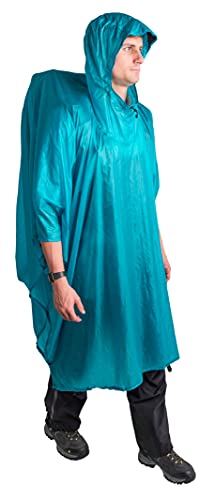
- MATERIAL: 15D Ultra-Sil Nano nylon
- BODY WEIGHT: Sea to Summit currently lists approximately 6.5 oz / 185 g in its technical specifications
- PACKED WEIGHT: Approximately 8.1 oz / 230 g in Sea to Summit’s current product highlights
- DIMENSIONS: 57 x 104 in / 145 x 265 cm
- PACKED SIZE: Approximately 5 x 3 x 3 in / 13.5 x 7.5 x 7.5 cm
- SIZE: One size
- SEAMS: Double stitched and tape sealed
- HOOD: Three-panel design with brim
- BACKPACK COVERAGE: Designed to accommodate a large backpack
- TARP USE: Guy attachment points for converting it into a shelter
Sea to Summit currently gives two different weight figures on its own product page: a lower garment weight in the technical-specification table and a higher packed-weight figure in the product highlights.
That is why you may see both numbers quoted online.
Either way, the important practical point remains the same: this thing is extremely light for something that can cover both you and a full backpack and then become a tarp.
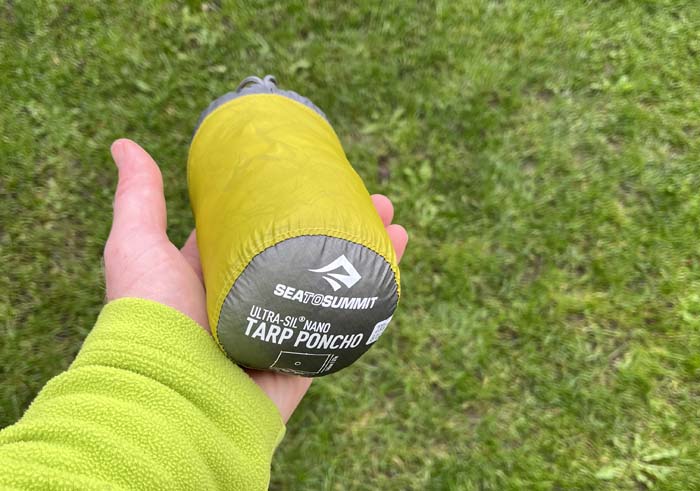
Weight and Pack Size
Weight and packed size are the main reasons I continue to use it.
It packs down small enough that there is almost no argument for leaving it at home.
That matters more to me than it sounds.
With a conventional waterproof jacket and waterproof trousers, there are plenty of warm-weather trips where I start questioning whether I really want to carry them all day just in case it rains.
I don’t have that argument with myself about this.
I can throw it in the pack and forget about it.
That makes it particularly good for:
- Hot and humid hiking
- Travel
- Fast-and-light trips
- Summer backpacking
- Festivals and outdoor events
- Emergency rain protection
You can find lighter disposable ponchos, but that isn’t really a fair comparison.
This is reusable equipment with proper seams, snaps, a usable hood and enough material to create a shelter.

Fit and Sizing
For reference, I am 5 ft 10 inches, and the poncho comes down to around/below my knees depending on whether I have a backpack underneath it.
It is deliberately enormous.
That makes sense because it needs enough material to cover a large backpack and enough surface area to become a tarp.
The downside is that without a pack underneath, there is a lot of fabric hanging around you.
I have used it three ways.
Backpack Underneath
This is normally the most useful arrangement in proper rain.
The backpack fills out the rear of the poncho and everything stays under one waterproof layer.
It also means I don’t need a separate pack cover.
Backpack Over the Poncho
This pulls the loose fabric in around my torso and stops it flapping as much.
It feels neater, but obviously the backpack is then exposed to the rain unless it has its own protection.
Belt Around the Outside
This isn’t elegant, but it works.
A simple strap or belt around the waist can transform the poncho in windy conditions by controlling all the spare material.
Sea to Summit itself recommends using a belt or accessory strap when conditions are windy because tarp ponchos are not designed to be aerodynamic.
Waterproofing

I have no complaints about the basic rain protection.
The siliconised 15D nylon doesn’t need to behave like a breathable membrane.
Its job is to stop rain penetrating the fabric, while the enormous open areas around the bottom and sides provide ventilation.
Sea to Summit currently describes the outer surface as siliconised so it won’t wet out, and the seams are double stitched and tape sealed.
The long cut protects:
- Head
- Torso
- Arms
- Upper legs
- Most or all of a backpack
In heavy rain I would much rather have the backpack underneath the poncho.
Sea to Summit makes the same point: with the pack underneath, rain runs over the fabric rather than the material being compressed beneath wet backpack straps.
That is where this design has a real advantage over trying to use an ultralight rain jacket as both body protection and pack protection.
Breathability and Ventilation
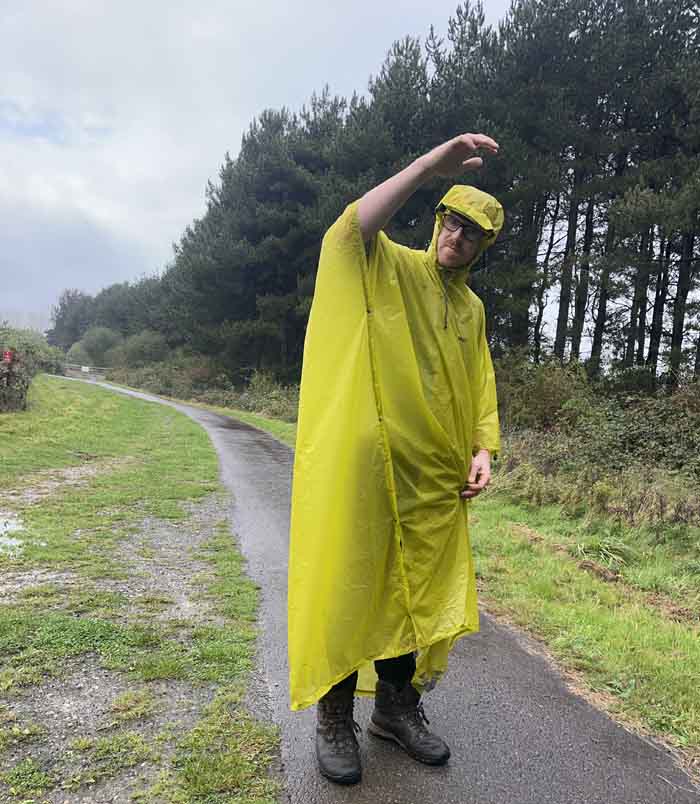
The fabric itself is not breathable.
Sea to Summit says this directly.
What makes it comfortable in warm weather is ventilation.
There is a massive difference between those two things.
A breathable waterproof jacket attempts to let water vapour escape through the fabric.
This poncho doesn’t.
Instead, warm moist air escapes through the huge openings around your arms, sides and bottom.
You can leave fewer side snaps closed when you want maximum airflow or button things down more when the rain gets heavier.
I still get condensation when working hard uphill in warm, wet and humid conditions.
That is unavoidable with this kind of material.
The difference is that the open design generally feels less clammy to me than being completely enclosed in a waterproof jacket.
Noise and Fabric Feel
For such thin fabric, I actually think the Ultra-Sil Nano feels better than you might expect.
I have used other lightweight ponchos that are much more obviously crinkly and rustly.
This one still makes some noise because it is a large sheet of 15D nylon moving around your body, but I don’t find the sound especially annoying.
That matters on long hikes.
A noisy poncho can become surprisingly irritating after hours of movement.
The Ultra-Sil Nano feels soft and flexible enough that I don’t really think about the material once I am walking.
The main thing I notice is how little it weighs.
Durability

15D sounds alarmingly thin.
And it is thin.
You can almost see through the material in certain light.
But I have been impressed by how well it holds up considering the weight.
I am still more careful with it than I would be with a heavy 70D poncho.
Sharp branches, thorns and rough rock are the obvious enemies.
I also wouldn’t drag it around the ground unnecessarily simply because Sea to Summit says it can function as a groundsheet.
That feature is useful.
It doesn’t magically turn 15D nylon into bombproof canvas.
Sea to Summit also sells a much heavier 70D Nylon Tarp Poncho.
That makes more sense if durability is more important to you than weight, but it weighs dramatically more.
For backpacking, I would still take the Ultra-Sil Nano.
Comfort and Practicality

Comfort is a strange mix.
Physically, there is almost nothing to it.
There are no tight cuffs, stiff shoulders or restrictive sleeves.
You can move around underneath a giant sheet of incredibly lightweight fabric.
The open sides let huge amounts of air through.
That is excellent.
The disadvantages are all consequences of the same design.
There is lots of loose fabric.
It can flap.
It can get in the way.
My old Homer Simpson comparison still feels about right: wearing it is less like putting on a fitted waterproof jacket and more like throwing an enormous lightweight waterproof dress over yourself.
It looks slightly ridiculous.
I don’t really care when it is raining.
Using the Ultra-Sil Nano Poncho as a Tarp
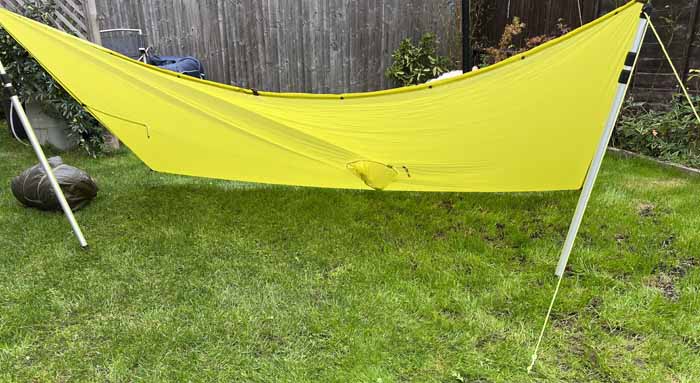
This is the feature that separates the Ultra-Sil Nano Tarp Poncho from Sea to Summit’s shorter Ultra-Sil Nano Poncho.
The current normal Nano Poncho cannot be used as a tarp.
The Tarp Poncho in this review is much longer and has attachment points specifically for shelter use.
I have pitched mine to see how it behaves under tension.
With poles, trees or suitable anchor points and some guylines, you can create a small A-frame or lean-to style shelter.
I hadn’t slept overnight under this particular poncho when I originally reviewed it because mosquitoes were awful where I was testing it.
I have, however, spent multiple weeks sleeping beneath poncho shelters before, so I know the compromises.
A poncho tarp is minimalist.
You don’t get:
- An enclosed inner
- Bug protection
- A bathtub floor
- Huge weather protection from every direction
What you get is an emergency or ultralight shelter that was already in your pack doing another job.
That is why I like it.
I also use tarp-style shelter much more casually for stopping in rain or cooking underneath a tarp than I do for sleeping beneath one.
Using It Over a Backpack

This is probably the strongest reason to use a hiking poncho instead of a conventional rain jacket.
One layer protects me and my pack.
If rain suddenly starts, I don’t need to:
- Remove my backpack.
- Find the pack cover.
- Stretch it over the pack.
- Put the backpack on again.
- Then put on a waterproof jacket.
I can throw the poncho over everything.
It easily accommodates a large backpack.
Occasionally the rear catches on the pack and needs a shake or a tug to drop into place, but once it is covering everything it works extremely well.
For comparison, see my guide to a rain poncho vs pack cover.
How Does It Perform in Wind?
Not brilliantly if you just leave all that material flapping around.
This is inherent to ponchos.
Strong wind catches underneath the fabric and turns it into a sail.
The side snaps help, but a belt or lightweight strap around the outside makes the biggest difference.
Sea to Summit itself says a tarp poncho is not designed for very windy conditions and recommends a belt/accessory strap where wind is an issue.
If I knew I was heading into exposed mountains with prolonged wind-driven rain, I would normally prefer a fitted waterproof shell.
For humid forests, trails, travel and less exposed conditions, I prefer the ventilation and simplicity of the poncho.
Ultra-Sil Nano Tarp Poncho vs Ultra-Sil Nano Poncho
These are now two distinct Sea to Summit products and it is easy to confuse them.
Ultra-Sil Nano Tarp Poncho
This is the one reviewed here.
It is the longer version, designed to:
- Cover a large backpack
- Work as rainwear
- Convert into a tarp
- Work as a groundsheet
It is roughly 57 x 104 inches / 145 x 265 cm.
Ultra-Sil Nano Poncho
The regular Nano Poncho is much smaller and lighter.
Sea to Summit currently lists it at around 46 x 55 inches / 118 x 140 cm and specifically says it cannot be used as a tarp.
If I only wanted emergency body rain protection, the normal Nano Poncho would be tempting.
For hiking with a backpack, I prefer the extra utility of the Tarp Poncho.
Is the Sea to Summit Ultra-Sil Nano Tarp Poncho Worth It?
Yes, if you value weight and pack size.
It is expensive compared with a generic poncho.
But comparing it with a disposable plastic poncho misses the point.
The Sea to Summit gives you a properly constructed reusable piece of gear with:
- Taped seams
- A proper hood
- Side snaps
- Backpack coverage
- Shelter attachment points
- A tiny packed size
For somebody who wants a heavy-duty rain cape to crash through thorny woodland, I would buy something thicker.
For somebody counting pack weight who wants one item to replace a rain layer, pack cover and emergency tarp, it makes much more sense.
Who Should Buy It?
I would recommend it for:
- Thru-hikers
- Lightweight backpackers
- Warm-weather hikers
- Travellers
- People who dislike sweaty waterproof jackets
- Anyone wanting an emergency tarp and rain layer in one
I would be less enthusiastic if you:
- Hike mainly in high winds
- Frequently push through thorns and dense scrub
- Prefer fitted technical clothing
Final Verdict
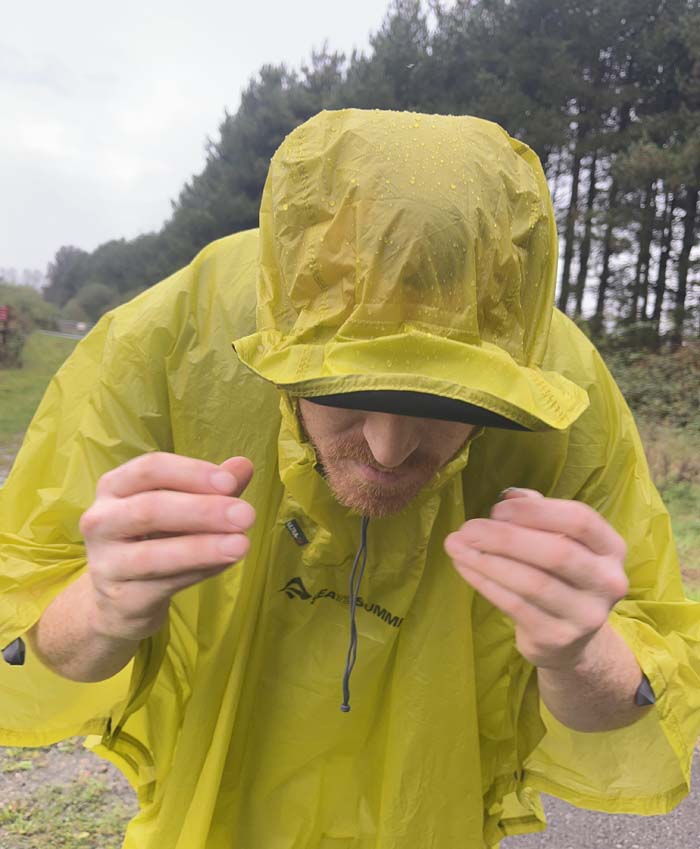
The Sea to Summit Ultra-Sil Nano Tarp Poncho isn’t perfect.
The loose cut can be awkward in wind, and the 15D fabric still needs more care than a heavy-duty poncho.
But the material itself is not something I find particularly annoying.
In fact, compared with some other ultralight ponchos I have used, this one feels relatively soft and not especially crinkly.
When rain gear weighs this little, packs this small, keeps me and my backpack dry, gives better ventilation than a conventional shell and can become a tarp, the trade-off works extremely well for me.
If I am heading somewhere extremely windy or abrasive, I will take more conventional waterproofs.
If I want maximum versatility for minimum pack weight, this is still one of the first rain layers I reach for.
I hope this Sea to Summit Ultra-Sil Nano Tarp Poncho review helps if you are trying to decide whether the tiny pack size and versatility are worth accepting the compromises of such lightweight fabric.