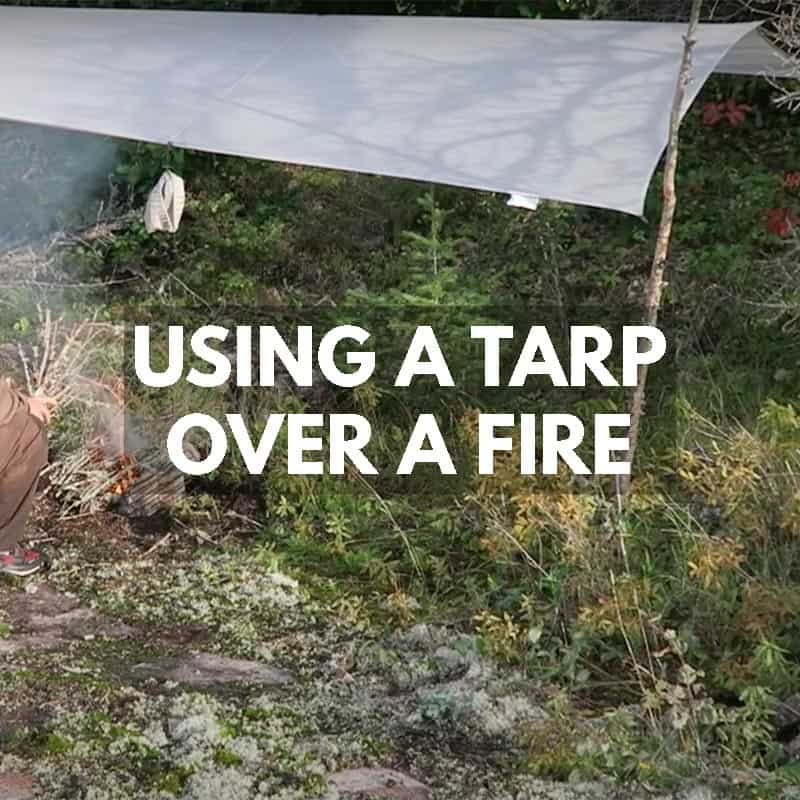
Yes, you can have a small campfire beneath or beside a properly pitched tarp, but there is always some risk of heat damage, sparks, melting fabric, and fire. I have used fires with tarp shelters many times, and the things that matter most are keeping the fire small, giving it plenty of clearance, maintaining good ventilation, using sensible firewood, and never leaving it unattended.
If you are trying to keep warm or cook under a tarp in the rain, bringing a fire close to your shelter can make a miserable wet evening much more comfortable.
It also introduces a fairly obvious problem: most lightweight camping tarps are made from synthetic fabric that can melt or burn.
I’ve used fires around lightweight tarps successfully, but I don’t treat it casually. I keep the flames much smaller than I would around an open campfire and pay close attention to sparks, wind direction, tarp height and ventilation.
If fires are prohibited, conditions are dry enough for a wildfire risk, or you can’t create a safe setup, don’t light one.
Can You Have a Fire Under a Tarp?
Yes, but I wouldn’t put a normal campfire directly beneath the middle of a low synthetic tarp.
The setup I prefer is more like an open-sided lean-to, with the fire positioned towards the open edge of the shelter rather than enclosed underneath it.
That gives the smoke somewhere to escape and increases the distance between the hottest part of the fire and the tarp.
The safest option is always to keep the fire completely outside the tarp.
But if you’re using a fire to warm an open tarp shelter or cook while sheltered from rain, you can reduce the risk considerably by keeping the fire small and maintaining plenty of clearance.
There is no single distance that makes every tarp and every fire safe.
A tiny cooking fire is completely different from a roaring campfire, and a heavy canvas tarp behaves very differently from an ultralight nylon or polyester one.
11 Tips for Using a Tarp Near a Fire
These are the things I pay attention to whenever I’m using a fire around a tarp shelter.
1. Choose the Right Type of Tarp
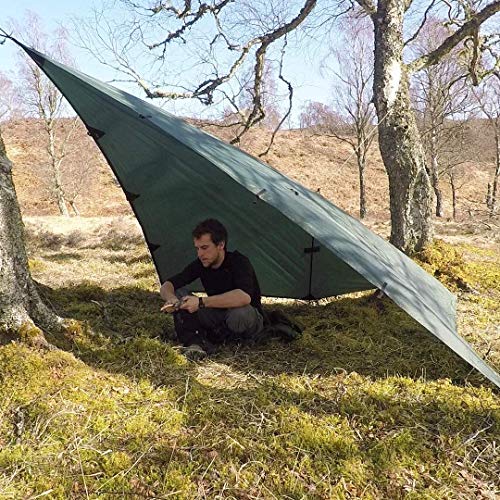
If you regularly plan to use a tarp around an open fire, heavy canvas or another fabric specifically designed to resist heat and sparks makes far more sense than an ultralight backpacking tarp.
Most normal camping tarps use polyester, nylon, polyethylene or similar synthetic materials.
They are excellent at keeping rain off and keeping pack weight down, but they aren’t designed to have flames underneath them.
A flying ember can melt a small hole almost instantly.
I’ve used lightweight synthetic tarps around fires, including tarps similar to the DD Hammocks Tarp 3×3, but I accept that every time I do it there is some risk of spark damage.
For frequent bushcraft use around fire, I’d choose canvas or a properly rated flame-resistant shelter.
2. Burn the Right Wood

Dry firewood is much easier to manage underneath a shelter than wet or green wood.
Wet wood produces far more smoke and tends to make the whole experience unpleasant very quickly.
I also avoid very resinous wood where possible because it can spit and throw sparks.
Dry hardwood generally gives me a slower, more predictable fire with good coals.
I don’t obsess over individual tree species because what is available legally and locally varies enormously.
The main things I want are:
- Dry wood
- Dead and down wood where collection is permitted
- Small pieces rather than enormous logs
- Wood that isn’t constantly spitting sparks
Never burn treated timber, painted wood, plastic or rubbish.
Also check the local rules before gathering or transporting firewood. Leave No Trace recommends keeping fires small and using dead and down wood where collection is permitted. :contentReference[oaicite:2]{index=2}
3. Give the Tarp as Much Clearance as Possible
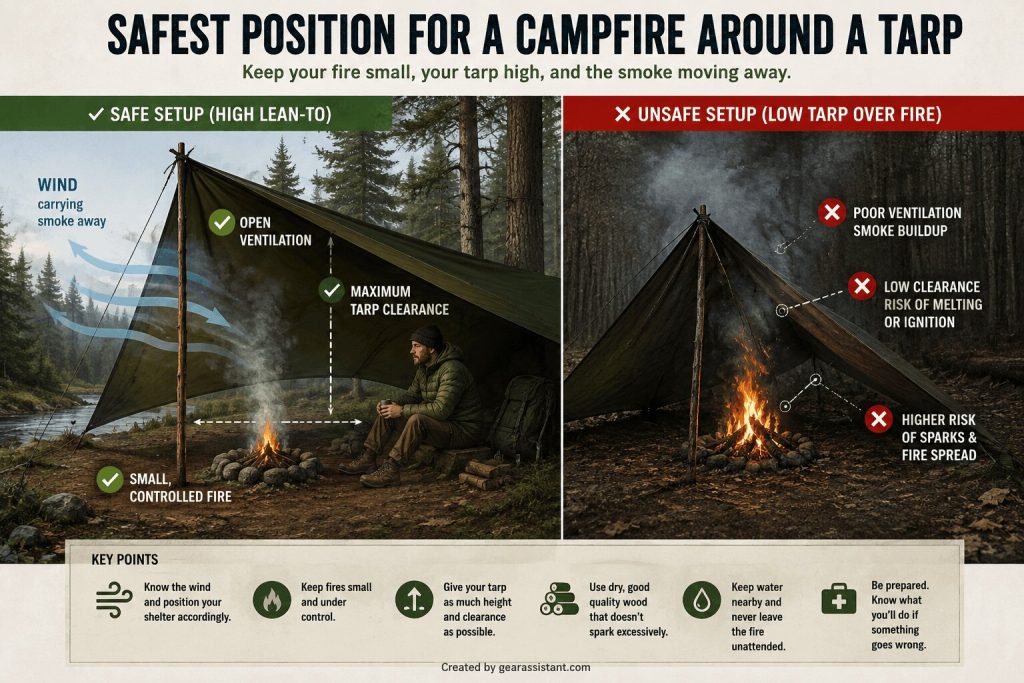
The higher the tarp is above and away from the flames, the better.
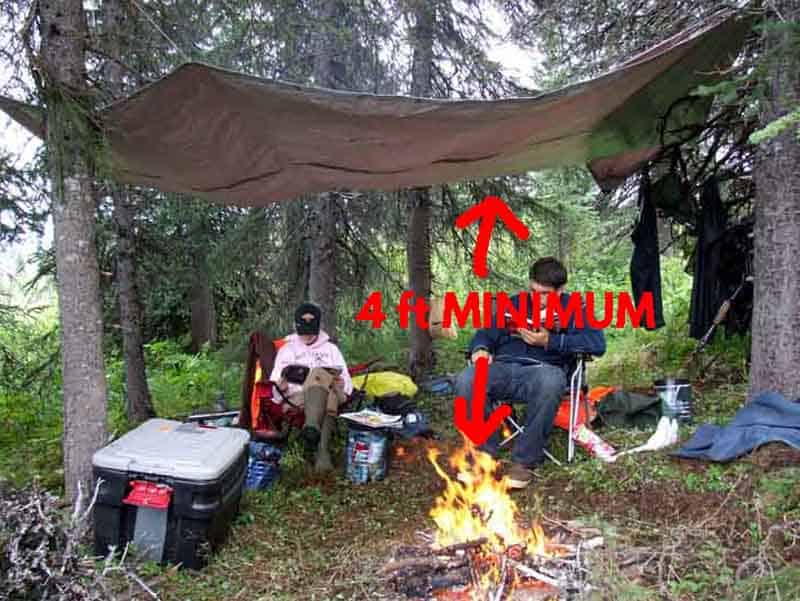
I previously gave a specific minimum height in this guide, but I don’t think that’s particularly useful because there are too many variables.
Instead, I now work on the principle of maximum practical clearance and minimum practical fire size.
I don’t want the flames anywhere close to the fabric.
I also don’t rely on holding my hand beneath the tarp as a test. Fabric can be damaged by radiant heat or a single flying ember even if the air beneath it feels comfortable.
If you can smell the tarp getting hot, see it deforming, or feel significant heat reaching the material, the setup is already wrong.
Raise the shelter, move the fire farther towards the open side, or reduce the fire.
4. Check Fire Restrictions Before You Start
This is more important than the tarp itself.
Before lighting a fire, check whether fires are permitted and whether there are any temporary restrictions because of dry weather or wildfire risk.
A setup that might be acceptable after days of rain can be completely irresponsible during a dry spell.
If there is any doubt, use a camping stove instead.
Leave No Trace specifically recommends checking local regulations and considering the weather, wind and fire conditions before building a campfire. :contentReference[oaicite:3]{index=3}
5. Use an Existing Fire Ring or Appropriate Fire Pan

I used to recommend creating a small circle of rocks as the default way to contain a fire.
I wouldn’t give that advice now.
If you’re at an established campsite, use an existing fire ring where possible rather than building another one or moving rocks around.
In places where fires are permitted but established rings aren’t available, a proper fire pan can be a much lower-impact option.
The important thing is keeping the fire small and controlled.
Leave No Trace recommends established fire rings, fire pans or mound fires where appropriate and keeping campfires small. :contentReference[oaicite:4]{index=4}
6. Position the Fire Towards the Open Side
There are two major things I think about when positioning a fire around a tarp:
wind direction and ventilation.
You don’t want smoke collecting beneath the roof.
I prefer the fire towards the open side of the shelter so that smoke and heat have an easy route out.
Pay attention to where the wind is blowing before you pitch the tarp.
Ideally, the shelter blocks the weather while the smoke is carried away through the open side.
Wind can change though, so don’t assume that because the setup worked perfectly when you arrived it will stay that way all night.
7. Use an Open Tarp Configuration

The tarp configuration makes a huge difference.
I don’t like low A-frame shelters for open fires.
The roof comes down too close on both sides and smoke has fewer places to escape.
Likewise, I wouldn’t put a fire inside a tightly enclosed synthetic tarp shelter.
For me, a lean-to or high pitched-roof configuration makes much more sense.
You get a large open side for ventilation and can keep the fire near that opening instead of directly beneath the lowest part of the roof.
If you specifically want an enclosed shelter built around a fire, use equipment designed for that job rather than trying to turn an ultralight rain tarp into a hot tent.
8. Keep Water Close By

I always want enough water available to completely extinguish the fire.
Not one drinking bottle with a few mouthfuls left in it.
Enough water to actually put the fire out.
Leave No Trace recommends extinguishing campfires thoroughly with water until the remains are cold. :contentReference[oaicite:5]{index=5}
A first aid kit should also be part of your normal camping equipment.
First aid equipment suitable for burns is sensible whenever you’re spending time around an open fire.
9. Never Leave It Unattended
This should be obvious, but it is even more important when there is combustible fabric nearby.
I keep an eye on:
- Flame height
- Sparks and embers
- Wind direction
- Guy-line tension
- The tarp itself
Adding fresh wood is one of the times I pay particular attention because the flames can suddenly increase.
A headtorch is useful after dark because firelight can make it surprisingly difficult to inspect the tarp and guy lines properly.
Never go to sleep with an open fire burning beneath or beside your tarp.
10. Secure the Tarp Properly

A loose tarp and an open fire are a bad combination.
If a gust causes the roof to sag or flap towards the flames, the distance between the fire and fabric can disappear very quickly.
Make sure the ridgeline and important guy lines are properly tensioned.
Look for loose cordage hanging near the fire as well.
I want to know that even if the wind changes direction or gives the tarp a good shake, nothing can suddenly swing down into the flames.
11. Know What You’ll Do If Something Goes Wrong
Before using any fire around a shelter, make sure you have an easy escape route.
Don’t arrange packs, chairs, firewood and guy lines in a way that means you have to climb over everything to get out.
If the tarp does ignite, get yourself and everyone else clear first.
Don’t instinctively grab burning synthetic fabric with your hands.
Depending on the material, it can melt as it burns and cause serious skin injuries.
I have a scar on my forehead from molten material burning me as a child, so this isn’t something I take lightly.
Having campfire gloves nearby is useful for normal fire handling, but personal safety comes before trying to rescue a tarp.
3 Main Hazards of Having a Fire Under a Tarp
There are three risks I think matter most.
Wildfire
The most serious risk isn’t damaging your tarp.
It is starting a wildfire.
Sparks can travel much farther than you expect, especially in wind.
Dry grass, leaf litter and other fine fuels can ignite easily, which is why the conditions around your campsite matter as much as the tarp above it.
If there are fire restrictions or the surrounding vegetation is extremely dry, don’t light a campfire.
Human-caused fires remain a major concern, and Leave No Trace recommends checking regulations, fire weather and local conditions before deciding to have one. :contentReference[oaicite:6]{index=6}
Burns and Melting Fabric
Most lightweight tarps are synthetic.
If they get too hot, they can deform or melt.
Direct flame or a sufficiently hot ember can create a hole very quickly.
More seriously, burning synthetic material can drip while molten.
If a tarp catches fire, move clear rather than automatically trying to grab it.
I’ve personally been scarred by molten material before, and it is something I would much rather avoid repeating.
Damage to the Tarp
This is by far the most likely problem.
If you regularly use a lightweight synthetic tarp near open fires, you have to accept that eventually you may get a small spark hole.
You can reduce the risk considerably by:
- Keeping the fire small
- Increasing clearance
- Avoiding excessively sparky wood
- Watching the wind
- Keeping the tarp properly tensioned
But if a tiny hole would ruin your day, don’t put your expensive ultralight tarp anywhere near an open fire.
What Is the Best Tarp Material for Using Near a Campfire?
For regular campfire use, I prefer canvas or another fabric specifically designed and rated for use around heat.
Heavy canvas won’t give you the ultralight pack weight of silnylon or polyester, but that’s the trade-off.
For a fixed camp, canoe trip, vehicle camping setup or bushcraft camp, the extra weight may be worth it.
For lightweight backpacking, I normally carry a synthetic tarp and simply manage the fire much more conservatively.
I wouldn’t describe ordinary nylon or polyester tarps as fireproof.
They’re rain shelters.
If you’re intentionally designing a shelter where the fire will regularly sit beneath the roof, buy something intended for that purpose.
How High Should a Tarp Be Above a Fire?
I don’t think there is a responsible universal number.
The old version of this article suggested a specific distance, but I’ve removed that because it gives a false sense of precision.
A fire can suddenly flare much higher when you add wood.
Wind can bend flames sideways.
Sparks can travel well beyond the flame itself.
Different tarp materials tolerate heat differently.
My approach is therefore:
pitch the tarp as high as practical, keep the fire as small as practical, and position the fire towards the open edge rather than directly beneath the roof.
If you’re wondering whether the tarp is too close, I’d take that as a reason to increase the distance.
Can You Cook Under a Tarp?
Yes, but I prefer cooking at the open edge rather than placing the stove or fire deep inside the shelter.
The tarp can still keep the rain off you while allowing heat, smoke and combustion gases to escape freely.
This is especially important if you’re using any kind of camping stove.
Never use a stove or fire inside a closed or poorly ventilated tent or shelter unless the shelter and heating system are specifically designed for it.
I’ve covered the subject in more detail in my guide to cooking under a tarp.
Is It Worth Having a Fire Under a Tarp?
Sometimes.
On a miserable wet camping trip, sitting under a large open tarp with a small fire just beyond the edge can completely transform the evening.
You stay dry, get some radiant heat and can cook without standing in the rain.
But I don’t think having the fire directly beneath your roof should be the goal.
The safer setup is usually an open shelter with the fire positioned towards or just outside the open edge.
If I expect to use fires underneath a shelter frequently, I’d choose a heavier canvas or purpose-built fire-resistant tarp.
If I’m carrying a lightweight backpacking tarp, I treat fire as something to keep at a respectful distance.
The tarp can be replaced.
A forest, or somebody with serious burns, isn’t quite so easy to fix.
Yes, you can use a tarp shelter around a fire, but keep the fire small, maintain as much clearance as possible, provide excellent ventilation, check local fire restrictions and never leave it unattended.