10 Best Hiking Umbrellas of 2026 That Are Windproof


The best hiking umbrellas are much lighter and tougher than normal umbrellas, with flexible frames that can survive gusts, large canopies for rain and sun protection, and low enough weights that carrying one all day doesn’t feel ridiculous. After using trekking umbrellas for hiking, backpacking and shelter around camp, my overall favourite is the EuroSCHIRM Swing Liteflex, while the Six Moon Designs Silver Shadow Carbon is my pick for hot-weather backpacking and the Rain Walker SUL is the one I would choose when every gram matters.
Hiking with an umbrella sounds slightly daft until you actually try it. The first thing you notice is the ventilation. Unlike a waterproof jacket, there is nothing wrapped around your torso trapping heat and sweat, and unlike a poncho there isn’t even a loose waterproof layer hanging around you.
The second advantage is shade. Reflective trekking umbrellas have become particularly popular with long-distance hikers because the exact same piece of equipment can keep rain off in the morning and put a patch of shade over your head when the sun comes out.
The downside is wind. No umbrella becomes magically immune to strong gusts, but there is a huge difference between a cheap folding umbrella and a properly designed trekking umbrella with flexible fiberglass or carbon components. Several models here are specifically engineered or tested for wind resistance.
If you’re wondering whether an umbrella actually makes more sense than wearable rain gear, I compare the two systems directly in my rain poncho vs hiking umbrella guide.
QUICK PICKS
Best overall: EuroSCHIRM Swing Liteflex
Best for sun: Six Moon Designs Silver Shadow Carbon
Best lightweight all-rounder: Gossamer Gear Lightrek
Best flexible ultralight: Zpacks Lotus
Lightest full-size: Six Moon Designs Rain Walker SUL
Best compact windproof: EuroSCHIRM Light Trek Automatic
Best large ultralight: Montbell Trekking Umbrella 60
Best value compact: Repel Windproof Travel Umbrella
Best collapsible hiking umbrella: Six Moon Designs Silver Shadow Mini
Best for serious wind: senz° original
10 Best Hiking Umbrellas That Are Windproof
EuroSCHIRM Swing Liteflex

- OPEN DIAMETER: 100 cm / 39.4 in
- PACKED LENGTH: 64 cm / 25.2 in
- WEIGHT: 209 g / 7.4 oz without case
- SHAFT: Fiberglass
- BEST FOR: Best overall hiking umbrella
The EuroSCHIRM Swing Liteflex remains my favourite overall hiking umbrella because it gets the fundamental design so right. There is no telescopic shaft and very little mechanism to go wrong; instead you get a single 64 cm fiberglass shaft with flexible fiberglass ribs and a full-size 100 cm canopy.
The current umbrella is actually lighter than some of the old published specifications. EuroSCHIRM now lists the bare umbrella at just 209 grams, which is impressive for something this substantial. The complete weight rises to around 290 grams with the protective case, but I don’t always need to carry the case while hiking.
What really stands out is the frame. EuroSCHIRM currently says the Swing Liteflex survived wind-tunnel testing at up to 150 km/h. I wouldn’t interpret that as permission to stand on an exposed summit holding it overhead in hurricane-force winds, but it does explain why the umbrella feels so different from a cheap folding model when gusts hit.
I also like the handle. It is long enough and substantial enough to actually hold for hours without forcing my hand into the tiny cramped position you get with many compact umbrellas.
The compromise is obvious: it doesn’t collapse. At 64 cm long, it normally has to live down the side or outside of a backpack rather than disappearing inside a small daypack.
VERDICT: Still my best overall choice. If I care more about strength, simplicity and long-term reliability than fitting an umbrella inside a tiny bag, this is the one I would carry.

Six Moon Designs Silver Shadow Carbon

- OPEN DIAMETER: 94 cm / 37 in
- PACKED LENGTH: 63.5 cm / 25 in
- WEIGHT: 193 g / 6.8 oz
- FRAME: Carbon fiber
- UPF: 50+
- BEST FOR: Hiking in sun and rain
The Six Moon Designs Silver Shadow Carbon is one of the most convincing reasons to carry an umbrella even when there isn’t much rain in the forecast.
The reflective silver canopy is rated UPF 50+, while the underside is black to deal with reflected light underneath the canopy. On hot open trails, I can create a patch of shade wherever I happen to be rather than waiting for a tree or rock to appear.
At only 193 grams, the Carbon is extraordinarily light for a full-size 94 cm umbrella. The shaft, spreaders and ribs use carbon fiber, and the rigid single-shaft construction avoids the extra hinges needed for a compact folding design.
It also has a published 5,000 mm water column, although waterproof ratings matter less to me with umbrellas than they do with jackets. Water doesn’t sit under pressure against the canopy; it lands on stretched fabric and runs straight off the edge.
Six Moon Designs also sells a simple hands-free attachment kit. If I want to use trekking poles, eat or navigate while walking, I can mount the shaft against a shoulder strap instead of holding it continuously.
VERDICT: My favourite hiking umbrella for genuinely hot conditions. It weighs very little, gives proper coverage and has sun protection that remains useful even when the rain disappears.
Gossamer Gear Lightrek Hiking Umbrella
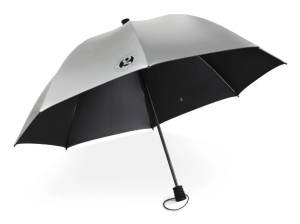
- TYPE: Full-size ultralight trekking umbrella
- DESIGN: Reflective hiking canopy
- BEST FOR: Lightweight backpacking and thru-hiking
The Gossamer Gear Lightrek replaces the old EuroSCHIRM Birdiepal Octagon in this guide. I still like EuroSCHIRM enormously, but I don’t think two large models from the same brand need to occupy the top of a current top-10 when there are now excellent hiking-specific alternatives from US backpacking companies.
The Lightrek follows the formula I like: large usable coverage, reflective fabric for sun and rain, a simple lightweight construction and compatibility with a backpack-mounted hands-free system.
What I notice most with umbrellas in this weight class is how little reason there is to leave them at home. Once the umbrella weighs less than plenty of jackets and straps neatly along the side of a pack, the argument that umbrellas are inherently heavy starts to fall apart.
Gossamer Gear is also selling the Lightrek as a current hiking product rather than a generic travel umbrella that happens to be light enough for the trail. That means the design priorities align far better with what I’m actually doing.
VERDICT: One of the strongest choices for a thru-hiker who wants a straightforward umbrella from a company already focused heavily on ultralight backpacking.
Zpacks Lotus Umbrella
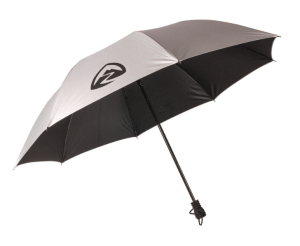
- OPEN DIAMETER: 96.5 cm / 38 in
- LENGTH: 63.5 cm / 25 in
- WEIGHT: 192 g / 6.8 oz
- UPF: 40
- BEST FOR: Ultralight umbrella with a flexible wind-resistant frame
The Zpacks Lotus Umbrella is one of the more interesting new additions because Zpacks has deliberately addressed one of the weaknesses of extremely light umbrellas: delicate single-strut frames.
The Lotus uses a frame designed to flex in the wind rather than relying entirely on ultra-rigid lightweight components. That doesn’t make it invincible, but I would rather have an umbrella flex under a gust than transfer all that force into one fragile joint.
At 192 grams it is almost exactly the same weight as the Silver Shadow Carbon, while the canopy is slightly larger at approximately 38 inches. The silver exterior is rated UPF 40, so it is useful as a sun umbrella as well as a rain shelter.
Zpacks also sells umbrella holsters so the Lotus can be mounted to a shoulder strap. I think that matters a lot on long hikes because holding even a very light umbrella for several hours becomes more annoying than the actual weight in your backpack.
VERDICT: An excellent option if you want Silver Shadow-like weight but particularly value a frame designed to flex instead of simply resisting every gust.
Sea to Summit Ultra-Sil Trekking Umbrella
- OPEN DIAMETER: 96 cm / 38 in
- PACKED LENGTH: 24.1 cm / 9.5 in
- WEIGHT: 240 g / 8.5 oz
- CANOPY: 30D siliconised CORDURA nylon
- UPF: 50+
- BEST FOR: Lightweight compact hiking and travel
The Sea to Summit Ultra-Sil Trekking Umbrella is a super lightweight and compact option for backpackers and hikers alike. It has an aircraft-grade aluminum shaft that measures 23 inches long when extended or 9.5 inches when closed and is highly durable.
The fabric is made of super lightweight and waterproof 30D Siliconized Cordura to save weight but also provide superb protection from sun, wind, and rain. At just 8.2 ounces or 230 grams, this would be considered very lightweight when compared with most other hiking umbrellas.
VERDICT: Like all Sea to Summit gear, this umbrella is designed to be packable and lightweight, which lends itself to things like hiking and backpacking. That being said, it does make an excellent day-to-day umbrella for commuters and dog walks for the same reasons that make it the best for hiking. If you are of the mindset that weight and packability are more important than overall durability, then this is the pocket umbrella I would get for hiking and traveling.
VIEW ON SEA TO SUMMIT
EuroSCHIRM Light Trek Automatic

- OPEN DIAMETER: 98 cm / 38.6 in
- PACKED LENGTH: 29 cm / 11.4 in
- WEIGHT: 315 g / 11.1 oz without case
- FRAME: Aluminum and fiberglass
- BEST FOR: Compact umbrella for windy hiking
The EuroSCHIRM Light Trek Automatic remains current and is still one of the compact umbrellas I trust more than most in poor weather.
It folds to just 29 cm, which makes it dramatically easier to store inside a daypack than the Swing Liteflex. Open it and you still get a 98 cm canopy, so you’re not sacrificing much actual rain coverage.
The cost of that collapsibility is weight and complexity. At 315 grams before the case, it weighs considerably more than the fixed-shaft ultralight models above, and there are naturally more moving components.
What keeps it in the top 10 is the wind performance. EuroSCHIRM says the Light Trek Automatic survived wind-tunnel testing at Beaufort force 11, and the fiberglass-reinforced frame is designed so an inverted canopy can recover rather than simply breaking.
The automatic open-and-close button is also genuinely convenient when showers keep appearing and disappearing.
VERDICT: If I needed an umbrella to live permanently inside a daypack rather than strapped outside it, this is one of my favourites. It’s not ultralight, but it is much more reassuring than most compact umbrellas.
Montbell Trekking Umbrella 60
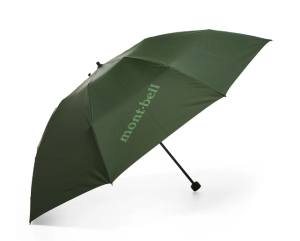
- OPEN DIAMETER: 103 cm / 40.6 in
- RIB LENGTH: 60 cm
- WEIGHT: Approx. 166 g / 5.9 oz
- RIBS: Carbon-fiber-reinforced resin
- BEST FOR: Large coverage at exceptionally low weight
The Montbell Trekking Umbrella 60 replaces the old Helinox Umbrella One in this guide. Helinox has made excellent trekking umbrellas, but the current Montbell is a more compelling recommendation if the priority is actual hiking performance and low weight.
The numbers are impressive. Montbell currently lists the Trekking Umbrella 60 at around 166 grams while opening to approximately 103 cm in diameter. That is one of the largest canopies here while still weighing less than many smaller competitors.
Eight carbon-fiber-reinforced ribs provide the structure, and the canopy uses lightweight water-repellent polyester. Unlike a rigid stick umbrella, it folds down for packing, so you get a surprisingly large amount of coverage without having a 60 cm pole permanently strapped down the side of the pack.
I like Montbell gear because the company has a habit of removing weight without turning every product into a gimmick. This umbrella feels like exactly that kind of design.
VERDICT: One of the best combinations of coverage and weight in the guide. If I wanted a genuinely large umbrella but still cared about every gram in my pack, this would be high on my list.
Repel Windproof Travel Umbrella

- PACKED LENGTH: Approx. 12 in / 30 cm
- FRAME: 9 reinforced fiberglass ribs
- OPEN/CLOSE: Automatic
- BEST FOR: Budget-friendly hiking and travel
The Repel Windproof Travel Umbrella isn’t really an ultralight hiking umbrella, but I am keeping it because it remains current, widely available and represents a very different kind of buyer.
If you want one umbrella for travelling, commuting, keeping in the car and occasionally taking hiking, this makes more sense than spending specialist trekking-umbrella money.
The current Repel still uses nine resin-reinforced fiberglass ribs and an automatic open-and-close mechanism. Repel currently claims resistance to gusts of up to 50 mph, although I treat any umbrella wind rating as a structural test rather than a recommendation to deliberately use it in those conditions.
It is noticeably heavier than the true backpacking models. That matters if I’m walking hundreds of miles, but much less if it spends most of its life in a daypack.
VERDICT: Not my choice for an ultralight thru-hike, but probably the easiest recommendation here for somebody who wants a tough compact umbrella that also gets used away from the trail.
Six Moon Designs Silver Shadow Mini
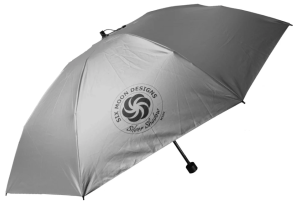
- OPEN DIAMETER: 96.5 cm / 38 in
- PACKED LENGTH: 25.4 cm / 10 in
- WEIGHT: 193 g / 6.8 oz
- UPF: 50+
- BEST FOR: Compact ultralight backpacking and travel
The Silver Shadow Mini is probably the most impressive compact umbrella here from a pure size-to-weight perspective.
Folded, it is only around 10 inches long. Open it and the canopy expands to approximately 38 inches, actually giving it slightly more nominal width than the full-size Silver Shadow Carbon.
It still weighs only 193 grams and retains the reflective UPF 50+ canopy. The trade-off is the more complicated telescopic aluminum shaft and folding frame, which can’t feel quite as reassuring to me in wind as a one-piece fiberglass or carbon pole.
But that’s exactly what compact umbrellas are about: compromising some simplicity to gain packability.
I can hide the Mini inside almost any daypack, travel bag or large jacket pocket. For somebody who actively dislikes having a long umbrella strapped to the outside of their pack, that’s a significant advantage.
VERDICT: My favourite genuinely compact hiking umbrella. If packed length is your priority but you still want a proper hiking-focused sun/rain canopy, this is the one I’d look at first.
Senz° Original Storm Umbrella

- CANOPY: Approx. 87 x 90 cm
- LENGTH: 79 cm / 31.1 in
- WIND RATING: Up to 100 km/h claimed/tested by manufacturer
- UPF: 50+
- BEST FOR: Aerodynamic wind performance
The senz° original still looks strange, and that unusual shape is exactly why it stays on this list.
Instead of presenting a symmetrical round canopy to the wind, the elongated aerodynamic design is intended to orient itself with the airflow. Senz currently rates the original for wind speeds of at least 100 km/h.
I wouldn’t choose it for an ultralight backpacking trip because at 79 cm long it isn’t particularly packable, and it is heavier than the specialist carbon umbrellas above.
Where it gets interesting is genuinely bad weather. The long rear section also provides surprisingly good coverage over the upper part of a backpack, and I find the asymmetrical canopy easier to control in gusty conditions than a normal broad circular umbrella.
The current fabric is also UPF 50+, so despite being primarily marketed as a storm umbrella it can provide useful sun protection.
VERDICT: The most specialised design here. If wind resistance matters more than minimum pack weight, the senz° still does something very different from almost every conventional trekking umbrella.

Hiking Umbrella Buying Guide
Having hiked in the rain far more than I would ideally like, I’ve tried pretty much every obvious way of staying dry. Waterproof jackets work, ponchos work and umbrellas work, but umbrellas solve one problem better than almost anything else: ventilation.
If it is warm and raining, I can walk underneath an umbrella without enclosing my upper body in waterproof fabric at all. My clothes remain exposed to moving air and I don’t end up creating my own little tropical climate underneath a shell.
That doesn’t mean I carry an umbrella for every hike. Dense woodland, strong winds, scrambling and technical ground can all make one more trouble than it’s worth.
The key is choosing the umbrella around where you actually hike.
What Makes an Umbrella Suitable for Hiking?
A hiking umbrella isn’t necessarily some completely different species of umbrella. What changes is the priority given to weight, wind resistance, durability and how easily it can be carried on a backpack.
The main components are simple. The canopy is the fabric overhead, the ribs hold that canopy open, the stretchers support the ribs, and the shaft connects everything to the handle.
A cheap umbrella can fail at almost any one of those points. Hiking models normally save weight while paying much more attention to flexible frame materials and simplified mechanisms.
Fixed Shaft Vs Folding Hiking Umbrella
This is still the first decision I would make.
A fixed-shaft umbrella such as the EuroSCHIRM Swing Liteflex has fewer moving parts. That makes it mechanically simpler and generally gives me more confidence in gusty weather. It can also be extremely light because there are no telescopic sections and locking mechanisms.
The downside is packed length. A 60-plus-centimetre umbrella isn’t disappearing inside a normal daypack.
A folding umbrella solves that problem. Something like the Silver Shadow Mini shrinks to around 25 cm, so it can live inside a pack rather than being permanently attached to the outside.
For regular long-distance hiking, I normally prefer the fixed shaft. For travel and day hikes where the umbrella may never come out, I prefer the compact version.
How Windproof Does a Hiking Umbrella Need to Be?
This is where marketing gets slightly silly.
Several umbrellas are laboratory tested or rated at extremely high wind speeds. EuroSCHIRM quotes up to 150 km/h for the Swing Liteflex and senz° quotes 100 km/h for the original.
Those figures tell me something useful about structural strength, but they don’t mean I would actually enjoy hiking while holding the umbrella at those wind speeds.
Long before a strong umbrella physically breaks, the wind can make it tiring or difficult to control. It can drag my arm sideways, obscure my view and turn into a liability on exposed ground.
For me, a wind-resistant umbrella is one that flexes rather than immediately breaking when a gust catches it. If the weather gets genuinely severe, I close it and put on wearable waterproofs.
Why Fiberglass and Carbon Fiber Work Well
Fiberglass is brilliant for umbrella frames because it can flex significantly before failing. That flexibility allows the canopy to distort under a gust and then return to shape.
Carbon fiber provides an extremely high strength-to-weight ratio and is one of the reasons some full-size trekking umbrellas now weigh less than 200 grams.
Neither material is automatically superior. A slightly heavier fiberglass frame can be incredibly robust, while carbon makes sense for somebody trying to minimise pack weight.
What I care about more is the complete structure. An exotic carbon shaft doesn’t help if the weakest hinge in the frame fails first.
How Much Should a Hiking Umbrella Weigh?
For long-distance hiking, I think anything around 150-250 grams is excellent.
Below 200 grams starts feeling almost ridiculous for a full-size umbrella. The Rain Walker SUL, Montbell Trekking 60, Zpacks Lotus and Silver Shadow Carbon all show how little weight a serious hiking umbrella now needs to add.
Around 300-450 grams can still be perfectly reasonable for day hiking, especially if the umbrella is compact or particularly strong.
Once I get close to 600 grams, though, I need a very good reason to carry it instead of proper rainwear.
Canopy Size
A larger canopy keeps more of me and the upper part of my backpack dry. Something around 94-103 cm in diameter is a good sweet spot for one hiker.
Much larger than that and wind becomes increasingly difficult to manage.
This is why I don’t generally carry a golf umbrella hiking even though the coverage is fantastic. I want enough canopy to shelter my head and shoulders without carrying a portable sail.
Sun Protection and UPF Ratings
One of the best things about hiking umbrellas is that they don’t become useless when the rain stops.
Reflective models such as the Silver Shadow Carbon are designed specifically to provide shade in strong sunlight. The current Silver Shadow is UPF 50+, as is the silver UV version of the EuroSCHIRM Swing Liteflex.
The old article said black was probably the best umbrella colour for sun protection because it absorbs heat. That is too simplistic.
What matters is the complete canopy system, including UV transmission and what happens to absorbed solar energy. A reflective outer surface is particularly useful for hiking because it sends a large amount of incoming radiation away rather than absorbing all of it into the fabric directly above your head.
If sun protection matters, look for an actual UPF rating rather than choosing purely by colour.
Are Hiking Umbrellas Waterproof?
They should shed rain very effectively, but I don’t obsess over hydrostatic-head figures in the same way I do with jackets and tents.
An umbrella canopy is stretched into a steep curve. Rain hits it and immediately runs downhill rather than sitting against the material under pressure.
Six Moon Designs does publish a 5,000 mm water-column figure for the current Silver Shadow Carbon, which is more than enough for an umbrella canopy.
For me, frame strength and canopy coverage are more useful buying specifications.
Breathability
This is the whole reason I became interested in hiking umbrellas.
They are effectively 100% mechanically ventilated because there is no shell around the body.
When humidity is high, that can be transformational. Waterproof breathable jackets have improved enormously, but if I am producing sweat faster than the membrane can shift it, moisture still accumulates inside.
An umbrella doesn’t have that problem.
The trade-off is obvious: there is no protection from sideways rain or wind around the body.
Can You Use a Hiking Umbrella Hands-Free?
Yes, and I think this makes umbrellas far more useful for serious hiking.
Six Moon Designs, Zpacks, Gossamer Gear and others offer attachment systems or clips that secure the shaft along a backpack shoulder strap.
That leaves both hands available for trekking poles, food, navigation or photography.
The umbrella still needs reasonably open terrain above you, and in changing wind I may want one hand available to adjust its angle. But on long open trails, hands-free mounting is much better than holding the handle for six hours.
Can an Umbrella Protect Your Backpack?
Partly.
A reasonably large canopy can shelter the top of a backpack and stop a surprising amount of water reaching it. A hands-free mount can also position the umbrella so it sits slightly behind your head and over the upper pack.
But it isn’t the same as enclosing the entire backpack underneath a poncho.
For prolonged rain, I still protect important equipment internally with a liner or dry bags.
If full backpack coverage is a priority, a hiking poncho may make more sense. My waterproof poncho guide covers the models designed to go over both hiker and pack.

When Hiking Umbrellas Work Best
Umbrellas really shine on open trails with relatively light wind.
They are particularly good for:
- Hot-weather hiking
- Exposed sunny trails
- Long-distance backpacking
- Desert routes
- Warm humid rain
- Intermittent showers
- Lunch and rest stops in rain
Those are the situations where the combination of rain protection, shade and complete ventilation genuinely offers something jackets can’t.
When I Wouldn’t Use a Hiking Umbrella
There are several situations where I put the umbrella away.
Strong wind is the obvious one. Even if the frame survives, controlling the umbrella can become more trouble than it is worth.
Dense vegetation is another. Constantly hitting the canopy against branches gets annoying very quickly.
Scrambling and climbing also favour wearable rain protection. I want my hands free and don’t want a large object sitting above me.
I would also put the umbrella away during an electrical storm. The important safety issue isn’t that carrying an umbrella somehow makes you a uniquely irresistible lightning rod; it’s that being exposed outdoors during lightning is dangerous in the first place. I would prioritise getting away from exposed summits, ridges, isolated trees and other high-risk locations rather than debating umbrella materials.
Can You Use a Hiking Umbrella as a Shelter?
To a limited extent, yes.
I’ve used umbrellas to create a dry working area around camp and they can work particularly well alongside bivvy bags or bug nets. Some hikers position the canopy over the upper body to provide a little extra rain protection.
I wouldn’t treat one as a substitute for a proper tarp in serious weather.
Where an umbrella really excels is as temporary shelter. I can sit underneath it, sort gear, look at a map or eat without everything getting soaked.
And yes, it remains considerably better than a hood at keeping a sandwich dry.
Can You Use a Hiking Umbrella as a Walking Stick?
I occasionally find myself planting a rigid-shaft umbrella against the ground, but I wouldn’t deliberately use one as a substitute for a trekking pole.
The frame is designed primarily to deal with forces from the canopy rather than repeatedly taking body weight.
A sturdy EuroSCHIRM can tolerate far more abuse than an ultralight folding model, but I’d rather carry an actual hiking pole if I need support.
Compact Vs Full-Size Hiking Umbrella
For me this comes down to how often I expect to use it.
If rain or extreme sun is likely and I know the umbrella will spend hours open, I choose a rigid full-size model. The improved simplicity and comfortable shaft are worth having.
If it is emergency rain protection that may stay inside the backpack all day, I choose something compact such as the Silver Shadow Mini or EuroSCHIRM Light Trek Automatic.
The best umbrella is the one you actually carry.
Best Hiking Umbrella for Sun
My choice is the Six Moon Designs Silver Shadow Carbon.
At 193 grams it is very light, the canopy is UPF 50+, and the reflective upper surface is specifically designed around hot-weather use.
The Silver Shadow Mini gives you similar sun protection in a much smaller packed package if compactness matters more.
Best Hiking Umbrella for Wind
For a conventional hiking design, I would choose the EuroSCHIRM Swing Liteflex.
The flexible fiberglass construction is exactly what I want when unpredictable gusts hit, and EuroSCHIRM’s current wind-tunnel testing is far beyond the conditions in which I would willingly keep using an umbrella.
For aerodynamic wind performance regardless of weight, the senz° original is the specialist option.
Best Ultralight Hiking Umbrella
The Six Moon Designs Rain Walker SUL takes this category on pure weight.
Depending on the current published specification, it sits around 5.5-6 ounces while still providing a full-size canopy.
The Montbell Trekking Umbrella 60 is also remarkably light at around 166 grams while giving an even larger 103 cm diameter.
Best Compact Hiking Umbrella
I would choose the Six Moon Designs Silver Shadow Mini.
The combination of a 10-inch folded length, 6.8-ounce weight and 38-inch UPF 50+ canopy is difficult to beat.
If I wanted something more substantial and wind-focused rather than ultralight, I’d choose the EuroSCHIRM Light Trek Automatic.
Do You Really Need a Hiking Umbrella?
No.
You can hike your entire life with waterproof jackets, ponchos and hats and never need an umbrella.
But that isn’t really the point.
A hiking umbrella gives me something those other systems can’t: rain protection without wearing rainwear. On hot humid trails, that is a surprisingly big deal.
Add portable shade, instant shelter during breaks and the ability to mount it hands-free, and the idea stops looking nearly as silly as it did before I started using one.
What Is the Best Hiking Umbrella?
For most hikers, I still choose the EuroSCHIRM Swing Liteflex.
It is extraordinarily light for such a sturdy fixed-shaft umbrella, the fiberglass structure handles gusts extremely well and the current model is still being actively sold rather than surviving as old stock.
If I were hiking somewhere hot and sunny, I would switch to the Six Moon Designs Silver Shadow Carbon. If minimum weight were everything, I would choose the Rain Walker SUL. And if I needed an umbrella that disappeared completely inside my backpack, I’d take the Silver Shadow Mini.
The important thing is not finding an umbrella that claims to be indestructible. No umbrella is the right tool for genuinely severe wind.
What I want is an umbrella light enough that I’ll actually carry it, strong enough to tolerate normal hiking gusts and large enough to give me useful shelter from both rain and sun.