Thermarest Neoair Uberlite Review | Lightest Inflatable Sleeping Pad


The Therm-a-Rest NeoAir UberLite was one of the most extreme ultralight sleeping pads I ever tested: ridiculously light, tiny when packed, surprisingly comfortable, and noticeably less noisy than the older NeoAir pads I had used. It also came with an obvious compromise — very thin 15D fabric and an R-value of only 2.3. Therm-a-Rest has now discontinued the UberLite, so this review explains how it performed, what I liked and didn’t like, and what I would buy instead today.
When I originally reviewed the UberLite, the attraction was obvious. At just 8.8 oz / 250 g for the Regular size, it gave you a proper full-length inflatable sleeping pad that packed down to roughly the size of a drinks can.
For ultralight backpacking, that was a huge achievement.
The problem was that Therm-a-Rest had pushed weight savings about as far as they could. The UberLite used extremely thin 15D fabric and almost no meaningful insulation, which made it brilliant for warm-weather trips but much less versatile than something like the NeoAir XLite.
The UberLite is now discontinued and no longer in production. If you already own one, this review is still useful because the pad remains incredibly light. If you’re buying a new sleeping pad today, I would look at the current Therm-a-Rest NeoAir XLite NXT first because it is readily available on Amazon US and gives you much more warmth and durability for only a few extra ounces.
- Check out my review of the Therm-a-Rest Trail Scout sleeping pad
- See my guide to the best backpacking sleeping pads
QUICK VERDICT
What I liked: Almost unbelievably light and compact, comfortable for the weight, and quieter than the older NeoAir pads.
What I didn’t like: The 15D fabric needs careful treatment and the R-2.3 insulation makes it a warm-weather specialist.
Would I buy one now? Only if I found old stock at a very good price and specifically wanted the lightest possible summer pad.
What I would buy instead: Therm-a-Rest NeoAir XLite NXT for much better all-round usability.
Therm-a-Rest NeoAir UberLite Review: The Basics
The UberLite was designed for people who count every gram.
The Regular version weighs just 8.8 oz / 250 g, has an R-value of 2.3 and provides 2.5 inches / 6.4 cm of cushioning.
Those figures still look impressive today.

- WEIGHT: 8.8 oz / 250 g (Regular)
- R-VALUE: 2.3
- TOP/BOTTOM FABRIC: 15D nylon
- THICKNESS: 2.5 in / 6.4 cm
- REGULAR SIZE: 72 x 20 in / 183 x 51 cm
- PACKED SIZE: Approx. 6 x 3.6 in / 15 x 9 cm
- BEST USE: Warm-weather ultralight backpacking
The specification explains the UberLite perfectly.
It wasn’t trying to be the warmest or toughest sleeping pad.
It was trying to provide the comfort of a full inflatable mat at a weight previously associated with much less comfortable foam pads.
That worked.
The question was whether the compromises were worth it for the kind of camping you do.
First Impressions
When I first took the UberLite out of the box, the packed size was probably the most impressive thing about it.
It is genuinely tiny.
Seeing something not much bigger than a drinks can turn into a full-sized sleeping mat still feels slightly ridiculous.
The other thing I noticed immediately was the fabric.
Compared with the older NeoAir XLite I was familiar with, the UberLite feels noticeably thinner.
That is exactly where much of the weight saving comes from.
The fabric still felt well made, but it never felt like a pad I would casually throw onto rough ground and forget about.
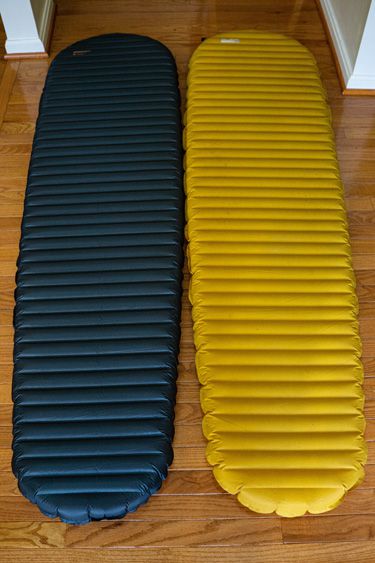
Therm-a-Rest NeoAir UberLite vs Therm-a-Rest NeoAir XLite
Comfort
For something this light, I found the UberLite surprisingly comfortable.
The 2.5-inch thickness gives you enough air underneath your hips and shoulders that it doesn’t feel like sleeping on a minimalist mat.
I could adjust the pressure until it was soft enough to conform slightly to my body without bottoming out against the ground.
Where you do notice the ultralight design is the width.
The standard Regular pad is only 20 inches wide, so there isn’t much room for wandering arms or rolling around.
If you tend to move a lot in your sleep, this can make the pad feel smaller than the dimensions suggest.
One thing I preferred about the UberLite compared with older NeoAir designs was the noise.
Those early NeoAir pads had a reputation for sounding like a crisp packet every time you rolled over.
The UberLite still makes some noise, but in my experience it was noticeably less irritating.
Packability
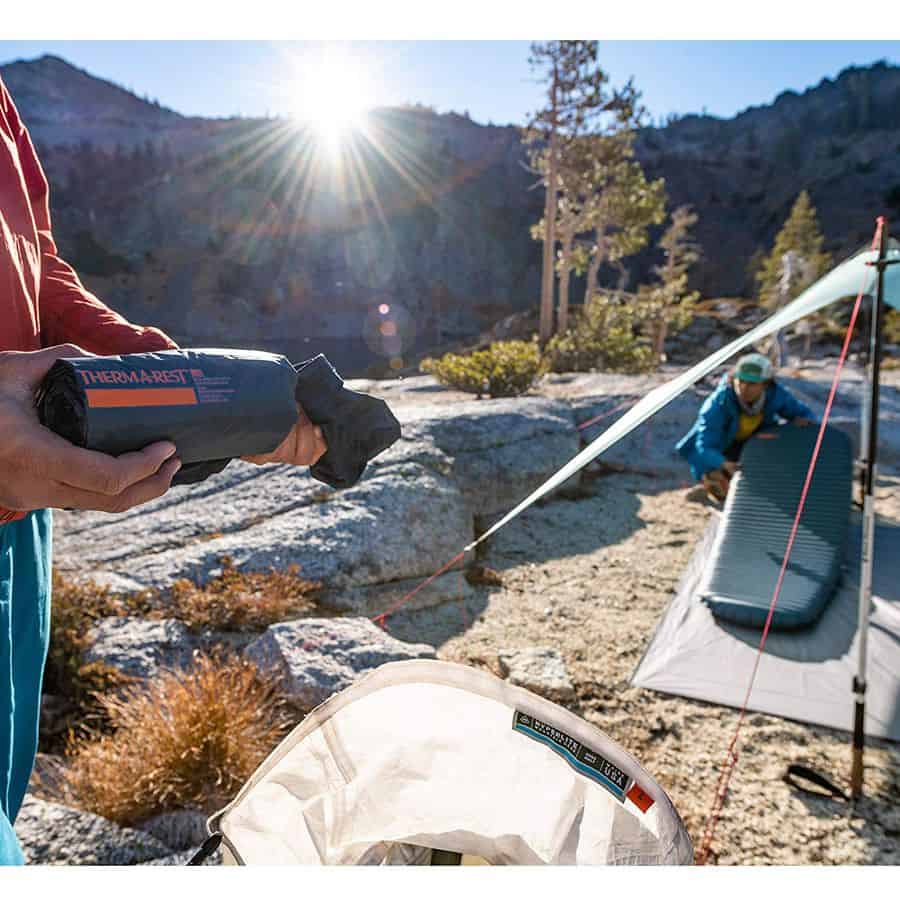
This was probably the UberLite’s greatest strength.
Rolled properly, it takes up hardly any room.
If you’re trying to fit all your equipment into a small backpack, bikepacking bag or fastpacking setup, that compactness is genuinely useful.
I have used plenty of lightweight gear where saving a few grams feels more impressive on a spreadsheet than it does outdoors.
The UberLite’s pack-size saving is something you actually notice because your sleeping pad practically disappears into the pack.
I would still keep it in its stuff sack or another protected part of the backpack rather than stuffing it loose against sharp objects.
Weight
At 8.8 oz / 250 g for a Regular, the UberLite was absurdly light.
Even now, that is an impressive figure for a full-length inflatable pad.
That is roughly 4 oz lighter than the current NeoAir XLite NXT Regular.
Four ounces doesn’t sound enormous until you’re trying to reduce an entire backpacking setup below a certain weight.
The problem is that those four ounces buy you quite a lot on the XLite NXT: more durable 30D fabric, 3 inches of cushioning instead of 2.5, and an R-value of 4.5 instead of 2.3.
So I no longer think the weight figure can be considered in isolation.
Inflation and Valve

The version I tested inflated quickly enough by mouth.
Around 20 decent breaths was normally enough for me, although obviously that varies depending on how much air you move with each breath.
Later UberLite versions used Therm-a-Rest’s WingLock valve and pump sack, which made inflation and deflation easier than the older valve system.
I generally prefer using a pump sack when one is available anyway.
Apart from being easier, it reduces how much moisture you’re repeatedly blowing inside the sleeping pad.
For a pad this small, inflation was never one of my complaints.
Durability

This is the compromise everybody asks about.
The UberLite uses 15D fabric.
That is extremely thin.
During my testing I didn’t have a serious failure, so I’m not going to pretend it exploded the moment it touched the ground.
But I absolutely treated it more carefully than a heavier sleeping mat.
Before laying it down, I checked for obvious stones, sticks and thorns and made sure the tent floor wasn’t hiding anything sharp underneath.
I also carried the repair kit.
That’s sensible with any inflatable sleeping pad, but especially with something built this light.
There were enough reports of leaks and failures from other UberLite owners that durability became part of the pad’s reputation, and the UberLite was eventually discontinued.
I still think the correct way to look at it is this:
The 15D fabric was not automatically fragile, but the margin for careless use was much smaller than with a 30D or heavier pad.
If you’re the kind of camper who throws a sleeping mat straight onto rough ground, I wouldn’t choose an UberLite.
Warmth

The R-value of 2.3 tells you almost everything you need to know.
This is a summer sleeping pad.
There is very little insulation inside because removing insulation is one of the ways Therm-a-Rest got the weight so low.
For mild summer nights, that can be perfectly fine.
Once the ground gets properly cold, I want more underneath me.
A sleeping bag doesn’t solve this problem because your body compresses most of the insulation beneath you.
Your sleeping pad is what protects you from conductive heat loss into the ground.
You can pair the UberLite with a thin closed-cell foam pad to increase warmth, and that also gives the 15D fabric a little more protection.
But once I start carrying two mats to compensate for the UberLite’s limitations, I have to ask whether simply using a warmer pad makes more sense.
Therm-a-Rest NeoAir UberLite vs XLite NXT
The UberLite’s most obvious replacement is the current NeoAir XLite NXT.
I have kept these figures separate from my UberLite field-test comments because the XLite NXT is a different product.
| Specification | UberLite Regular | XLite NXT Regular |
| Weight | 8.8 oz / 250 g | 13 oz / 370 g |
| R-value | 2.3 | 4.5 |
| Thickness | 2.5 in / 6.4 cm | 3 in / 7.6 cm |
| Fabric | 15D | 30D |
| Packed Size | Approx. 6 x 3.6 in | 9 x 4.1 in |
| Availability | Discontinued | Current |
The XLite NXT adds about 4.2 oz / 120 g in the Regular size.
In return, you get almost double the R-value, thicker cushioning and 30D fabric instead of 15D.
Therm-a-Rest also says the NXT construction reduces noise by 83% compared with the previous XLite generation.
For most people, I think that is the better trade.
If I were building an absolutely obsessive warm-weather ultralight setup, I would still understand wanting an UberLite.
For one sleeping pad that can handle a much wider range of trips, the XLite NXT makes more sense.

What I Like About the UberLite
- The weight: 8.8 oz for a full-length Regular inflatable is still impressive.
- The pack size: It takes up almost no room inside a backpack.
- The comfort: 2.5 inches of air cushioning is plenty for such a minimalist pad.
- The lower noise: I found it less crinkly than older NeoAir designs.
- Perfect for warm-weather fast-and-light trips: If R-2.3 is enough, you’re not carrying insulation you don’t need.
What I Don’t Like
- 15D fabric: You need to be more careful where you put it.
- Only R-2.3: It is not a versatile cold-weather pad.
- Narrow standard width: 20 inches doesn’t give restless sleepers much room.
- Discontinued: Buying old stock now means you’re buying into a product line that is no longer being made.
Who Is the UberLite Best For?
The UberLite made the most sense for experienced ultralight backpackers who understood exactly what they were giving up.
I would choose it for:
- Summer backpacking
- Fastpacking
- Bikepacking
- People trying to get their base weight as low as possible
- Trips where temperatures are reliably mild
I would not choose it as my only sleeping mat if I regularly camp through spring, autumn and winter.
I also wouldn’t choose it for people who are hard on their gear.
Is the Therm-a-Rest NeoAir UberLite Still Worth Buying?
If you already own one and it holds air properly, absolutely keep using it.
There is nothing about the pad becoming discontinued that suddenly makes 8.8 oz and a tiny pack size less useful.
I would just treat it carefully and carry a repair kit.
Buying one now is different.
Because the UberLite is discontinued, I wouldn’t pay an inflated price for old stock simply because it has become harder to find.
If you find one cheaply and specifically want a warm-weather ultralight pad, it is still an interesting piece of kit.
For almost everybody else, I think the current Therm-a-Rest NeoAir XLite NXT is the better purchase.
Final Verdict
The Therm-a-Rest NeoAir UberLite was a brilliant example of an outdoor brand pushing one idea to its logical extreme.
Therm-a-Rest wanted to make the lightest practical full-size inflatable sleeping pad possible.
They succeeded.
At 8.8 ounces, the UberLite is comfortable, incredibly compact and almost absurdly light.
But achieving that meant using 15D material and stripping the insulation back to an R-value of 2.3.
For the right trip, those compromises make sense.
For an all-purpose backpacking sleeping pad, they don’t.
When I originally reviewed it, I thought the UberLite was one of the best options available for light-and-fast summer missions, and I still think that assessment was fair.
Today, though, it is a discontinued specialist pad.
If I were buying new, I would spend the extra few ounces on the NeoAir XLite NXT and get substantially more warmth, thicker cushioning and tougher fabric.