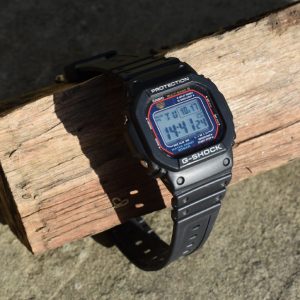
Casio G-Shock GWM5610 Review
This is my review of the Casio G-Shock GWM5610 solar watch, one of the best-value outdoor watches I have used. It combines the classic square G-Shock design with Tough Solar charging, Multi-Band 6 radio timekeeping, 200 m water resistance and a compact 52 g case that works especially well if you don’t want a huge watch on your wrist.
The GWM5610 has always appealed to me because it gives you most of the useful things I want from an outdoor watch without piling on features I will never use. It is tough, accurate, lightweight and doesn’t need regular battery changes.
It is also considerably smaller and slimmer than a lot of modern G-Shocks. If you have relatively small wrists, or simply hate wearing a massive lump of plastic on your arm, that makes a huge difference.
If you are comparing it with other models, check out our guide to the best outdoor watches.
2026 update: The model you are most likely to find new today is the GW-M5610U, which is the updated version of the original GWM5610 reviewed here. Casio has kept the same basic square design, dimensions, 52 g weight, Tough Solar system, Multi-Band 6 radio control and 200 m water resistance, while updating features such as the backlight and some timekeeping functions. :contentReference[oaicite:1]{index=1}
Casio GWM5610 Specifications
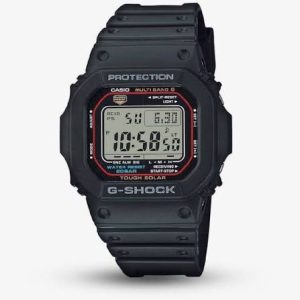
- Weight: approximately 52 g
- Case dimensions: 46.7 × 43.2 × 12.7 mm
- Case and bezel: resin
- Band: resin
- Glass: mineral glass
- Water resistance: 200 m / 20 bar
- Power: Tough Solar
- Timekeeping: Multi-Band 6 radio controlled
- Functions: world time, alarms, stopwatch, countdown timer, automatic calendar and backlight
Casio’s current GW-M5610U keeps almost exactly the same physical dimensions and weight, which shows how little the basic formula needed changing. The current model is still 46.7 × 43.2 × 12.7 mm and 52 g, with shock resistance, resin construction and 200 m water resistance. :contentReference[oaicite:2]{index=2}

First Impressions
My GWM5610 arrived in the usual small metal G-Shock tin with the instruction manual, warranty paperwork and the watch sitting inside the foam. It had a medium charge straight out of the box, which was reassuring because solar watches can sometimes spend a long time sitting in storage before you buy them.
The main attraction for me was the size. For a G-Shock, the 5610 has a surprisingly low profile and feels much closer to an ordinary digital Casio than one of the huge modern G-Shock cases.
I don’t have massive wrists, so I was relieved to find that it sat naturally rather than looking like I had strapped a small alarm clock to my arm. In size and feel, it isn’t dramatically bigger than a basic Casio Illuminator Watch.
Case and Size
The square case measures 46.7 mm long, 43.2 mm wide and 12.7 mm thick. That is still essentially the same size Casio uses on the current GW-M5610U. :contentReference[oaicite:3]{index=3}
The resin bezel rises slightly above the mineral-glass display, helping protect the face when the watch gets knocked against something. That recessed screen is one of the simple reasons G-Shocks survive abuse so well.
At only around 12.7 mm thick, it also slips under sleeves far better than many larger outdoor watches. This is useful if you are working with your hands, wearing gloves or pulling waterproof sleeves over the watch.
Display
The display is one of the things I like most about the 5610 because it is simple and readable. Time is displayed prominently, with the day and date above it, and you don’t have to cycle through five screens just to work out what time it is.
The LCD is easy to read in daylight, and the original model has an electro-luminescent backlight with an automatic illumination mode. The current GW-M5610U has moved to a high-brightness LED Super Illuminator while keeping the same basic display layout. :contentReference[oaicite:4]{index=4}
The solar panel surrounds the display and constantly tops up the rechargeable battery when exposed to light. In normal outdoor use, I never found myself thinking about charging it at all.
Usability
The buttons are deliberately recessed into the case, which makes accidental presses unlikely. That does mean they are not the biggest or easiest buttons in the world if you are wearing thick gloves, but once you know what each one does the watch is straightforward to operate.
The automatic backlight is particularly useful outdoors. In low light, a turn of the wrist can illuminate the display without needing to press anything, although you can switch the automatic function off if you want to conserve power.
Once your home city, alarms and other settings are configured, there really isn’t much reason to mess around with the menus regularly.
Multi-Band 6 Radio Timekeeping
One of the best features is Casio’s Multi-Band 6 system. The watch can receive radio time-calibration signals from transmitters serving Japan, North America, the UK, Germany and China, automatically correcting its time when reception is available. :contentReference[oaicite:5]{index=5}
That means the watch can stay extremely close to official time without you manually adjusting it every month. I have always liked being able to use the G-Shock as the watch I set everything else from.
It is worth remembering that radio reception depends on location, buildings, terrain and atmospheric conditions. If it can’t receive the signal, it simply continues working as a normal quartz watch until it can synchronize again.
Tough Solar
Solar power is probably the feature that makes the GWM5610 feel most like a long-term outdoor watch. Light is converted into electrical energy and stored in an internal rechargeable battery, so under normal conditions there is no routine battery change every few years.
That is useful for convenience, but I also like it because every unnecessary opening of a watch case is another opportunity to disturb the gasket or compromise the factory seal. A solar watch largely avoids that maintenance cycle.
That said, the internal rechargeable cell is not literally immortal. Like any rechargeable battery, it can eventually age and may one day need professional replacement. “Solar powered” is much more accurate than saying you will never replace a battery for the entire life of the watch.
Water Resistance
The GWM5610 is rated to 200 m / 20 bar water resistance, and the current GW-M5610U retains the same rating. :contentReference[oaicite:6]{index=6}
That is far beyond what most people need for hiking, camping, swimming or working outdoors in terrible weather. It is one of those specifications you can largely forget about during normal outdoor use because rain, rivers and showers are nowhere near its limit.
As with any watch, seals age over time. If you ever have the case opened for servicing, it is sensible to have the water resistance checked properly afterwards.
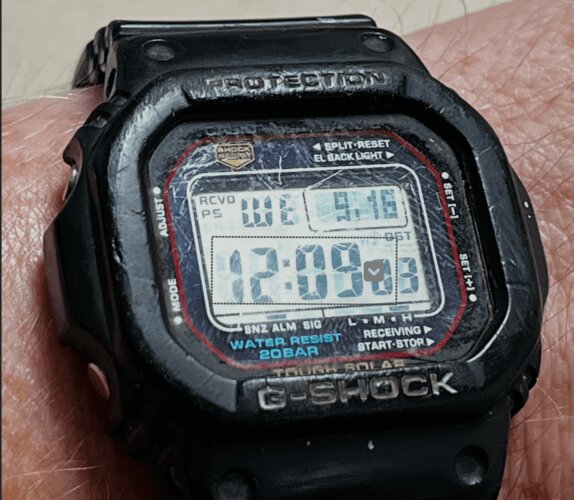
this is the same watch after 6 years of use haha
Durability
Durability is the main reason most people buy a G-Shock instead of a normal digital watch. The 5610 is shock resistant, lightweight and surrounded by a raised resin bezel that protects the face from everyday impacts.
I haven’t deliberately tried to destroy mine because smashing a watch for the sake of a review would be slightly stupid. What matters more is that during normal outdoor use I have never felt the need to baby it.
The mineral glass isn’t magically scratchproof, but the recessed design means it doesn’t take direct hits as easily as a completely exposed watch crystal.
Comfort
The 52 g weight makes this extremely easy to wear all day. Plenty of outdoor watches now weigh two or three times as much, which might not sound important until you have one strapped to your wrist for sixteen hours.
The resin strap is flexible and comfortable, and the compact square case doesn’t move around much. For me, this is one of the biggest advantages over the giant G-Shocks that look great but feel like protective equipment rather than watches.
Favorite Features
Multi-Band 6
The radio synchronization is one of those features you stop thinking about because it simply works in the background. When reception is available, the watch periodically corrects itself using an official time signal, so you rarely need to manually adjust the seconds. :contentReference[oaicite:7]{index=7}
For somebody who likes an accurate watch but doesn’t want GPS, Bluetooth or another device to charge every night, it is almost perfect.
Compact G-Shock Size
The classic square case is a huge part of the appeal. You get proper G-Shock protection without having a watch that catches on every sleeve, backpack strap or doorway you pass.
If you have smaller wrists, I would choose this shape over a lot of the giant G-Shock models without hesitation.
Automatic Backlight
The auto-light function is brilliant when you are walking, camping or wearing gloves. Tilting your wrist in the dark can illuminate the display without needing your other hand.
The original GWM5610 uses an electro-luminescent display light, while the current GW-M5610U uses an LED Super Illuminator. :contentReference[oaicite:8]{index=8}
Tough Solar
Tough Solar is probably my favorite feature overall. For an outdoor watch, sunlight is hardly in short supply, and not having to think about charging cables or routine battery changes is exactly what I want.
Leave it exposed to normal light regularly and the watch basically looks after itself.
200 m Water Resistance
For hiking and camping, the 200 m rating is complete overkill in the best possible way. You don’t need to panic when it starts raining, when you fall into a river or when you forget to remove it before swimming.
Affordable
The 5610 sits in a nice place in the G-Shock range because you are paying for genuinely useful features rather than sensors you might never use. Altimeters, barometers, GPS and Bluetooth are great if you need them, but plenty of people simply want something rugged that tells the time accurately.
This does that incredibly well.
Original GWM5610 vs New GW-M5610U
If you are shopping today, this is worth understanding. The original GWM5610 reviewed here is still around on the used market and in some old stock, but Casio’s current version is the GW-M5610U. :contentReference[oaicite:9]{index=9}
The basic formula is almost unchanged: 52 g, classic square resin case, Tough Solar, Multi-Band 6, mineral glass and 200 m water resistance. The newer model updates the lighting system and expands some functions, including world time and countdown-timer settings. :contentReference[oaicite:10]{index=10}
If I were buying one new now, I would simply get the current GW-M5610U unless the original was significantly cheaper.
Is the GWM5610 Good for Hiking?
Yes, especially if you don’t need navigation or altitude data on your wrist. For hiking, what you get is a watch that is extremely light, highly water resistant, shock resistant and capable of maintaining accurate time without needing regular charging.
It doesn’t have GPS, maps or an altimeter, so it obviously cannot replace a dedicated navigation watch. But that simplicity is also the reason the battery life is so much less hassle.
Is It Good for Small Wrists?
This is one of the best G-Shocks for smaller wrists in my opinion. The square shape is compact, the case is only 12.7 mm thick and the current model is designed for wrist sizes roughly 145 to 205 mm. :contentReference[oaicite:11]{index=11}
It still looks like a G-Shock, but it doesn’t dominate your entire forearm.
What I Like
- Classic compact G-Shock design
- Only around 52 g
- Tough Solar charging
- Multi-Band 6 radio synchronization
- 200 m water resistance
- Excellent outdoor durability
- Comfortable resin strap
- Simple, readable display
- Automatic backlight
- No unnecessary smartwatch distractions
What I Don’t Like
- Recessed buttons can be fiddly with gloves
- Mineral glass can still scratch
- No GPS, compass or altimeter
- Radio synchronisation depends on reception where you live
- The older model’s EL backlight is less bright than the newer GW-M5610U LED system
Casio G-Shock GWM5610 Review: Final Verdict
I still think the GWM5610 is one of the best examples of what a proper outdoor watch should be. It is lightweight, rugged, comfortable, accurate and almost completely hassle-free.
The Tough Solar system means I don’t need another charging cable, while Multi-Band 6 means the time effectively looks after itself whenever a radio signal is available. Add 200 m water resistance and G-Shock durability and there isn’t much I need to worry about when wearing it outdoors.
The fact that Casio has kept the same basic design alive in the current GW-M5610U says a lot. This isn’t a watch that needed reinventing every two years; it was already doing most things right.
If you want GPS maps, blood oxygen readings and a colour touchscreen, this isn’t the watch for you. If you want a tough digital watch that can sit on your wrist for years and quietly do its job, the 5610 is difficult to beat for the money.
Where to Buy It
If you are buying new, look for the Casio G-Shock GW-M5610U, which is the current updated version. If you find the older GWM5610 at a good price, the core watch is still excellent, but the newer version gets a few worthwhile functional updates. :contentReference[oaicite:12]{index=12}