
8 Best Bushcraft Hatchets in 2026 | Small Hatchets for Chopping, Splitting, And Carving


In this guide to the best bushcraft hatchets, I share the most durable and well-made hatchets I have used for chopping, splitting, carving and general camp work. My favourite overall is still the Gränsfors Bruk Wildlife Hatchet, but there are better options if you mainly want to carve, split wood or keep your axe as compact as possible.
The difference between a bushcraft hatchet and an axe is kind of a grey area. It’s hard to pin down exactly when a bushcraft hatchet becomes an axe. The best explanation I have is that hatchets, or hand axes as they are also known, are primarily single-handed chopping tools for smaller tasks that don’t require a full-length axe.
If I had to pick one tool I could not live without when practising bushcraft in the wild, it would probably come down to a bushcraft hatchet, a knife or a water pot. A good bushcraft axe is incredibly versatile: you can use it for firewood, shelter building, food prep, carving and all kinds of camp jobs. If you keep the edge sharp enough, it can even handle many of the rough cutting jobs I would otherwise use a knife for.
QUICK PICKS
Best overall: Gränsfors Bruk Wildlife Hatchet
Best for carving: Helko Werk Rheinland Hatchet
Best for chopping: Hults Bruk Hultån Hatchet
Best compact hatchet: Gränsfors Bruk Hand Hatchet
Best mini splitter: Hultafors Ågelsjön Mini Hatchet
Best value: Husqvarna Wooden Handle Hatchet
Best metal-handled hatchet: Estwing Sportsman’s Axe
Best survival hatchet: Gerber Bushcraft Hatchet
8 Best Bushcraft Hatchets
Gränsfors Bruk Wildlife Hatchet
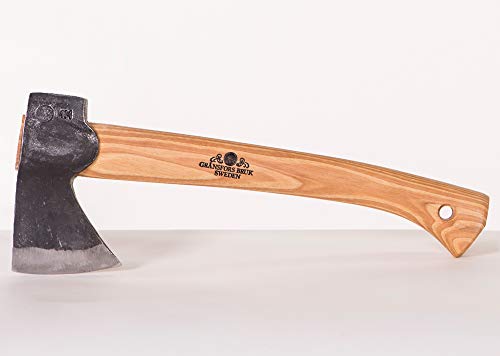

- LENGTH: 13.8 in / 35 cm
- WEIGHT: 1.3 lbs / 600 g
- MATERIALS: Swedish recycled C55/C60 high-carbon steel head, hickory handle, leather sheath
- BEST USE: Best all-round hatchet for bushcraft
The Gränsfors Bruk Wildlife Hatchet is the best all-round bushcraft hatchet for me. It is big enough to fell small trees, chop up piles of firewood and split smaller logs, but still small and controllable enough for carving and more detailed work. Unless I specifically need a big tree-felling axe, this is what I take on bushcraft trips most of the time.
Am I biased about this axe? Maybe. I own and love it, so I obviously like it. I’m not associated with Gränsfors, so I can say what I like, but I just love swinging this more than almost any other axe I own or have tested. I like sharpening it, I like the weight, I like the handle ergonomics, I like fastening it on my belt… I just like holding it. It’s my favourite bushcraft hatchet and the one I can most confidently recommend.
The current Wildlife Hatchet remains very close to the axe I originally reviewed. Gränsfors lists it at 35 cm long and 600 g, with a head made from recycled Swedish C55/C60 high-carbon steel. Interestingly, it uses the same head as the much shorter Gränsfors Hand Hatchet below; the longer handle is what gives the Wildlife considerably more chopping power.
CHOPPING: The size of this hatchet is just big enough to chop down small trees and is ideal for processing smaller blocks of firewood. You can easily clean off the side twigs and branches from a shelter pole and chop larger branches into neat lengths in a few swings. You can get the edge so sharp that it will slice paper, which helps it bite surprisingly deeply for such a compact axe.
SPLITTING: Something I really like about the Wildlife Hatchet is that there is some meat behind the cutting edge. It gives the head enough substance to force smaller pieces of wood apart without making it feel like a dedicated splitting wedge. There are better hatchets for splitting large logs, but it certainly holds its own against other similar-sized models, and when a piece of wood is being stubborn I have no problem setting the edge into it and batoning the axe through with another piece of timber.
CARVING: When you need more control and precision, the Wildlife can do that too. You can shift your hand up and down the handle depending on whether you want power or control. With my hand choked up underneath the head, I can use the upper part of the blade to carve rough timber down, make pegs, cut joints or take surprisingly fine shavings.
VERDICT: The Gränsfors Bruk Wildlife Hatchet is ideal for almost every bushcraft task I can think of apart from felling and splitting genuinely large trees. It is the perfect size and shape to get decent power from a one-handed swing while still giving me plenty of control for detailed work. This is a bushcraft hatchet you can own for life, and it is such a pleasure to use that you’ll probably find yourself looking for excuses to get it out.
Helko Werk Rheinland Hatchet
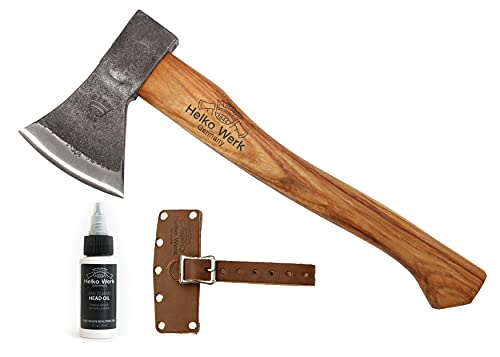
- HANDLE LENGTH: 14 in / 35.5 cm
- HEAD WEIGHT: 1.25 lbs / 567 g
- TOTAL WEIGHT: 1.75 lbs / 794 g
- BIT LENGTH: 4 in
- MATERIALS: C50 high-carbon steel head, Grade A American hickory handle
- HARDNESS: 53-56 HRC
- BEST USE: Best bushcraft hatchet for carving
The Helko Werk Rheinland Hatchet is one of the best bushcraft hatchets I have used for slicing, carving and making clean cuts. The wide-bit Rheinland design fans out towards the cutting edge to give you a much larger usable blade than you get on a chunky little splitting hatchet, while the gradual taper behind the edge means you can keep it seriously sharp.
The current Rheinland is still handmade in Germany from C50 high-carbon steel hardened to around 53-56 HRC. Helko also still uses individually selected Grade A American hickory for the handle, paying attention to grain orientation and density. That matters more than a lot of people realise because a nicely shaped handle is only as good as the piece of wood it was cut from.
CHOPPING: The Helko Rheinland is brilliant for chopping smaller timber up to a few inches thick. For bushcraft jobs such as making wooden stakes, cutting shelter poles or delimbing branches, this hatchet makes quick work of things. The broad cutting edge gives you a good chance of hitting exactly where you want while the relatively thin profile bites deeply.
SPLITTING: This hatchet isn’t the best for splitting big chunks of firewood because the blade is thinner than the more wedge-shaped options. I wouldn’t be afraid to baton it through a stubborn smaller log, but I’m not foolish enough to expect a one-handed Rheinland hatchet to split a fully grown oak trunk like a maul.
CARVING: Carving is where the Rheinland really shines. Because the head can be sharpened so finely, you can carve surprisingly thin slices from timber, make feather sticks or remove a lot of material quickly. Another benefit of the wide blade is that the heel and toe give you useful points for more detailed carving.
VERDICT: The Helko Werk Rheinland Hatchet is one of my favourites for several reasons. The shape makes it easy to park the axe by sticking the edge lightly into a piece of wood, and when I have the edge properly sharp I sometimes use it to chop meat and vegetables instead of my knife. The main reason to choose this over the Gränsfors or Hults Bruk is that the wide, relatively thin head is particularly good for clean cutting and carving.
Hults Bruk Hultån Hatchet
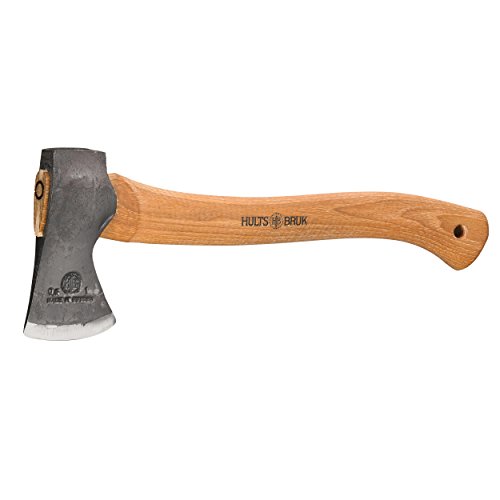
- FORMER NAME: Hults Bruk Almike Hatchet
- HANDLE LENGTH: 15 in / 375 mm
- HEAD WEIGHT: 500 g / 1.1 lbs
- TOTAL WEIGHT: 805 g / 1.77 lbs
- MATERIALS: Swedish steel head, American hickory handle, leather sheath
- BEST USE: Best bushcraft hatchet for chopping wood
The Hults Bruk Hultån Hatchet is the current version of the hatchet I originally reviewed as the Hults Bruk Almike. The name has changed, but the Hultån occupies the same position as a compact trekking and camp hatchet, and the current specifications still put it towards the larger end of what I want to use one-handed.
The Hultån has a 375 mm American hickory handle, a 500 g hand-forged Swedish steel head and weighs around 805 g overall. The handle has more of a curve than the Gränsfors Wildlife and the head has a different profile, which makes this a real thing of beauty.
CHOPPING: Because the handle is longer than most of the other bushcraft hatchets here, those extra inches of leverage noticeably increase the amount of power you can get from every swing. The substantial head helps too, so I can use this for cutting small trees, larger branches, shelter poles and a decent amount of firewood without feeling under-equipped. Chopping power is still a 10/10 for a bushcraft hatchet in my opinion.
SPLITTING: Splitting wood is also easier because of the longer handle and heavier overall feel. You can tackle slightly bigger pieces of timber than you would with one of the mini hatchets, and the extra handle length keeps your hand further away from the block. When a piece doesn’t want to split cleanly, I am perfectly happy to set the axe into it and baton it through.
CARVING: Carving is probably this hatchet’s weakest point, although it is far from useless. The edge can be made razor sharp, but the Hultån is simply larger and heavier, so it becomes more cumbersome during extended one-handed detail work. For making a few stakes or cutting a joint around camp it works fine; for sitting down to do lots of detailed carving I would rather have something smaller.
VERDICT: The Hults Bruk Hultån Hatchet bridges the gap between a bushcraft hatchet and a small axe extremely well. It remains comfortable to use one-handed but has noticeably more chopping and splitting power than the mini hatchets. If chopping wood is your priority, this is probably the one I would choose.
Gränsfors Bruk Hand Hatchet

- LENGTH: 9.45 in / 24 cm
- WEIGHT: 1.3 lbs / 600 g
- MATERIALS: Swedish recycled C55/C60 high-carbon steel head, hickory handle, leather sheath
- BEST USE: Best mini hatchet for bushcraft
The Gränsfors Bruk Hand Hatchet is my favourite of the mini hatchets under 10 inches long. It uses the same basic axe head as the Wildlife but puts it on a dramatically shorter handle, which turns it into a very different tool.
I like this size of hatchet for jobs such as spoon carving and chopping up kindling inside a shelter. It is so small that it will fit inside almost any backpack and will even fit in many large outer pockets for easy access. If you prefer wearing your hatchet on your bushcraft belt instead of carrying it in your backpack, this compact design gets in the way far less than a longer axe.
CHOPPING: The Gränsfors Hand Hatchet is really nice to use for smaller chopping tasks, but because the handle is so short you need to pay attention to where your knuckles are going. I’ve hit mine on enough pieces of timber to know. The blade has a lovely shape for chopping small bits of kindling, and despite the size you can make a clean cut through smaller branches with one good strike.
SPLITTING: You are limited in how thick a log you can split with normal one-handed swings. I have found that somewhere around 5.5 inches is where it starts to struggle, although the species, grain, knots and moisture content obviously make a massive difference. But you can baton the hell out of it on smaller logs, which lets this tiny hatchet process pieces of wood that look far too big for it.
CARVING: If you aren’t buying the Hand Hatchet purely because of its compact size and weight, you are probably looking at it for carving. This is that hatchet. The short curved handle gives you brilliant control whether you are making dowels, adjusting a joint, roughing out a spoon or shaving small amounts of material away.
VERDICT: The Gränsfors Bruk Hand Hatchet might be the pound-for-pound most useful bushcraft tool here. The small size makes it perfect for keeping on your belt or in your backpack, while the head has excellent balance and a very sharp cutting edge. I highly recommend it on its own for lighter bushcraft, but I like it even more as a companion to a larger axe or saw.
Hultafors Ågelsjön Mini Hatchet
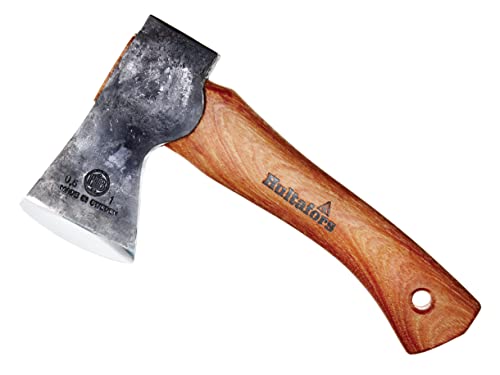
- HANDLE LENGTH: 9 in / 235 mm
- HEAD WEIGHT: 500 g / 1.1 lbs
- TOTAL WEIGHT: 775 g / 1.7 lbs
- MATERIALS: Swedish steel head, American hickory handle, leather sheath
- EDGE: Convex, sharpened and polished
- BEST USE: Best mini bushcraft hatchet for splitting wood
The Hultafors Ågelsjön Mini Hatchet is similar in size to the Gränsfors Hand Hatchet but feels quite different because there is more weight concentrated in the head. The current model has a 500 g head on a 235 mm American hickory handle and weighs 775 g overall, so there is a decent lump of steel sitting on a very short handle.
The handle is made from hickory, treated with linseed oil and shaped nicely enough that it feels good in either hand. Hultafors still hand-forges the axe from Swedish steel at Hults Bruk and supplies it with a polished convex edge and leather sheath.
CHOPPING: Small hatchets like this are more limited than longer ones because you simply can’t generate the same head speed. However, the 500 g head gives the Ågelsjön enough weight to dig into some surprisingly meaty branches, and its compact size makes it very handy for smaller jobs around camp.
SPLITTING: I found the Hultafors better for splitting small logs than the Gränsfors Hand Hatchet because it has more of a wedge shape and plenty of weight behind the edge. Smaller pieces will often split cleanly with one good strike, and when they don’t I have no problem batoning it through. You can use this little hatchet hard without feeling as though you are carrying some delicate ornament; just watch your fingers.
CARVING: The axe arrives with a very sharp, polished edge and is immediately good for light carving and shaving. It works well for stakes, feather sticks, small joints and rough carving, although I still don’t think it makes quite as good a feather stick as the Gränsfors I keep comparing it with.
VERDICT: The Hultafors Ågelsjön Mini Hatchet is a lovely little hatchet for all kinds of bushcraft duties and especially splitting smaller firewood. The hickory handle is one of my favourites on a small axe and the whole thing looks incredible. If you buy one I don’t think you will be disappointed, although I personally still prefer the Gränsfors Hand Hatchet for detailed carving.
Husqvarna Wooden Handle Hatchet
- CURRENT LENGTH: 36 cm / 14.2 in
- CURRENT WEIGHT: 0.82 kg / 1.8 lbs
- CURRENT HEAD WEIGHT: 0.6 kg / 1.3 lbs
- CURRENT MATERIALS: Forged steel head, ash handle
- BEST USE: Best value bushcraft hatchet
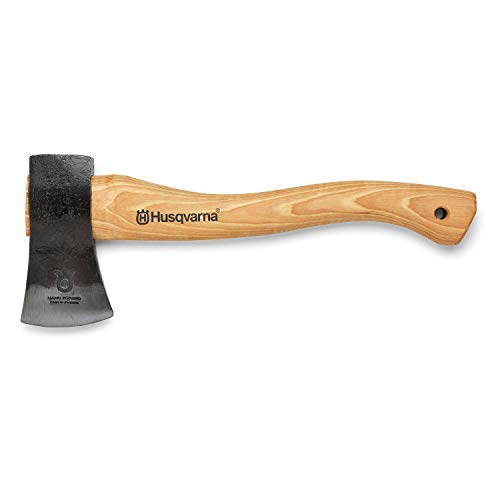
The Husqvarna Wooden Handle Hatchet remains my value choice, although Husqvarna’s current wooden-handled hatchet has changed from the older 13-inch version I originally tested. The current model is 36 cm long, weighs 0.82 kg and has a 0.6 kg forged steel head with an ash handle rather than the hickory handle on my older version.
What hasn’t changed is why I like this type of Husqvarna hatchet. Having compared mine with axes I have paid hundreds for, the biggest difference was the level of finishing rather than its ability to chop wood. The edge on mine wasn’t as sharp, the bevel didn’t seem to have been finished by hand to the same standard, and the handle benefited from a bit of sandpaper.
But once I had addressed those things with a sharpening stone and some sandpaper, there was far less separating it from the expensive hatchets. If you enjoy working on and maintaining your own tools, that makes the Husqvarna very appealing.
CHOPPING: The Husqvarna is ideal for small branches, little trees and general work around camp. Mine needed quite a lot of sharpening out of the box before I got the bite I wanted, but once the edge was sorted it could remove big chunks of material from thicker timber. It is the sort of hatchet I don’t worry about scratching or covering in sap; I just use it.
SPLITTING: The more wedge-shaped profile makes splitting one of its better jobs. The head forces smaller logs and firewood apart effectively, and I have hit the back of the older Husqvarna I tested very hard when working it through stubborn timber. It held up fine. I wouldn’t try to split a full cedar trunk with one, but for normal bushcraft-sized logs it has plenty of grunt.
CARVING: Carving is definitely the biggest weakness because the head is more wedge-shaped and doesn’t have the beautifully gradual profile of the Helko. Mine needed plenty of sharpening before I was happy using it for finer work, but once sharp it was perfectly capable of rough carving, pointing stakes and cutting simple joints.
VERDICT: The current Husqvarna Wooden Handle Hatchet is a good place to start if you want a proper traditional hatchet but don’t want to spend Gränsfors money. It might need more finishing from you, but that’s hardly a disaster on a tool you should know how to sharpen and maintain anyway.
Estwing Sportsman’s Axe
- MODEL: E24A
- LENGTH: 13.5 in / 343 mm
- CUTTING EDGE: 3.25 in / 83 mm
- MATERIAL: One-piece forged American steel
- GRIP: Genuine leather
- BEST USE: Best hatchet with a metal handle
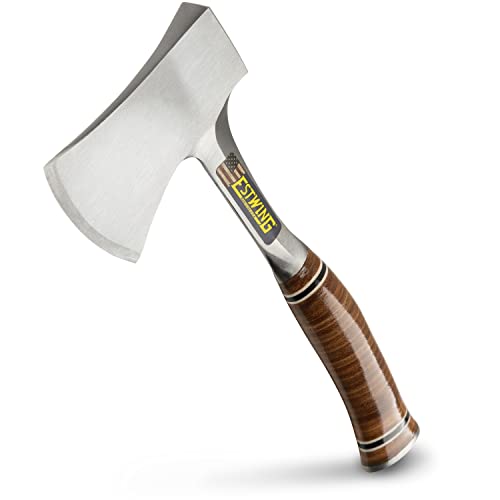
The Estwing Sportsman’s Axe is made from a single piece of forged steel and features the same basic construction you see on Estwing hammers. The current E24A is still made in the USA, measures 13.5 inches overall and has a 3.25-inch cutting edge with the distinctive stacked-leather grip.
It is incredibly strong. If you are worried about an axe head coming loose or snapping a traditional wooden handle, the Estwing removes both of those failure points. The downside is that it is heavier than most wooden-handled hatchets and, if you somehow did catastrophically damage the steel shaft, you aren’t carving a replacement handle beside the fire.
CHOPPING: The Estwing is a true workhorse and an efficient chopper thanks partly to the extra weight. Whether you are chopping small trees, branches or shrubs, the sharp edge gives a clean cut as long as you keep it maintained, and the whole tool feels extremely solid every time it lands.
SPLITTING: There is no issue with its actual splitting ability, but I much prefer a wooden handle for long sessions. Hickory absorbs impact surprisingly well, whereas more of the shock from a bad strike seems to travel through the solid steel Estwing into my hand and arm. If you are repeatedly smashing into stubborn hardwood, I notice the difference.
CARVING: You can carve with this just like any other sharp hatchet, but because of the signature Estwing neck design you can’t slide your hand right up underneath the head as comfortably as you can on a traditional wooden axe. For chipping away at structural joints or making some fine shavings to start a fire it works, but it wouldn’t be my first choice for prolonged carving.
VERDICT: The Estwing Sportsman’s Axe isn’t really for me, but plenty of bushcrafters like the fact that it is essentially one solid piece. If you want a tough compact hatchet that can be thrown into a toolbox, truck or camping box and abused for years, I completely understand the appeal.
Gerber Bushcraft Hatchet
- LENGTH: Around 15 in
- MATERIALS: Forged steel head, glass-filled nylon handle with rubber overmould
- EXTRAS: Waterproof gear storage, 5 ft paracord and hammerhead
- BEST USE: Best survival hatchet
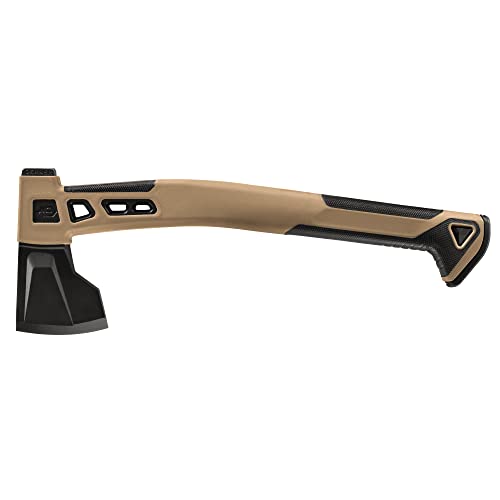
The Gerber Bushcraft Hatchet breaks my normal rule about preferring bushcraft tools with wooden handles. The reason I still think it is worth a look is that it was actually designed around bushcraft, with a waterproof storage compartment inside the handle for small survival items such as dry tinder, a mini lighter, paracord or fishing line. I also like to keep some emergency cash in mine just in case I ever need it.
Gerber still sells the same 31-003783 Bushcraft Hatchet and currently includes 5 feet of paracord, the waterproof storage compartment, rubber overmould grip and a proper hammerhead on the back. It is not as light as you might imagine from looking at the composite handle, but it feels very solid.
CHOPPING: The edge comes pre-sharpened and it is a surprisingly good chopper thanks to the long handle and broad head. In my experience I need to sharpen it more often than some of the harder premium hatchets. The upside is that it sharpens easily and I can get it very sharp. I’ve only used mine on wood, so I can’t tell you how the edge behaves after hitting other materials, but for normal bushcraft work I have found it needs more frequent attention than the Swedish axes.
SPLITTING: The head has a weird shape with wedge-like flares behind the edge that appear to be designed to push wood apart, and they work. When you crack into a suitable log, the head often encourages it to open cleanly. The main reason I don’t baton this one as aggressively as my traditional hatchets is the composite handle; if I somehow destroy a normal wooden handle I can replace it, whereas I can’t remake the Gerber’s moulded structure in the woods.
CARVING: I don’t think this is a great hatchet for carving, to be honest. The flares are designed more around splitting and make the head feel a little clumsy, while the weight feels top-heavy compared with the Gränsfors. If you keep it sharp enough you can still make feather sticks, stakes and camp furniture, but detailed carving isn’t the reason I would buy it.
VERDICT: The Gerber Bushcraft Hatchet is a cool tool to have in a survival setup. If I wanted a hatchet to keep repairing for decades I would get one of the traditional wooden-handled options, but if you like survival gear and mainly want something for chopping and splitting firewood, the Gerber’s hidden storage makes it genuinely different from everything else here.

Bushcraft Hatchets vs Axes: What’s the Difference?
A bushcraft hatchet is basically a small axe that you primarily use with one hand for tasks around camp that are beyond a bushcraft knife’s capabilities. Axes are generally longer and designed to be used with two hands for felling bigger trees, processing large timber and splitting full-sized rounds. Hatchets are more of a multitool and are used for cutting, chopping, carving and light splitting among many other things.
The exact difference between a hatchet and an axe is still a grey area. I used to put the dividing line at roughly 16 inches and 2 lbs, and I still think that is a useful rough guide, but it isn’t an official definition. A better question is whether the tool is designed and balanced to be comfortably used one-handed for the majority of the work you want to do.
Do You Need a Hatchet for Bushcraft?
I think a hatchet is right up there with the most useful bushcraft tools you can own. You can obviously go into the woods without one, but because fire, shelter building and woodcraft are such big parts of bushcraft, a hatchet quickly becomes indispensable once you start doing more than simply camping.
Some of the everyday jobs I use a bushcraft hatchet for include:
- Gathering firewood
- Processing firewood
- Creating kindling and tinder
- Shelter building
- Trail clearing
- Furniture building
- Making wooden pegs
- Spoon and bowl carving
- Cooking and food prep
- Hunting and game-processing jobs
Of course you will find yourself using it for other things too. Something else you need alongside a hatchet is the knowledge and means to maintain its edge, because even the best axe in the world becomes much less useful if you let it get completely blunt.

Guide to the Best Hatchets for Bushcraft and Survival
I strongly advise trying both a mini bushcraft hatchet below about 10 inches long and a more conventional 13-15 inch hatchet if you get the chance. Give them a swing and see how balanced they feel. A few inches doesn’t sound like much on paper, but it makes a massive difference to the way an axe behaves.
Once you know what size feels right for your arm and the kind of jobs you normally do, you can choose between different head and blade shapes. These are the things I pay the most attention to.
Handle Length
Handle length plays a significant role in leverage and force. Short handles are easier to manoeuvre and give you excellent close control, while longer handles generate more speed and power. With a longer wooden-handled hatchet, you can usually slide your hand up closer to the head whenever you need more control, but the opposite can’t be done with a short hatchet when you suddenly want extra leverage.
The other consideration is packability. A 9-inch hatchet can disappear inside almost any backpack, whereas a 15-inch model is more likely to end up strapped to the outside. For one all-round bushcraft hatchet, I like the 13-14 inch area because it gives me useful chopping power without becoming cumbersome.
Handle Shape
Handle shape is way more important than most people realise. It affects comfort, grip, control and how quickly your hand gets tired during repetitive work. A well-contoured, slightly curved handle can give you a secure grip without forcing you to squeeze it as hard as possible on every swing.
Many of the best bushcraft hatchets use American hickory because of its combination of strength, flexibility and impact resistance. Good manufacturers also pay attention to grain orientation and the individual piece of wood rather than simply carving every handle from whatever happens to be available.
Head Weight
The weight of the hatchet head directly affects chopping power, with a heavier head delivering more force and a lighter head being more nimble. Heavy heads can become tiring during extended use and need enough handle length to balance properly, while very light heads don’t have the same authority when you hit harder timber.
Once the whole thing starts getting seriously heavy, I think you should at least consider whether a slightly longer two-handed axe would be a better tool. For a normal one-handed bushcraft hatchet, something around a 500-700 g head works particularly well for me.
Head and Blade Shape
The head and blade shape are essential in determining how the hatchet performs. A thicker wedge-shaped head is generally better for splitting, while a wider and relatively thinner cutting profile like the Helko Rheinland is better for chopping and carving. Forest-style heads such as the Gränsfors Wildlife sit somewhere between those extremes.
That compromise is exactly what I want from one all-round bushcraft axe. If I know I will be doing almost nothing except splitting, I can use a dedicated splitting tool. If I’m carrying one hatchet into the woods for everything, I want it to chop, split and carve reasonably well.
Blade Size
Blade size affects both precision and how much usable cutting edge you have. A wider blade gives you a larger striking area and more edge to work with when carving or delimbing, while a smaller head can be more compact and concentrate its weight into a smaller area.
Hatchets vary far more than you might expect here. Compare the broad 4-inch edge on the Helko Rheinland with a chunky little splitting-oriented head and you can immediately see that they are going to behave differently even if their overall weights aren’t miles apart.

Materials
For bushcraft hatchets, more than almost any other type of axe, I prefer the handle to be made from wood. Hickory is my favourite because it is strong, flexible and excellent at absorbing repeated impacts, but ash is also a traditional tool-handle wood and is what Husqvarna uses on its current hatchet.
The other reason I like wood is repairability. If a traditional axe handle somehow breaks while I’m out in the wilderness, I at least have the possibility of making a temporary handle until I can replace it properly. If a moulded fibreglass or composite handle completely fails, I’m not recreating that structure beside the campfire. The Estwing is obviously different because the entire head and shaft are forged from one piece of steel.
Most of the premium axe heads here use relatively straightforward carbon steels, which is exactly what I want. Forging, heat treatment and edge geometry matter more to me than having some exotic steel name stamped on the head. A bushcraft axe needs to take a good edge, hold it reasonably well and still be practical to sharpen yourself.
Sharpness
Out-of-the-box sharpness and edge retention are important for efficient chopping and carving. A dull hatchet needs more force and doesn’t bite into timber in the same clean way. If I spend premium money on something like a Gränsfors or Hultafors, I expect the edge to arrive properly finished.
Cheaper hatchets don’t always arrive that way, but it isn’t necessarily a deal breaker. My Husqvarna needed a lot more sharpening out of the box than the premium axes, but once I had worked on the bevel the underlying tool was still very good. You should know how to sharpen a bushcraft axe anyway because no edge stays perfect forever.
Chopping
Chopping is one of a bushcraft hatchet’s most important jobs. Good performance depends on a combination of head weight, blade shape, sharpness, handle length and overall balance rather than any single specification.
If chopping is my priority, I prefer a 13-15 inch handle over a mini hatchet because the additional leverage and head speed make a huge difference. Of the models above, the Hults Bruk Hultån is probably the strongest pure chopper, while the Gränsfors Wildlife gives away a little power in exchange for better control during finer jobs.
Splitting
You might not realise it before buying a hatchet for bushcraft, but splitting firewood quickly becomes one of the jobs you perform most often. A heavier, more wedge-shaped head generally makes the job easier, and a slightly longer handle helps generate more force while keeping your hand further away from the chopping block.
Batoning is also one of the most useful ways to get more out of a small axe. If a piece of wood isn’t going to split cleanly with one swing, I set the cutting edge into the end grain, pick up another solid lump of timber and baton the hell out of the axe until the split runs through. I’ve done this countless times and it lets a compact hand hatchet process wood that looks far too big for it.
The downside of really short hatchets is that your hand is much closer to the block. I can’t count the number of times I’ve hit my knuckles on the wood I am trying to chop with a short single-hand axe, which is one reason I appreciate a few extra inches of handle when processing a lot of firewood.
Carving
Carving tasks need a sharp, well-shaped blade and a handle that gives you plenty of control. This is where the mini hatchets excel because you can choke your hand right up underneath the head and use very small movements instead of full chopping swings.
A properly sharpened little axe can take thin shavings almost like a knife. I use hatchets for making wooden pegs, rough spoon and bowl blanks, feather sticks, notches, camp furniture and basic joints. The Gränsfors Hand Hatchet and Helko Rheinland are my favourites for this kind of work.
Sharpening a Bushcraft Hatchet
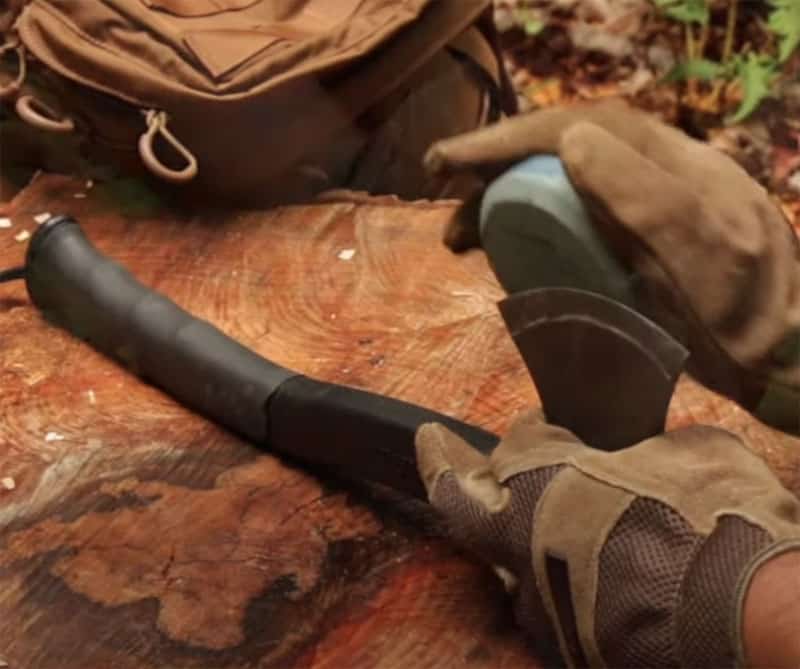
Sharpening your hatchet is an essential part of maintaining it. Not only does a sharp edge make chopping, carving and splitting wood easier, but it also means you don’t have to attack every piece of timber with maximum force just to make the blade bite.
What Tools Can You Use?
There are several tools I use to sharpen a camp hatchet, including a mill file, axe puck or sharpening stone, finer stone or ceramic, and a leather strop. They all have different jobs: a file is useful for restoring a damaged or badly rounded edge, while the stones refine the bevel and a strop can polish the final edge.
I don’t use a file every time I sharpen an axe. If the bevel is already in good condition, there is no point removing more steel than necessary.
What Is the Process? 5 Steps for a Sharp Hatchet
Here is the basic five-step process I use to sharpen and maintain my bushcraft hatchets:
- Secure the hatchet so the head isn’t moving around while you work.
- If the edge is damaged or badly rounded, use a mill file to restore the existing bevel on both sides.
- Move to the coarse side of your sharpening stone and work both sides of the edge until the bevel is even and you start to develop a burr.
- Use the finer side of the stone to refine the edge and remove the coarse scratches.
- Finish on a leather strop if you want a particularly clean, sharp edge.
Use water, oil or the stone dry according to the sharpening stone you actually own. Not every sharpening stone is designed to be used in exactly the same way.
How Often Should You Sharpen a Bushcraft Hatchet?
The right answer is as often as it needs doing. The better question is how you know when it needs sharpening. I inspect the edge, carefully check it with my thumb and look for flat spots, rolling, small chips or an edge that is starting to feel rounded instead of crisp.
If I’m not sure, I see whether it will bite into a sheet of paper or thin cardboard. If it starts tearing instead of slicing or doesn’t bite into wood as cleanly as it normally does, I give it a quick sharpening and test it again. I would much rather touch an edge up regularly than leave it until it is completely knackered and have to rebuild the bevel.
What Is the Best Bushcraft Hatchet?
For me, the Gränsfors Bruk Wildlife Hatchet is still the best bushcraft hatchet overall because it gives me the best combination of chopping power, splitting ability, carving control, weight and packability. It isn’t the outright winner at every individual job, but it is the one I would choose if I could only take a single axe.
If I mostly wanted to carve, I would choose the Helko Rheinland. If chopping and firewood were the priority, I would choose the Hults Bruk Hultån. For a tiny carving hatchet I would get the Gränsfors Hand Hatchet, while the Hultafors Ågelsjön is my favourite mini option when splitting matters more. The Husqvarna is the value choice, the Estwing is the one-piece steel workhorse, and the Gerber makes the most sense if you specifically want survival features and hidden storage.
I hope you’ve found the best bushcraft hatchet for the way you actually use an axe and, at the very least, have a better understanding of what different handle lengths, weights and head shapes actually change.






[…] guide aims to provide you with the best axe sheaths and ensure your axe, bushcraft hatchet, or tomahawk head is protected and ready for use at all […]
[…] design to the larger axe but are increasingly being made with plastic handles to save on weight. A bushcraft hatchet will also commonly have a flattened area for hammering, making the hatchet more […]
[…] innovative plastic holster makes transportation very safe and easy. Overall I would recommend this hatchet for bushcraft, and to anyone who isn’t put off by any ax that doesn’t have a wooden handle; it is a […]
[…] in your backpack, then carrying a mallet for tent stakes would be dead weight. The back of a survival hatchet is pretty much a hammer already, and if you plan on having a campfire, then you will want one of […]