Guide to Camping On Sand
Camping on sand can be incredibly comfortable and give you access to some amazing places, but beaches, dunes, and deserts all create a few problems you don’t normally have on firm ground. In this guide, I explain how I camp on sand, how to stop your tent blowing away, which pegs work best, how to keep sand out of your gear, and the important things to check before choosing a pitch.

I really enjoy camping on sand.
Beach camping can give you incredible sunrise and sunset views, while desert camping gives you a sense of space and a night sky that is difficult to match anywhere else.
Sand can also make a surprisingly comfortable place to sleep because you can flatten out bumps and shape the surface underneath your tent.
The problems are fairly predictable though.
Sand gets everywhere, ordinary tent pegs don’t hold particularly well, exposed beaches can become extremely windy, and choosing the wrong pitch near the sea can become dangerous when the tide comes in.
Once you understand those issues, camping on sand is actually quite straightforward.
How to Camp on Sand
The main difference between camping on sand and camping on normal soil is that you can’t rely on the ground providing much resistance.
Your tent therefore needs to be either freestanding or securely anchored, and you need to think more carefully about wind.
Before setting up, I normally focus on four things:
- Is camping actually permitted here?
- Will this location remain safe at high tide?
- Where is the wind coming from?
- How am I going to anchor the tent?
Equipment helps too.
A tent suitable for desert or sandy conditions, proper sand stakes or anchors, a sleeping mat, and enough drinking water make a big difference.
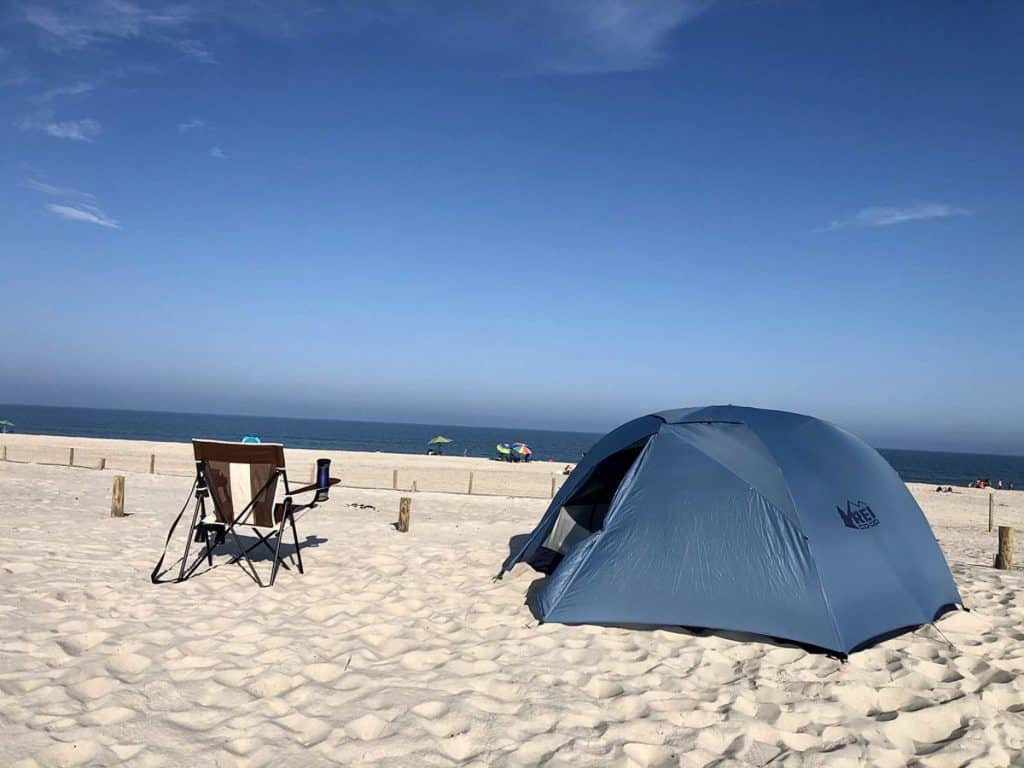
Check the Tide Before Beach Camping
This is the first thing I would add to my old advice about camping on a beach.
A patch of perfectly dry sand does not necessarily mean the sea won’t reach it later.
Before pitching anywhere close to the coast, check the local tide times and look for obvious signs of the normal high-water line such as seaweed, shells, driftwood, or a change in the appearance of the sand.
I would always camp comfortably above the expected high-tide line rather than trying to squeeze into the closest possible spot to the water.
Also remember that tides aren’t the only thing affecting how far the water reaches.
Large waves, storms, strong winds, and unusually high tides can push water much farther up a beach than you might expect.
If there is any doubt, move farther inland.
Check Whether Camping Is Allowed
Not every beach, dune system, or desert allows camping.
Rules vary enormously between countries, national parks, private land, and individual beaches.
Some places permit camping freely, some require permits or reservations, and others prohibit overnight camping completely.
Don’t assume that because a beach looks remote you can automatically put a tent there.
I also avoid pitching directly on dune vegetation.
Sand dunes can be surprisingly fragile ecosystems, and frequently used or bare sandy areas are generally a better place to camp where permitted.
Choosing a Tent for Sand
When camping on sand, I prefer a tent that doesn’t depend entirely on its pegs to remain standing.
A freestanding or geodesic tent is especially useful because the pole structure maintains the shape of the tent even before everything is properly anchored.
That doesn’t mean you can forget about stakes.
A freestanding tent can still blow away remarkably easily.
Other useful features include:
- A raised bathtub floor to help stop blowing sand entering.
- Good ventilation for hot beach and desert conditions.
- A strong pole structure for exposed locations.
- Plenty of guy-out points so you can spread the wind load.
- A decent porch for keeping sandy footwear and equipment outside the sleeping area.
I also prefer lighter-colored tents in very sunny conditions because the inside generally feels less oppressive than a very dark shelter sitting in direct sun.
Choosing a Pitch on Sand
Look for the flattest area you can find.
Sand makes this easier than rocky ground because you can smooth out small bumps and hollows before putting the tent down.
I still check carefully for anything sharp underneath the surface.
Shells, rocks, sticks, broken glass, fishing equipment, and other debris can easily be hidden by a thin covering of sand.
On the beach, I also consider wind direction and the tide.
In the desert, I pay attention to depressions and dry channels. A low sandy area might look like the most comfortable pitch available, but it can become a bad place to be if unexpected rain sends water through it.
Natural shelter can be useful, but avoid damaging dunes or vegetation just to get out of the wind.
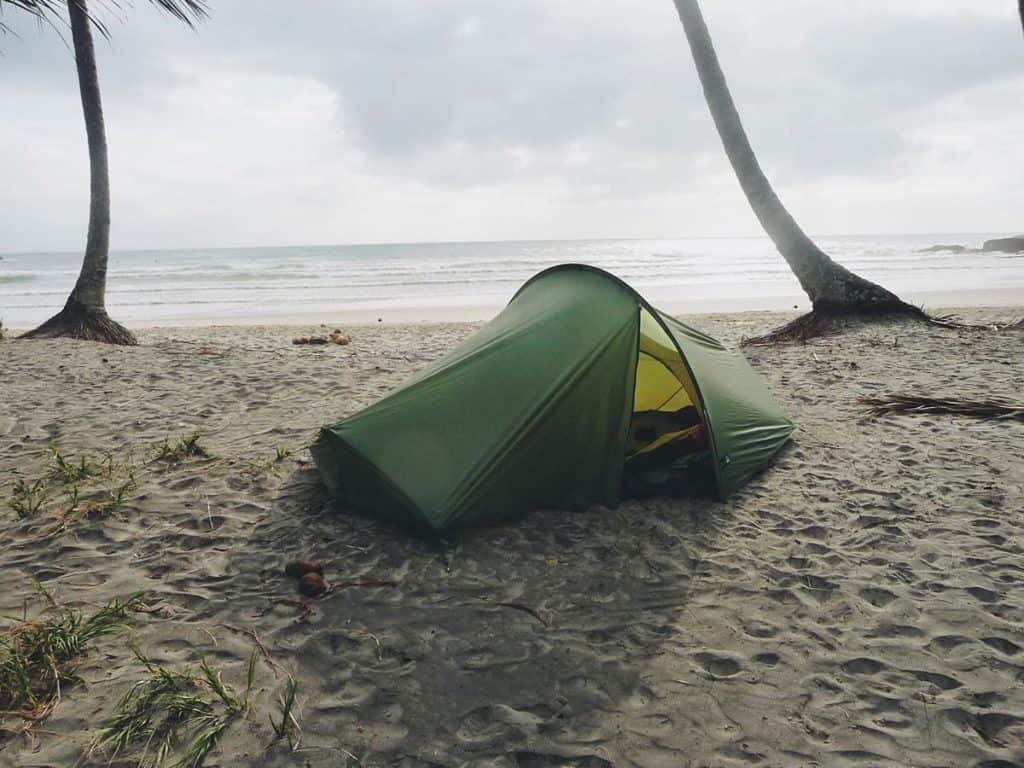
Setting Up Your Tent on Sand
Sand isn’t difficult to pitch on, but wind can make the process chaotic.
Before inserting the poles, I keep control of the tent body at all times.
A lightweight tent spread out on an exposed beach can catch the wind like a parachute.
If I’m alone, one of the first things I do is put my backpack or another heavy piece of gear inside the tent.
That isn’t a substitute for anchoring it properly, but it gives you some insurance while you’re setting everything up.
Once the poles are installed, I orient the tent before securing every anchor.
Ideally, position the strongest or narrowest end of the tent into the prevailing wind rather than presenting the broad side like a sail.
I also try to position the entrance away from blowing sand.
How to Secure a Tent in Sand
This is probably the biggest practical difference between camping on sand and camping on normal ground.
Standard narrow tent pegs rely on compact soil gripping them.
Loose sand doesn’t provide much grip, so an ordinary peg that feels secure when you first push it in can pull out surprisingly easily when a gust hits the tent.
The easiest solution is to use tent stakes designed for sand.
These are normally longer and have much more surface area than standard backpacking pegs.
Long corkscrew-style anchors can also work well in suitable sand.
Using Deadman Anchors in Sand
If normal stakes aren’t holding, one of the most effective techniques is a buried or “deadman” anchor.
Instead of pushing a peg vertically into loose sand:
- Dig a hole or narrow trench away from the tent.
- Attach your guyline to a tent stake, stick, rock, or purpose-made anchor.
- Place it horizontally across the hole.
- Bury it deeply with compacted sand.
- Tension the guyline after covering it.
Because the anchor now has to move a large volume of sand before it can pull free, it can hold much more securely than a normal vertical peg.
Large rocks can also be used where permitted and available.
Whatever method you use, check the anchors again after the tent has been tensioned and whenever the wind increases.
Keeping Sand Out of Your Tent
You aren’t going to keep every grain of sand out.
The realistic goal is keeping most of it outside.
I normally treat the tent porch as a dirty area and the sleeping compartment as a clean area.
Shoes stay outside or in the porch.
Before getting into the tent, brush the sand off your feet and legs.
A towel near the entrance works surprisingly well, although a surf changing mat can also give you somewhere clean to stand while getting changed.
Keeping the tent door facing away from the wind helps too.
If the door is directly exposed to a strong beach wind, every time you unzip it you can get a small sandstorm inside.
I also keep the door zipped whenever I’m not actively getting in or out.
Cooking When Camping on Sand
Cooking on a windy beach is one of the fastest ways to discover just how far sand can travel.
Even a small gust can put sand straight into a pan or onto food.
I therefore cook somewhere sheltered where this is permitted.
A tent porch can sometimes provide shelter, but you should never use a stove inside a closed tent and must follow the stove and tent manufacturers’ safety guidance.
A separate windbreak or naturally sheltered cooking area is often better.
Try to keep food containers closed until you actually need them.
Once fine sand gets into something like butter, cheese, or a sticky sauce, you aren’t getting it back out again.

Do You Need a Sleeping Mat on Sand?
Yes, I would still take one.
Sand can feel so soft that it is tempting to assume you don’t need a sleeping mat.
Comfort isn’t the only reason you carry one though.
A sleeping mat also insulates you from the ground.
Once the sun disappears, sand can lose heat quickly and sleeping directly above cold ground can become surprisingly uncomfortable.
I might take a thinner mat than I would on extremely rocky ground, but I wouldn’t deliberately camp without one just because the sand feels soft.
Do You Need a Groundsheet for Sand Camping?
Not necessarily.
If your tent already has a good waterproof floor, a separate groundsheet isn’t essential purely because you’re camping on sand.
However, a footprint can protect the tent floor from hidden shells, sharp debris, and abrasion.
It also makes packing up easier because much of the wet or dirty sand stays on the footprint rather than directly on the tent floor.
If you use one, make sure it doesn’t stick out beyond the edges of your tent.
A groundsheet protruding outside the fly can catch rain and direct water underneath the tent.
Water for Beach and Desert Camping
Take more drinking water than you think you’ll need.
This is particularly important when desert camping, but remote beaches can create exactly the same problem.
You may be surrounded by water while having absolutely nothing safe to drink.
Hot weather, wind, walking on soft sand, and carrying equipment all increase how much you drink.
Check where your next reliable water source is before setting off rather than assuming you’ll find somewhere to refill.
Insects and Other Beach Problems
Biting insects can be surprisingly bad around coastal camps.
Mosquitoes, midges, sand flies, and other insects can become particularly active around dusk.
A tent with proper insect mesh makes a huge difference.
Depending on the location, I also take insect repellent and lightweight clothing that covers my arms and legs.
Food storage matters too.
Beaches often have opportunistic birds and animals that quickly learn campsites mean food.
Keep food sealed and follow any local requirements for animal-resistant storage.
Camping on Sand in High Winds
Wind is the weather condition I take most seriously when camping on exposed sand.
The problem isn’t only that the tent might blow away.
Wind continually loads the poles, guy lines, stakes, and fabric.
If one sand stake pulls free, the additional force can suddenly transfer to the remaining anchors.
Before going to sleep in windy conditions I:
- Check every anchor.
- Use all important guy lines.
- Make sure the tent is properly tensioned.
- Keep some weight inside the tent.
- Remove loose equipment from outside.
- Check that the door and vents are secured.
If severe weather is forecast and the site is completely exposed, the sensible option may simply be to move.
Beach Camping vs Desert Camping
Although both involve pitching on sand, they aren’t exactly the same.
Beach camping means thinking about tides, salt water, wind, insects, and potentially very damp air.
Desert camping puts much more emphasis on water supply, shade, extreme temperature changes, wind-blown dust, and choosing somewhere that won’t flood during sudden rainfall.
In both environments, though, good anchoring and careful site selection solve many of the practical problems.
12 Tips for Camping on Sand
These are the most useful lessons I would take from this guide:
- Check whether camping is permitted before pitching.
- Check tide times and camp safely above the expected high-water line.
- Use long sand stakes or anchors instead of relying on short conventional pegs.
- Learn how to make a deadman anchor for very loose sand.
- Choose a freestanding tent if you regularly camp on soft ground.
- Orient the tent for the wind and avoid pointing the entrance directly into blowing sand.
- Put some gear inside immediately so the tent can’t blow away while you finish pitching.
- Keep footwear in the porch and clean your feet before entering.
- Use a sheltered cooking area to keep blowing sand away from your food.
- Take a sleeping mat even though the sand itself feels soft.
- Carry plenty of fresh water, especially in remote beach and desert locations.
- Prepare for insects, wind, and rapid temperature changes.
Is Camping on Sand Worth It?
Definitely.
Some of my favorite places to pitch a tent are beaches and other sandy locations because you get wide-open views, soft ground, and often a much greater sense of space than you get at a normal campsite.
The sand itself isn’t really the problem.
Most frustrations come from using equipment designed for firm ground or choosing a pitch without thinking about wind, tides, and exposure.
Use proper anchors, keep the sand outside the sleeping area, take enough water, and choose your pitch carefully.
Once those things are sorted, camping on sand can be one of the most enjoyable ways to camp.
I hope this updated guide to camping on sand helps you prepare for your next beach, dune, or desert camping trip.