


In this guide to the best geodesic tents, you’ll learn why dome tents are so good for harsh weather and four-season use. I’ll show you how to tell if a tent has a strong frame just by looking at it and which geodesic dome I’d pick for a two-person Arctic expedition. My first pick is the NEMO Chogori, followed by the Marmot Thor and The North Face Mountain 25.
There are literally hundreds of tents you can use for camping, but the shape of the frame is one of the first things I look at when I know I’m going to pitch somewhere exposed. The way the poles cross can make a big difference to how well a tent handles wind and snow. It also affects how much room you get inside and how long it takes you to get the thing up when your fingers are going numb.
I’ve used all five tents in this guide and been impressed by how well they keep the rain out. Where they differ is how easy they are to pitch, how much space you get once the gear comes inside and how much condensation you have to deal with. The Snow Peak at number five is a modular base-camp shelter for anyone who wants a proper living area alongside the sleeping compartment.
This guide includes affiliate links. As an Amazon Associate, Gear Assistant earns from qualifying purchases.
Quick Picks
- Best overall: NEMO Equipment Chogori
- Best classic expedition dome: Marmot Thor
- Best compact two-person expedition tent: The North Face Mountain 25
- Best geodesic hot tent: POMOLY Dome X6 Pro
- Best base-camp alternative: Snow Peak Living Shell Long Pro with Inner Tent
What Is a Geodesic Tent?
A geodesic tent is usually dome-shaped, with poles that cross at several points across the main body. These crossings help support the poles and spread loads through the frame. Five or more crossings is a useful rule of thumb for a full geodesic frame. When you’re comparing tents, count the crossings that brace the sleeping area separately from the poles that hold up a porch or awning.
5 Best Geodesic Tents and Base-Camp Shelters
NEMO Equipment Chogori
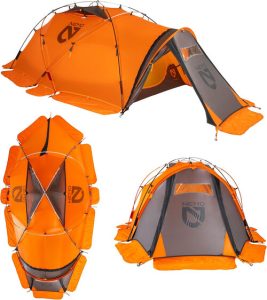
- Capacity: Two- and three-person versions
- Season rating: Four-season mountaineering
- Frame: External crossing poles with an integrated fly and inner
- Packaged weight: 7 lb 11 oz / 3.49 kg for the 2P version listed by REI
- Floor area: 40.1 sq ft / 3.73 m² for that 2P version
The NEMO Equipment Chogori is my number-one pick because it gets the basics right for the sort of trip where you’re forced to pitch wherever you can find a flat spot. The poles go on the outside and the fly and inner go up together. That’s the bit I like most. When rain or snow is coming down, you can get the whole shelter up in one go without having to put the fly over an exposed inner.
On the 2P, two long poles cross diagonally and two shorter side poles brace the dome. The vestibule has a pole of its own. That front space matters more than it sounds on paper. Once you’ve taken off wet boots and put two packs down, it’s nice to have somewhere to leave them while you spread yourselves out in the sleeping area. I’d still check your pad widths before trying to squeeze in two wide winter mats.
The Chogori feels like a sensible size to carry for the amount of tent you get. At 7 lb 11 oz packed for the 2P version above, I’d split the poles and pegs from the rest of the tent between two people. One useful thing to know before packing is that the fly and inner are designed to pitch together. Splitting off the poles and stakes is easier than planning to hand one person the fly and the other the inner every morning.
It keeps the weather out well, and the vents give you room to play with airflow. In cold, damp conditions I pay particular attention to how much wet kit comes inside. A wet pack in the vestibule is one thing. Two soaked jackets sitting by your sleeping bags are another. NEMO also designed the Chogori so you can link two tents of the same size together. I can see the appeal of that if a group is sitting out the weather at base camp.
Verdict: The Chogori is the best all-rounder here for me. It’s sturdy, gives wet gear somewhere to go and makes a foul-weather pitch a bit less of a faff. Check whether the listing is for the 2P or 3P before ordering.

Marmot Thor
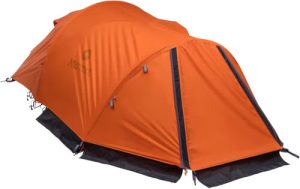
- Capacity: Two- and three-person versions
- Season rating: Four-season expedition tent
- Frame: Five main poles and a separate vestibule pole in Marmot’s pitching guide
- Reference specs: Marmot’s catalog lists the Thor 2P style 29660 at 10 lb 3 oz / 4.62 kg total, with 36.9 sq ft / 3.4 m² of floor space
The Marmot Thor is exactly the sort of tent I picture when someone says geodesic. There are five main poles in the body before you even get to the one that supports the vestibule. If you want to see why these tents feel so solid, look at the Thor with the fly off. You can see all the places where the frame braces itself and how little of the body is left hanging between supports.
It takes more sorting out than the Chogori’s external pitch. You’ve got sleeves to feed the main poles through, then a separate fly and vestibule pole to get into place. I’d put it up at home once or twice and get familiar with which poles go where. The extra work is easier to justify if you’re going to leave it up for several nights or spend a long time inside while the weather sorts itself out.
The floor area on the older 2P gives you a little more room to work with than the current Mountain 25. It’s handy if you want space to sit up, sort gear and get changed without kicking your partner in the head. Marmot’s catalog lists two doors and two vestibules for that 2P version, so you can divide up the gear instead of making one person crawl over all of it to get out. I’d look for the 3P if the third person is actually coming with you or if the extra room is worth the load for two.
The full fly gives the Thor good coverage in rain. The thing I’d watch on a cold night is how far you close the vents to stay warm. The inner gives you a little separation from damp on the fly, but when you’ve got two people breathing and wet clothing hanging around, a bit of airflow is worth having. On a long walk-in, I’d divide the poles, inner and fly between people. This is the kind of tent where splitting the load makes as much difference as the number on the scales.
Verdict: A proper expedition dome for people who value a solid frame and room to spread out. The Thor is an older model and remaining stock can be patchy. Check whether you’re buying the 2P or 3P and that the listing includes the fly and complete pole set.
The North Face Mountain 25
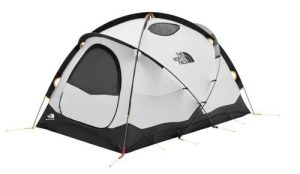
- Capacity: Two people
- Season rating: Four-season mountaineering
- Frame: Four main dome poles and a fifth pole for the fly at the vestibule
- Total weight: 9 lb 13 oz / 4.45 kg for current style NF0A8BDG
- Floor area: 29.3 sq ft / 2.72 m² for current style NF0A8BDG
The North Face Mountain 25 is the one I’d pick for a two-person Arctic expedition from this list. It’s built around a compact sleeping area with a poled front vestibule to take the gear that would otherwise end up under your feet. The Mountain 25 has a fairly low profile for an expedition dome. I’d take that trade when I know the pitch is going to be exposed and there’s little choice about where the tent goes.
Two poles form the main cross and another two complete the dome. The fifth supports the fly at the front. The sleeves and clips make sense once you know which way the poles go. Give yourself room in front when you pick a spot. The sleeping area can fit onto a fairly compact patch, but you’ll still need space for the vestibule and its anchors.
There are two doors, which I appreciate on a tent this size. At 29.3 square feet for the current version, it’s a proper two-person sleeping compartment with a front porch doing much of the work when it comes to storage. If you’re stuck inside a while, I’d keep boots and packs out in the vestibule and only bring in what you actually need. That’s what makes the difference between a compact tent and two people sitting on top of each other’s gear.
The current fly is 40D ripstop nylon with a 1,500 mm rating, while the floor is 70D nylon taffeta rated to 5,000 mm. Those figures are useful when you compare materials, but coverage matters too. The full fly and covered entry are the bits I value when it’s raining and someone needs to get in or out. I’d use whatever venting the weather allows. Moisture on the underside of a fly after a cold night can be condensation even when no rain has come through.
It’s close to ten pounds all in, so I’d have one person take the poles and pegs and the other take the tent and fly. The Mountain 25 has been around long enough for more than one generation to show up under the same name. Check the style number if the Amazon listing gives a different weight.
Verdict: A compact two-person shelter that makes sense for exposed winter pitches. If I wanted more room for a long stay, I’d consider the Thor. If I wanted an easier pitch with the fly already attached, I’d take the Chogori.
POMOLY Dome X6 Pro
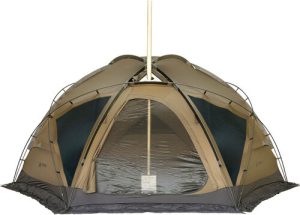
- Capacity: POMOLY lists up to four with a stove or six without
- Outer tent and poles: 18.7 lb / 8.5 kg
- Inner and groundsheet: 3.5 lb / 1.6 kg and 3.3 lb / 1.5 kg respectively
- Height: 6 ft 7 in / 200 cm
- Fly: 40D ripstop silnylon with a 3,000 mm hydrostatic head rating
The POMOLY Dome X6 Pro is the hot tent I’d take for a fixed winter camp. You get a big, round shelter with enough height to stand up and get changed, even after you’ve put the inner in. The poles cross around the dome, and POMOLY reinforces the fabric where those crossings can rub. There are three doors, so you have some choice about which one to use when the wind comes around.
Putting it up takes more space and more handling than pitching either of the small expedition tents. You have a lot of outer fabric to get under control and a much bigger area to anchor. The upside is having enough room to spread gear out once it’s up. POMOLY lists 112 square feet under the outer, with about 55 square feet in the inner. Use the inner dimensions when you’re working out where sleeping pads will actually go. The full footprint includes the space you’re using to get in and out and store gear.
The fly has a 3,000 mm hydrostatic head rating, and there are adjustable mesh vents around the shelter. Those vents are especially useful on damp nights. There’s a lot of fabric inside a tent this size for moisture to collect on, particularly if you shut it up with wet gear inside. I like that you can adjust the airflow without having to leave a main door wide open in the rain.
The dedicated stove jack is part of the design. If you’re using a stove, follow the tent and stove instructions for ventilation, clearances and setup. Once you’ve allowed room for the stove and a clear way out, you’ll have less usable space than the six-person figure might suggest. The outer and poles already weigh 18.7 lb, and the inner and groundsheet take those three components to roughly 25.5 lb before any stove kit. Check what your listing includes before ordering.
Verdict: A big geodesic hot tent I’d happily choose when the walk from the vehicle is short and I want to stand up under cover. The space and headroom are what make carrying the extra weight worthwhile.
Snow Peak Living Shell Long Pro
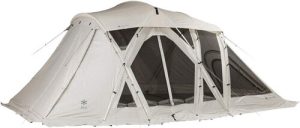
- Shelter: Living Shell Long Pro, model TP-660
- Sleeping inner: Living Shell Long Pro Inner Tent, model TP-660IR, sold separately
- Weight: 41 lb / 18.6 kg for the shelter, plus 7.7 lb / 3.5 kg for the inner
- Outer dimensions: 17.4 × 13.6 ft with 7.2 ft of peak height
- Sleeping capacity: Up to five in the separate inner, according to Snow Peak
The Snow Peak Living Shell Long Pro is the one I’d use if I wanted to spend a weekend outdoors with family or friends and still be able to sit together when it pours down. The ridge-frame layout makes it a modular base-camp shelter. I’ve included it as an alternative to the geodesic domes because it solves a different problem. You can stand up, sort out wet gear and move about without having to shuffle around on your knees.
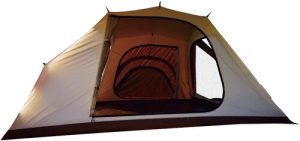
The Living Shell Long Pro Inner Tent is what turns it into an overnight setup. With the inner in, you’ve got a bedroom at one end and living space out in front. Snow Peak lists the shell for six and the inner for up to five. If you’re taking wide mats or camp beds, lay out the dimensions before you assume that number works. The best part of this arrangement is being able to keep muddy boots and damp coats out of the sleeping area altogether.
It’s a bigger job to pitch than the other tents here. I’d get someone to help hold the frame while it goes up and choose a site with room for the guylines before I start unloading. The shelter alone is 41 lb, and the inner takes the pair to just under 49 lb. This is one I’d carry from the car to a decent pitch and leave up for the trip.
The big mesh windows let you open up more of the shelter when it warms up, which helps when there’s a group inside generating heat and moisture. You can close it down on the weather side and still use the openings on the more sheltered side when conditions allow. The separate inner also makes it easier to keep sleeping bags away from any damp outer fabric. That’s a useful difference on a rainy weekend when you’ve had wet gear inside for most of the day.
Verdict: My pick here for a roomy family base camp. The big win is having a place to spend time together when the weather turns, with a proper sleeping area at the back. Buy the shell and matching inner separately if you want the full setup.
Black Diamond Bombshelter Tent Review
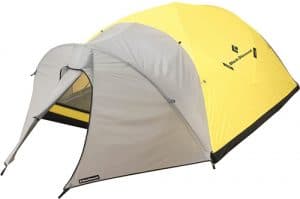
The Black Diamond Bombshelter Tent is the best geodesic tent I have ever tested. It was built for expeditions where your tent needs to be beyond reliable. It’s hard to find new now, but it’s worth keeping the review here because it shows just how strong a single-wall geodesic design can feel.
With four interior poles, the version I tested had seven crossover sections in total. It used a single layer of ToddTex, a PTFE laminate with a fuzzy polyester lining designed to spread moisture across the fabric so it could evaporate. When you give this tent a shake for the first time, you can see how bombproof it is. When I tested it in high winds, it didn’t move around or flex like a tunnel tent. The dome kept its shape even as the wind came at it from different angles.
I originally recorded 50 square feet inside the main pod plus another 20 in the porch. The porch is big enough for four people’s boots and backpacks, which helps free up the sleeping area when everyone’s inside. The 9 lb 12 oz / 4.42 kg weight I recorded was manageable when divided between people, and the 8 × 20 in pack size made it fairly easy to carry for a four-person expedition tent.
The single wall is part of what keeps the weight down, and it’s also the trade-off to think about in damp conditions. You have less separation between your sleeping gear and any moisture on the inside of the shelter. The aerodynamics and rigid frame were what won me over. When you’re trying to get some sleep in an exposed spot, it makes a difference when the tent isn’t shaking all over the place.
Verdict: As far as single-wall geodesic tents go, this is one of the best. If you find a used one, check the ToddTex, seams and complete pole set before committing to an older expedition shelter.
Other Tents From the Original Guide
- Fjällräven Abisko Dome 2: I liked this for couples and hiking partners who wanted one tent for winter and summer. At about 3 kg it was light for a roomy double-wall four-season tent, and the two doors and adjustable ventilation were worth having. Its three crossing points make it semi-geodesic. Fjällräven Abisko Dome 2 specs.
- VAUDE Space L 3P: I originally recorded five crossover points and a weight of 3.34 kg. Two of the four poles sat on top and tensioned the front and rear, giving the tent that turtle-shell shape when it was zipped up. I liked the two big porches for three-season camping. The original is hard to find, and VAUDE’s current Allround Space 3P uses a ridge-tunnel frame.
- Eureka K-2 XT: The old three-person expedition tent had 52 square feet inside, four feet of headroom and 14 pockets. At roughly 14 lb, it was one I’d split across the group, especially if everyone already had a full pack. The K-2 XT is discontinued, and Johnson Outdoors has exited Eureka’s consumer camping business.
- Marmot Halo 4: I really liked the oversized double door because it let everyone get in and out without climbing over each other. There’s room to open things up for ventilation in summer, and it makes sense if you’re taking the family away. The Halo 4 is a three-season family tent.

Guide to Geodesic Dome Tents
What should you look for in a geodesic dome tent? Start with the crossing pole sections and look at how they support the main body. If you plan to use it in winter, check that it’s designed for the wind and snow you expect. The weight, pack size and sleeping area can all influence which is the right tent for you. If you’re going somewhere hot instead, have a look at our best tents for desert camping.
Semi-Geodesic Tents
Semi-geodesic tents generally have fewer crossover points within the frame. Simply put, these are points where two poles overlap to create the dome-shaped structure. Semi-geodesic tents are often ideal for hiking and backpacking because they don’t need as many poles and typically weigh less.
Fully Geodesic Tents
Five crossover points over the main body is a useful guide for what I look for in a fully geodesic tent. Many use at least four main poles, which increases the pack weight but gives the frame more support over the sleeping area. This is why you’ll see so many geodesic domes used on expeditions and by high-altitude mountaineers.
Geodesic Tents vs Tunnel Tents
The benefits of geodesic tents are that they’re strong and durable and many hold their shape before being pegged out. Tunnel tents can save weight and give you plenty of usable space for what you carry. The downside is that they can be more sensitive to wind direction, especially when the wind hits them broadside. I’d take a geodesic dome for exposed mountaineering pitches and look at a semi-geodesic or tunnel tent if I wanted to travel fast and light.
Are Geodesic Tents the Same as Dome Tents?
You can get dome tents with only two poles and one cross at the top. Dome describes the shape. Geodesic describes how the poles repeatedly cross and support that shape. Looking at the frame with the fly off is often the quickest way to tell the difference.
What Are the Disadvantages of Geodesic Tents?
The main disadvantages of even the best geodesic tents are that they’re heavy and expensive. You’ve also got more poles to put together. If you can deal with the extra weight in return for a sturdier shelter on an exposed pitch, there are few tent designs I’d rather have.
What Makes Geodesic Tents So Strong?
The shapes the poles make where they cross help distribute the load throughout the frame. That gives you fewer long spans left to flex on their own when the wind hits. If my years of scaffolding have taught me anything, it’s worth looking at where the supports go as well as how many of them there are.
Are Geodesic Tents Easy to Set Up?
Many modern geodesic tents have color-coded sleeves or clips for the different poles. Some have an external frame, which can let you pitch the fly and inner together in the rain. Others have poles that go over the inner or inside the tent. It’s worth practicing at home so you’re not trying to work out where the last pole goes in a gale.
Are Geodesic Tents Freestanding?
Many geodesic tents hold their shape once the poles are in. You’ll still need to anchor the tent, and some porches need pegs to hold their shape. On solid rock you may need to tie off to suitable rocks instead of using pegs. I have two posts about tent pegs you may find useful, one on hard-ground stakes and one on stakes for sand, snow and soft ground.
If you want more space for wet gear, have a look at our guide to tents with vestibules. They’re handy for boots and bags. Use a regular fuel-burning camp stove outdoors, away from the tent and porch, because of the fire and carbon monoxide risks.




[…] more extreme environments with more than 1 person, I would recommend a geodesic tent over a tunnel tent but in terms of weight and size, the tunnel tent is so much […]
[…] Best Geodesic Tents […]
[…] Best Geodesic Tents […]
[…] Best Geodesic Tents […]