10 Best Hiking Beanies | Hats for Trekking and Outdoor Work


In this guide to the best hiking beanies, I share the hats I have found most useful for keeping my head and ears warm without immediately overheating once I start climbing. For hiking, I generally prefer lightweight merino wool or breathable synthetic fleece rather than the thickest winter hat I can find.
Your ears and head can feel painfully cold very quickly in exposed wind, but the old claim that you automatically lose most of your body heat through your head isn’t really true. You lose heat from any uncovered part of your body, so the reason a beanie makes such a noticeable difference is simply that your head is often one of the few areas left exposed.
The tricky part is finding enough warmth without creating a sweaty mess after the first steep hill. I normally prefer wool for its temperature regulation and ability to stay comfortable when damp, while lightweight synthetic beanies can be better for very high-output hiking because they dry so quickly.
If you specifically need something that keeps rain out rather than simply dealing well with moisture, see my guide to waterproof beanies.
QUICK PICKS
Best overall: Minus33 Ridge Cuff Merino Wool Beanie
Best water-resistant: Under Armour Storm ColdGear Infrared Beanie
Best fleece-lined: The North Face Jim Beanie
Best warm merino: Smartwool Thermal Merino Reversible Cuffed Beanie
Best ultralight: BUFF Merino Lightweight Beanie
Best synthetic winter beanie: Columbia Trail Shaker Omni-Heat Fleece Beanie
Best everyday wool blend: Patagonia Brodeo Beanie
Best premium: Arc’teryx Bird Head Toque
Best ultralight merino blend: Icebreaker Cool-Lite™ Flexi Beanie
Best fleece beanie for active hiking: Outdoor Research Polartec 200 Beanie
10 Best Hiking Beanies
Minus33 Ridge Cuff Merino Wool Beanie
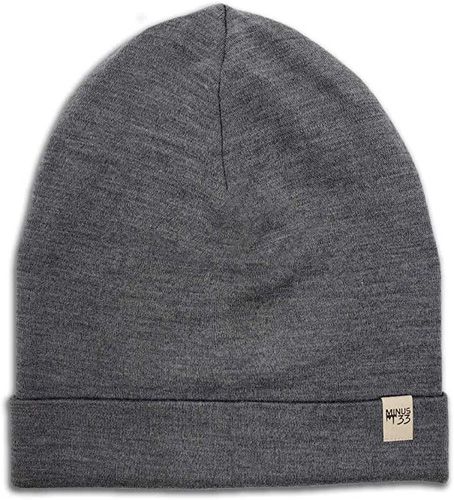
- MATERIAL: 100% merino wool
- WEIGHT: 2.4 oz / 68 g
- CONSTRUCTION: Double-layered
- FIT: Cuffed or uncuffed
- BEST FOR: Best all-round hiking beanie
The Minus33 Ridge Cuff Merino Wool Beanie remains my favourite all-rounder because it gets the balance between warmth, weight and breathability right. It is made from 100% merino wool, weighs only 68 grams and uses two layers of relatively lightweight fabric rather than one massive chunky knit.
One correction from the old version of this article is that I would not call this waterproof. Merino wool handles moisture very well and can still feel warm when damp, but rain will eventually pass through it. If I know I’m going to spend hours hiking in persistent rain, I either put my waterproof hood over the top or use an actual waterproof hat.
For normal cold-weather hiking, though, the Ridge is difficult to fault. I can unfold the cuff to create more coverage or double it back over my ears when it is particularly cold, and the fabric packs down small enough that I barely notice it in a jacket pocket.
Merino is also naturally good at managing sweat and odour, which matters on multi-day trips. I can wear this for significantly longer than a thick synthetic hat before it starts feeling horrible.
VERDICT: The Minus33 Ridge Cuff Beanie is still one of my favourite hiking hats because it is warm enough for proper winter walking without being so thick that I immediately need to take it off on the first climb. If I could only choose one beanie from this list, this is probably the one I would take.

Under Armour Storm ColdGear Infrared Beanie
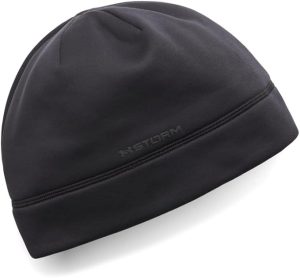
- MATERIAL: 100% polyester
- INSULATION: Brushed fleece with ColdGear Infrared
- WEATHER PROTECTION: UA Storm water-resistant treatment
- FIT: Close-fitting
- BEST FOR: Wet and windy winter hiking
The Under Armour Storm ColdGear Infrared Beanie is the current replacement for the old Elements 2.0 version I originally tested. The basic concept has survived because it makes sense: a soft fleece beanie with Under Armour’s water-resistant Storm treatment and its heat-retaining ColdGear Infrared lining.
This is a much better option than ordinary knitted wool if the weather is damp and windy. Again, water-resistant is not waterproof, but light rain beads off far better than it does on an untreated knitted beanie.
The brushed synthetic fleece is also very comfortable and dries quickly if I get sweaty. I prefer merino for long-distance use because of odour management, but if I’m heading out for a hard winter day hike where freezing wind and showers are more likely than several days without washing, the Under Armour works very well.
The fit is relatively streamlined, so it also works better underneath a hood than a big chunky cable-knit hat.
VERDICT: This is the beanie I would choose from the list if I expected cold wind and intermittent rain. The combination of fast-drying fleece, water resistance and a close fit makes much more sense for active winter hiking than some of the bulky fashion-orientated hats in the old article.
The North Face Jim Beanie
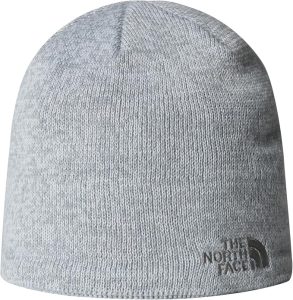
- MATERIAL: Recycled polyester/wool blend
- LINING: Recycled polyester fleece earband
- FIT: Classic fit
- BEST FOR: Fleece-lined hiking beanie
The North Face Jim Beanie replaces the old Bones Beanie from this guide. I liked the Bones because it was a straightforward medium-weight hat that worked well for hiking, but the Jim is a better current recommendation and still gives me the feature I actually want from a North Face winter beanie: a soft fleece band around the ears.
The body uses a blend of recycled polyester and wool, while the internal fleece headband gives extra insulation where I notice the cold most. That combination works well when walking because the crown isn’t buried under an unnecessarily thick layer of fleece.
I prefer this kind of partial lining to a completely fleece-lined chunky hat if I’m actually moving. My ears stay comfortable, but heat and moisture can escape more easily from the top of my head.
It isn’t a technical ultralight beanie, and it isn’t waterproof. It is just a comfortable, warm hat that crosses over nicely between hiking, camping and everyday winter use.
VERDICT: If you like the warmth of wool but find wool directly against your forehead irritating, the fleece band makes the Jim particularly comfortable. It is warmer than the BUFF and Arc’teryx Satoro-style lightweight options but still practical for hiking.
Smartwool Thermal Merino Reversible Cuffed Beanie
- MATERIAL: 100% merino wool
- CONSTRUCTION: Double-layered and reversible
- FIT: Cuffed, one size
- BEST FOR: Warm merino hiking beanie
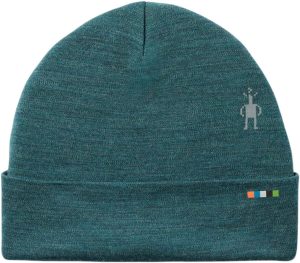
The Smartwool Thermal Merino Reversible Cuffed Beanie replaces the discontinued Patagonia Women’s Cable Beanie. I wanted to keep a proper warm wool hat in this position rather than replacing it with another generic synthetic beanie, and Smartwool makes much more sense for hiking.
It is 100% merino wool with a double-layer construction and a fold-up cuff, so it is noticeably warmer than something like the very thin BUFF further down. Despite that extra warmth, the merino manages moisture far better than a thick acrylic fashion beanie.
I particularly like the cuff on really cold mornings because I can double the material around my ears and then unfold or remove the hat once I warm up. The reversible construction also means there are no bulky internal seams rubbing against my head.
This is one I would choose when warmth is more important than absolute minimum weight. If I’m climbing hard all day in temperatures hovering well above freezing it can be too warm, but for colder hiking, camping and standing around at camp, it is excellent.
VERDICT: The Smartwool Thermal Merino is one of the best options here if you already know you like wool and want more insulation than the ultralight merino hats offer. The combination of double-layer merino and a proper cuff works particularly well in genuinely cold conditions.
BUFF Merino Lightweight Beanie
- MATERIAL: 100% merino wool
- FABRIC WEIGHT: 125 g/m²
- FIT: Slim, one size
- BEST FOR: Lightweight and high-output hiking
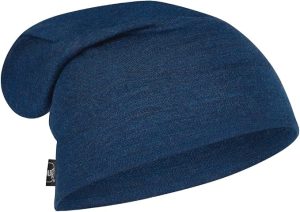
The BUFF Merino Lightweight Beanie replaces the old North Face Cable Minna because this is much closer to what I actually want when I’m working hard on a cold hike. It is made from 125 g/m² merino wool, which makes it one of the lightest and least bulky hats in this guide.
This isn’t the beanie I would choose for standing around at -10°C doing nothing. It is the one I choose when I know my body temperature is going to rise quickly once I start climbing.
The fabric fits close to the head, packs into almost no space and works extremely well underneath a hood or helmet. There isn’t a thick cuff or fleece lining, so you don’t get the same ear insulation as the Smartwool or North Face.
That lighter construction is the point. On steep winter hiking I find an extremely warm hat can become annoying very quickly because I am constantly taking it off and putting it back on.
VERDICT: The BUFF is my favourite ultralight option here. If your normal problem isn’t getting warm but staying warm without getting sweaty, this is exactly the kind of beanie I would look for.
Columbia Trail Shaker Omni-Heat Fleece Beanie
- MATERIAL: 100% polyester
- TECHNOLOGY: Omni-Heat Reflective lining
- FIT: Close-fitting fleece beanie
- BEST FOR: Warm synthetic hiking beanie
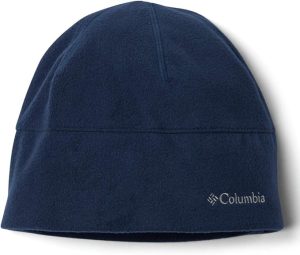
The Columbia Trail Shaker Omni-Heat Fleece Beanie is a better current Columbia choice for this guide than the Heat III. It is designed specifically for active winter use and combines soft polyester fleece with Columbia’s Omni-Heat Reflective lining.
The inside uses the familiar silver-dot pattern to reflect some radiant body heat back towards your head while the surrounding fabric remains breathable. I have always found this technology more useful than it looks; the dots seem a bit gimmicky at first, but they add warmth without requiring a massive amount of bulky insulation.
Because the entire hat is polyester, it dries quickly if I get sweaty and is easy to wash after a muddy winter hike. That makes it particularly useful for hard day hikes where I care more about fast drying and warmth than wearing the same hat for several days without washing it.
The fit is relatively low bulk, so it also works well beneath a jacket hood. It is warmer than the very lightweight BUFF but doesn’t feel like one of the enormous chunky knitted hats that become unbearable as soon as I start climbing.
VERDICT: The Columbia Trail Shaker is one of my favourite synthetic choices for cold-weather hiking. The fleece is warm, the Omni-Heat lining adds some extra heat retention, and it dries much faster than a heavy wool beanie when it gets damp.
Patagonia Brodeo Beanie
- MATERIAL: Recycled wool/recycled nylon blend
- WEIGHT: Approx. 82 g
- FIT: Shallow cuffed fit
- BEST FOR: Hiking and everyday winter use
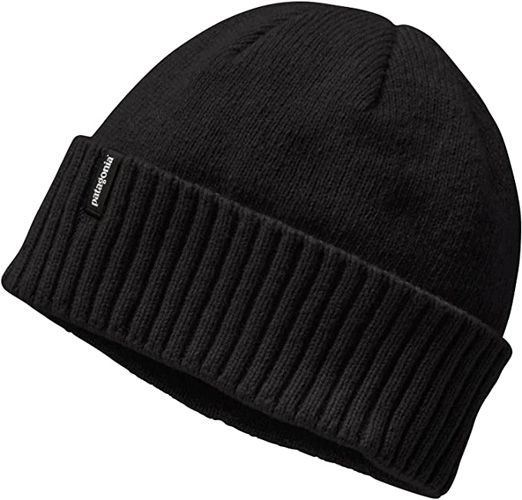
The Patagonia Brodeo Beanie was already in the old article, although I had somehow managed to call it the “Brodie.” The Brodeo is still current and remains a nice middle ground between a technical hiking hat and something I would happily wear all winter without looking like I’ve just stepped off a mountain.
The current version uses a warm recycled wool and recycled nylon blend with a 2.5-inch ribbed cuff. It weighs around 82 grams, so it isn’t particularly heavy, although the knitted construction feels more substantial than the lightweight BUFF.
One thing worth knowing is that Patagonia describes the Brodeo as having a relatively shallow fit that just skims the ears. If you want a beanie you can pull halfway down your neck in a blizzard, this isn’t it.
I like it most for normal cold-weather hiking, camping and travelling where I want decent warmth but don’t need a dedicated technical skull cap.
VERDICT: The Brodeo remains worth keeping in the guide because it is still current and does exactly what it always did well. It is warm, comfortable, made primarily from recycled materials and works just as well away from the trail.
Arc’teryx Bird Head Toque
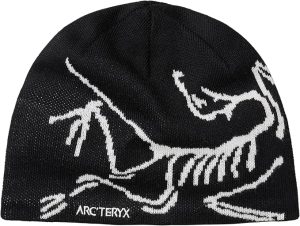
- MATERIAL: 50% merino wool, 50% recycled polyester
- LINING: Brushed polyester earband
- WEIGHT: Approx. 57 g / 2 oz
- BEST FOR: Premium lightweight winter beanie
The Arc’teryx Bird Head Toque replaces the discontinued Rolling Stripe Hat from the original list. It follows the same sort of formula I like for hiking: a relatively lightweight wool blend around the main part of the head with a soft fleece band around the ears.
The current version is a 50/50 blend of merino wool and recycled polyester and weighs around 57 grams. That puts it noticeably below most chunky winter hats while still giving you more insulation around the ears than a completely unlined merino skull cap.
I have always liked this style of Arc’teryx toque for active winter use because it doesn’t feel like a fashion hat pretending to be outdoor gear. It is breathable, folds down very small and fits easily underneath a jacket hood.
It is expensive for a beanie. You are paying partly for the materials and construction and partly because it says Arc’teryx on the side. Whether that bothers you is your decision.
VERDICT: The Bird Head Toque is one of the nicest premium hiking beanies here. The fleece earband, merino blend and 57-gram weight make it genuinely useful rather than simply expensive, although the Minus33 gives you excellent performance for considerably less money.
Icebreaker Cool-Lite Flexi Beanie
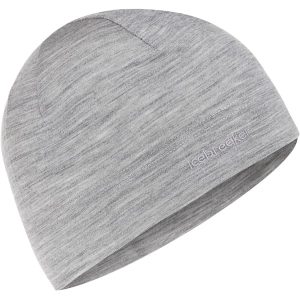
- MATERIAL: 60% TENCEL™ Lyocell, 40% merino wool
- FABRIC WEIGHT: 150 g/m²
- WEIGHT: Approx. 22 g
- FIT: Slim and close-fitting
- BEST FOR: Lightweight hiking and wearing under a helmet
The Icebreaker Cool-Lite™ Flexi Beanie is one of the lightest and most breathable hats in this guide. It uses Icebreaker’s Cool-Lite™ fabric, which combines soft merino wool with TENCEL™ Lyocell to create a thin, fast-drying fabric designed for active use.
At roughly 22 grams, this barely feels like carrying an extra item. I like that because a hiking beanie doesn’t always need to be a heavily insulated winter hat. On long climbs and high-output days, something this light can keep the chill off my ears without making my head feel like it is boiling.
The slim fit also makes it particularly good underneath a climbing, cycling or ski helmet. There is very little bulk and no thick folded cuff getting in the way, so it sits much more naturally under other headgear than a chunky knitted beanie.
The downside is obvious: this is not the hat I would choose for standing around camp in bitterly cold weather. It is thin and designed around breathability rather than maximum insulation. For active hiking, though, that can be exactly what you want.
The merino content also helps with odour resistance, while the TENCEL™ component improves moisture management and gives the fabric a very soft feel against the skin.
VERDICT: The Icebreaker Cool-Lite™ Flexi is one of my favourite choices for hikers who run hot. It is ultralight, breathable, packs almost flat and works brilliantly underneath a hood or helmet. If thick winter beanies always end up stuffed in your pocket halfway up the first climb, this is the kind of hat I would choose instead.
Outdoor Research Polartec 200 Beanie
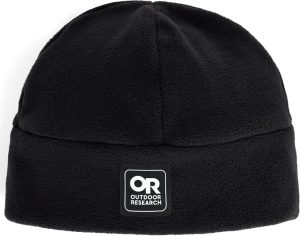
- MATERIAL: Recycled polyester fleece
- WEIGHT: Approx. 1.5 oz / 43 g
- FEATURES: Breathable, quick drying and wicking
- FIT: Low bulk and close fitting
- BEST FOR: High-output cold-weather hiking
The Outdoor Research Polartec 200 Beanie replaces the Gradient Hat from the old guide. I still like the Gradient, but it is being phased out through some retailers, while Outdoor Research now has much more technical fleece options that make better sense in a current hiking article.
The Polartec 200 weighs around 43 grams and is designed specifically as a low-bulk active beanie. The recycled synthetic fleece is warm, breathable, quick drying and wicks moisture far faster than a thick knitted wool hat.
This is the kind of hat I like when hiking hard in actual winter conditions. The fleece provides useful insulation, but the close fit means I can pull a hood or helmet straight over it without creating a giant lump on top of my head.
Synthetic fleece does pick up smells faster than merino in my experience, but for a day hike where I can wash the hat afterwards, that isn’t something I worry about.
VERDICT: The Outdoor Research Polartec is probably the most purely technical hiking beanie in the guide. It isn’t the one I would choose for sitting outside the pub in January, but for moving quickly through cold conditions it is excellent.

How to Choose a Beanie for Hiking
The best hiking beanie is not necessarily the warmest hat. If I am walking uphill with a backpack, my body produces a huge amount of heat and a heavily insulated beanie can become uncomfortable within minutes.
What I want is a hat that keeps my ears protected when the temperature drops but still breathes well enough that I don’t end up with sweat running down my forehead.
These are the main things I look for.
Merino Wool vs Synthetic Hiking Beanies
Merino wool is probably my favourite material for an all-round hiking beanie. It regulates temperature extremely well, manages moisture, remains comfortable when slightly damp and can be worn for several days without developing the same smell as most synthetics.
It is not waterproof, though. That is an important correction to several descriptions in the old version of this guide. Wool can absorb a surprising amount of water, and while it still performs better than many materials when damp, prolonged rain will eventually soak through.
Synthetic beanies made from polyester or fleece generally dry faster and can provide excellent warmth for their weight. They make a lot of sense for trail running, mountaineering and high-output winter hiking where sweat management matters more than wearing the same hat for a week.
I don’t think one is universally better. For backpacking I generally lean towards merino; for hard winter day hikes I am perfectly happy with either.
How Thick Should a Hiking Beanie Be?
For active hiking, I normally choose lightweight or medium-weight rather than the thickest possible hat.
A lightweight merino or fleece beanie is often enough once I’m moving, particularly if I also have a hood I can pull up when the wind gets nasty. A very thick hat is warmer while standing still but can quickly become irritating on climbs.
My rough preference is:
- Cool autumn/spring hiking: Lightweight merino or fleece
- Cold winter hiking: Midweight merino, fleece or lined wool
- Very cold but high-output hiking: Lightweight technical beanie underneath a hood
- Standing around camp: Thick cuffed or fleece-lined beanie
If I’m spending half the hike taking my hat off because I’m overheating, it isn’t the right hiking hat.
Ear Coverage
My ears are normally the first reason I reach for a beanie.
A cuffed hat gives you the most flexibility because you can double the fabric around the ears when it is freezing and then roll it higher once you warm up. That is one reason I like the Minus33 and Smartwool designs.
Some shallow fashion-style beanies only just skim the ears. They look good, but make sure that is actually what you want before ordering.
If you know you hate cold ears, choose something with a proper cuff or fleece earband.
Can You Wear a Beanie Under a Helmet?
Yes, but thinner is better.
If I am wearing a climbing, cycling or ski helmet, I want a close-fitting low-profile beanie with flat seams. The BUFF and Outdoor Research are much better for this than a thick cable-knit hat like the Coal Yukon.
I never force a helmet over a huge wool hat if it changes the fit or prevents the helmet sitting properly on my head.
Should a Hiking Beanie Be Waterproof?
Usually, no.
For most hiking I would rather have a highly breathable beanie underneath the hood of my waterproof jacket than a completely waterproof hat trapping sweat against my head.
A water-resistant treatment such as Under Armour Storm can be useful in showers because it delays the fabric becoming saturated.
If you expect prolonged rain without using a hood, then a genuinely waterproof beanie can make sense. Just understand that waterproofing and maximum breathability rarely go perfectly together.
Breathability
This is probably the most important feature once you start moving.
Cold air makes me want a thick hat when I’m standing beside the car, but ten minutes into a steep climb I can be producing enough heat that the same hat becomes ridiculous.
Merino works well because it regulates heat and moisture naturally. Lightweight fleece also performs brilliantly because damp air can escape and the synthetic fibres dry quickly.
If you run hot, I would choose the BUFF, Arc’teryx or Outdoor Research before something heavily lined.
Moisture Management
Even in freezing weather, your head can sweat.
A hiking beanie needs to move that moisture away from the skin rather than simply absorbing it until the entire hat is wet.
Merino can absorb moisture into the fibre while still feeling reasonably comfortable. Polyester absorbs very little water into the fibre itself and therefore tends to dry faster.
Both work. Cotton is the material I generally avoid for serious cold-weather hiking because once it becomes soaked it can feel cold and take a long time to dry.
Fit
A hiking beanie should stay on your head in wind without feeling like it is trying to compress your skull.
I like enough stretch to pull the hat properly over my ears, but I don’t want so much excess fabric that it bunches underneath my hood.
If you have particularly thick hair or a large head, check the manufacturer’s measurements instead of assuming “one size” genuinely means every human head on the planet.
Colour and Visibility
Most of the time I simply choose whatever colour I like.
There are situations where a brighter beanie has a practical advantage, though. If I am hiking somewhere hunting is taking place or travelling in a group where people can become spread out, a bright orange or yellow hat makes me much easier to spot.
Minus33 in particular sells the Ridge in a ridiculous number of colours, including high-visibility options.
Fleece-Lined vs Unlined Beanies
Fleece lining adds warmth and can make a wool hat far more comfortable if you find knitted wool itchy.
I particularly like hats that only use fleece around the ears rather than lining the entire crown. That gives me extra insulation where I want it without trapping as much heat on top of my head.
The North Face Jim and Arc’teryx Bird Head both use this basic idea.
Full fleece makes more sense if warmth is the overriding priority.
Do You Really Need a Beanie for Hiking?
Not on every hike.
If the weather is mild and I am moving continuously, a hood may be enough. But a beanie is so small and light that once temperatures start getting properly cold I nearly always carry one.
It becomes particularly valuable:
- At higher elevations
- In strong wind
- During rest stops
- At camp in the evening
- On exposed ridgelines
- When the temperature suddenly drops
A 40-70 gram hat is a very small penalty for something that can make such a noticeable difference to comfort.
What Is the Best Hiking Beanie?
For me, the Minus33 Ridge Cuff Merino Wool Beanie remains the best all-round choice because it is warm, light, breathable and easy to adjust by changing the cuff.
If I know I am going to be hiking very hard, I would choose the BUFF Merino Lightweight or Outdoor Research Polartec 200. For wet and windy weather I prefer the Under Armour Storm ColdGear Infrared, while the Smartwool Thermal Merino is the one I would choose when warmth matters more than minimum weight.
For something that works just as well around town as it does on the trail, I still like the Patagonia Brodeo.
I hope this guide to the best hiking beanies helps you find a hat that actually keeps your ears warm without making you overheat every time the trail starts going uphill.