

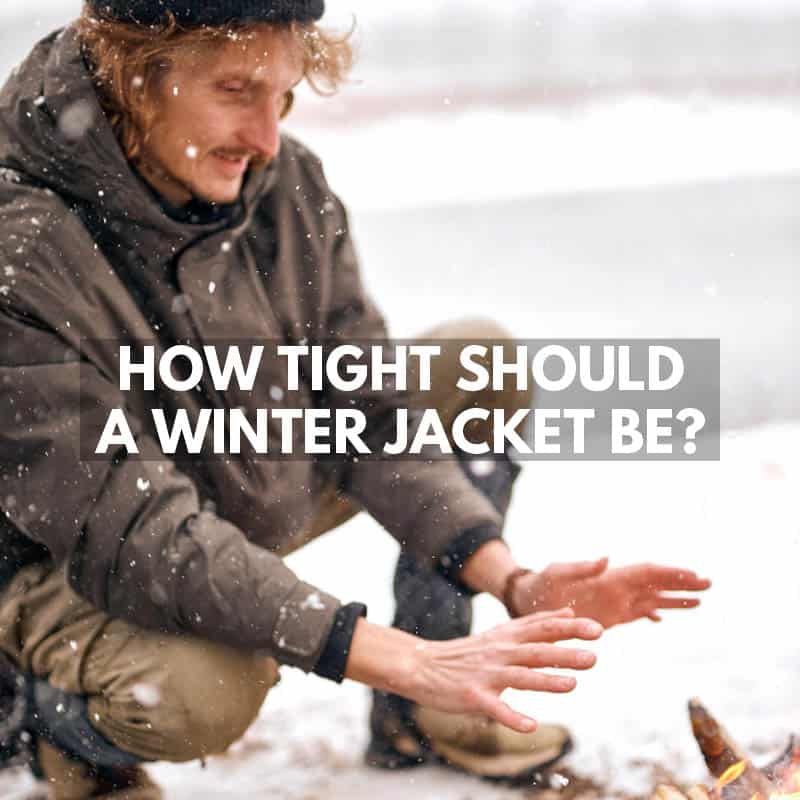
A winter jacket should feel comfortably snug, but never tight enough to restrict movement or squash the insulation. You should be able to zip it up easily, move your arms freely and still have room for the layers you realistically wear underneath. The ideal fit changes depending on whether you are buying a down jacket, parka, insulated shell or hardshell, so the best test is to try the jacket on with your normal winter layers and actually move around in it.
I have owned and tested a lot of winter jackets over the years, from slim-fitting down jackets to oversized parkas and heavy waterproof shells. The biggest mistake I see is people judging the fit while standing still in front of a mirror wearing only a T-shirt.
A winter jacket has to work when you reach overhead, bend down, wear a backpack, add a fleece underneath and actually move outside.
QUICK ANSWER
Too tight: The zip strains, insulation is visibly compressed, shoulders pull when you reach forward, sleeves ride up badly, or you can’t comfortably add your normal layers.
About right: The jacket sits close to your body, seals well at the cuffs/hem/neck, but still lets you move freely and wear the layers you actually use.
Too loose: Large gaps around the torso let warm air escape, excess fabric bunches under a backpack, or the jacket moves around rather than moving with you.
How Tight Should a Winter Jacket Be?
A winter jacket should generally be snug rather than tight.
You don’t want huge empty spaces inside because your body has to warm that extra air and cold drafts can move around more easily.
But tighter is not automatically warmer.
If a jacket is so tight that it compresses down or synthetic insulation, you can actually reduce the amount of loft available to trap warm air.
The right fit should let you:
- Zip the jacket up without pulling the two sides together.
- Raise both arms above your head without the hem exposing your stomach.
- Reach forward without strong pulling across your shoulders.
- Wear your normal base layer and midlayer underneath.
- Move your elbows, shoulders and torso normally.
- Close the collar without feeling pressure on your throat.
I would rather have a winter jacket that is slightly too roomy than genuinely too tight, especially if I intend to layer underneath it.
But I wouldn’t deliberately size up just because “winter jackets should be big”.
The correct size is the one that gives you enough room for your intended layering system without leaving unnecessary excess fabric everywhere else.
7 Tests to Check if a Winter Jacket Is Too Tight
These are the tests I actually use when trying on a jacket.
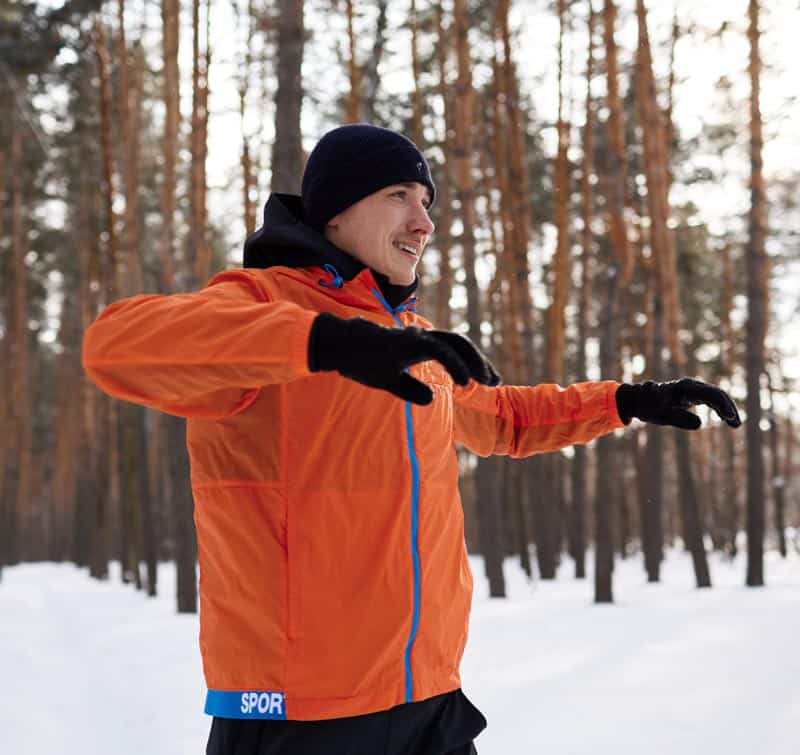
1. Check the Sleeves
Stretch your arms:
- Straight out in front
- Out to the sides
- Above your head
- Across your chest
Watch what happens at your wrists.
A well-cut outdoor jacket should let you move without the sleeves disappearing halfway up your forearms.
A small amount of movement is normal.
If several inches of wrist are suddenly exposed every time you reach overhead, either the sleeves are too short or the overall cut is too small for you.
Also pay attention to the elbows and forearms.
If the fabric feels stretched tightly across them when your arms are bent, try another size or a different jacket.
2. Check the Length
Stand normally and look where the hem sits.
A short technical jacket can legitimately finish around the hip, while a parka may extend well below it.
What matters is whether the jacket stays where it should when you move.
Raise both arms above your head.
If the hem shoots upwards and exposes your stomach or lower back, I would look for either:
- A larger size
- A longer cut
- Better articulation through the shoulders
I also use a cycling-style test.
Lean forwards, extend your arms as though you’re holding handlebars and check whether the rear hem still protects your lower back.
Then put a backpack on.
Some jackets that look perfect in a mirror immediately ride upwards once shoulder straps and a hipbelt are added.
3. Do the Hug Test
Wrap your arms around yourself as though giving yourself a hug.
This is one of the quickest ways to find a jacket that is too tight across the shoulders and upper back.
You should feel the fabric move with you.
If the jacket suddenly feels like it is pulling your arms backwards or the fabric across your shoulder blades becomes drum-tight, you need more room.
The armpits matter too.
If you can feel the jacket pinching underneath your arms when standing normally, I wouldn’t expect it to become more comfortable once you add winter layers.

4. Flex Your Back and Shoulders
Lift your elbows high and bring one elbow across the other.
You can also reach forwards as though grabbing something from a high shelf.
This puts more tension through the upper back than standing still.
A little tension is normal.
What I don’t want is a jacket that reaches a hard stopping point and starts restricting my movement.
Technical climbing and mountaineering jackets often perform particularly well here because the sleeves and shoulders are deliberately articulated for reaching overhead.
5. Adjust the Hem
Many winter jackets have a drawcord around the hem.
Use it.
The jacket itself may deliberately have some spare room around the waist so you can add layers.
The drawcord then lets you seal the lower opening and stop warm air escaping.
I prefer this to buying a jacket that is skin-tight around the waist.
Some technical shells have multiple adjustment points so you can tighten the hem without creating one huge bunch of fabric.
6. Zip the Collar and Hood Fully
Zip the jacket right to the top exactly as you would in bad weather.
Then move your head from side to side and tuck your chin down.
The collar should seal reasonably closely without pressing hard against your throat.
If you can’t comfortably move your neck or the zip is constantly pushing into your chin, the collar design may simply not suit you.
This is one area where trying a different model can work better than endlessly changing sizes.
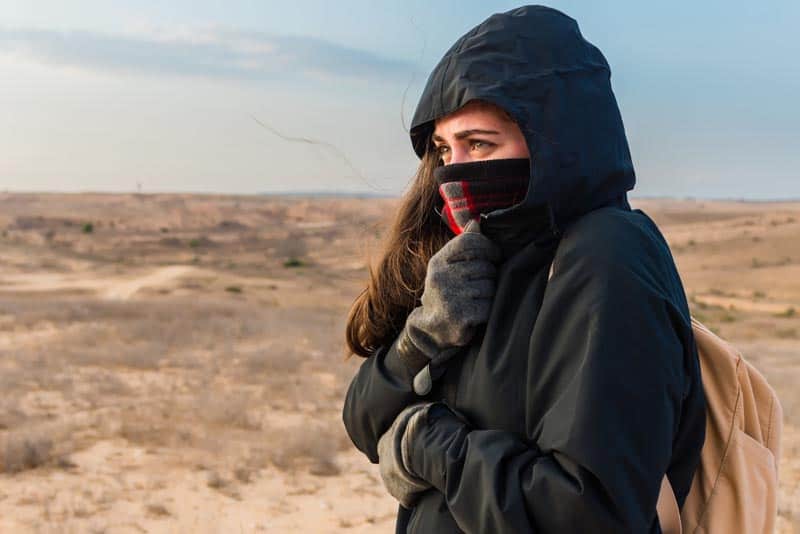
7. Zip It Up Over Your Actual Winter Layers
This is the most important test.
Don’t try on a winter jacket wearing a thin T-shirt if you intend to use it over:
- A base layer
- A fleece
- A light insulated midlayer
Bring the layers with you or wear something of similar thickness.
Zip the jacket fully.
If you have to suck your stomach in and pull both sides of the jacket together to start the zipper, it is too tight.
The zip should close easily without obvious strain across the chest or stomach.
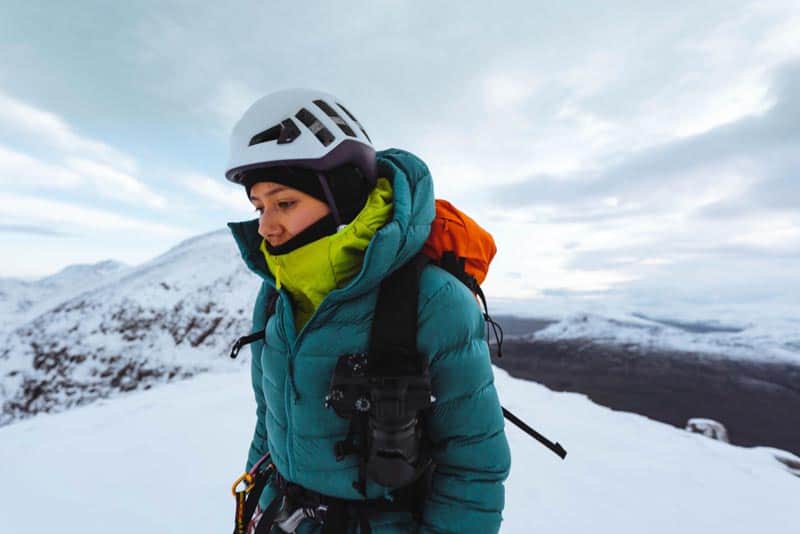
How Should Different Types of Winter Jackets Fit?
This is where the answer changes.
A slim down jacket and a long canvas parka shouldn’t fit the same way.
| Jacket Type | Ideal Fit | Main Reason |
| Down jacket | Close but not compressive | Preserve loft while reducing empty space |
| Synthetic puffer | Close to regular | Warmth without restricting movement |
| Insulated waterproof | Regular / slightly relaxed | Room for movement and moisture management |
| Parka | Relaxed | Length and bulky insulation need movement room |
| Hardshell | Enough room for intended layers | Designed to fit over insulation |
| Wool / canvas | Slightly relaxed | Less stretch than lightweight synthetics |
Down Winter Jackets
A down jacket should sit fairly close to your body without squeezing you.
The important distinction is close-fitting versus compressing the insulation.
Down keeps you warm because the lofted clusters trap air.
If a jacket is visibly stretched over your chest, shoulders or arms and the baffles are being flattened, it is too small.
At the same time, I don’t want a huge amount of empty space inside an ultralight down jacket.
Most of mine are fairly slim because I wear them over a base layer and fleece, then put a waterproof shell over the top when necessary.
The cuffs, hem and collar should fit especially well because those openings are where warm air escapes most easily.
Most down jackets are not designed to replace a waterproof shell, so make sure your layering system still works when everything is worn together.
Puffer Jackets
“Puffer jacket” is a broad term and can describe either down or synthetic insulation.
A big casual puffer can be designed as your outermost winter layer and may naturally have a roomier cut.
A lightweight technical puffer is often much slimmer because it is intended to work as part of a layering system.

The same rule still applies:
The insulation should be able to loft without the jacket feeling baggy.
If the baffles look stretched flat when you move your arms, size up.
Insulated Waterproof Jackets
An insulated waterproof jacket is normally an outer layer, so I prefer a slightly more relaxed fit.
You need enough room for whatever base and midlayers you expect to wear underneath.
You also don’t want the waterproof outer fabric stretched tightly against your body.
Even the most breathable waterproof membrane has limits, so having enough space to move naturally is useful.
Parka Jackets
Parkas are supposed to be roomier.
They are longer, often contain much more insulation and are usually designed as the final outer layer.
The upper body can still fit reasonably closely, but I want enough room through the hips and thighs to walk, sit and crouch without the whole jacket being pushed upwards.
Long parkas often use two-way front zips or side openings for exactly this reason.
Wool Jackets
How tight should a wool jacket be?
Usually a little looser than a lightweight synthetic insulated jacket.
Thick wool fabric doesn’t stretch or articulate in the same way as thin nylon.
If it is cut too tightly around your shoulders and elbows, movement quickly becomes restrictive.
The heavier and thicker the wool, the more room I generally want.

Waterproof Hardshell Jackets
A winter hardshell should be sized around the layers you intend to wear underneath it.
I would not automatically order one size larger.
Good technical shells are already designed with layering space built into their cut.
Try your normal size first while wearing your winter layers.
If it still moves freely and doesn’t compress the insulation underneath, that is the correct size.
If your shell is only ever worn over a T-shirt in the shop, you aren’t really testing the fit you will use outdoors.
For more on this style of jacket, see my guide to rain jackets vs ponchos.
Waxed Cotton and Canvas Jackets
Waxed cotton and canvas are less flexible than lightweight nylon.
That means I generally want slightly more room through the shoulders, elbows and torso.
If a waxed jacket is already tight when you’re standing upright, it can become surprisingly restrictive once you sit down, climb or reach forwards.
Should Winter Jackets Be Tight or Loose?
Neither.
The best winter jacket fit is close enough to eliminate unnecessary empty space but loose enough for full movement and your intended layers.
If I had to choose between two imperfect sizes, I would normally choose slightly loose rather than genuinely tight.
A slightly loose jacket can often be adjusted at the hem, cuffs and hood.
There isn’t much you can do with a jacket that physically doesn’t have enough room across your shoulders or chest.

How Much Room Should You Leave for Layering?
There isn’t a fixed rule like “you must be able to fit three layers underneath”.
It depends entirely on the jacket.
A huge insulated parka might only need to fit over a base layer and fleece because the parka itself provides most of the warmth.
A lightweight hardshell may need enough space for:
- A base layer
- A fleece
- A down or synthetic insulated jacket
Your base layer itself adds very little bulk.
The fleece and insulated layer are what normally determine whether your shell still fits properly.
My rule is simple:
Try the jacket with the thickest realistic combination you expect to wear underneath it.
If that setup works comfortably, you have enough layering room.
Can a Winter Jacket Be Too Loose?
Yes.
People sometimes assume a larger jacket must be warmer because it traps more air.
That isn’t automatically true.
If the jacket is dramatically oversized:
- Warm air can escape more easily through large openings.
- Cold air can circulate inside.
- The jacket can bunch under a backpack.
- The hood and collar may not seal properly.
- Excess fabric can interfere with movement.
A roomy parka is one thing.
Buying a technical insulated jacket two sizes too large is another.
How Can You Tell if a Down Jacket Is Too Tight?
Look at the baffles while you move.
If the insulation chambers remain nicely rounded and the jacket moves with you, the fit is probably fine.
Signs it is too tight include:
- Baffles visibly flattening across your chest or shoulders
- The zip pulling sideways
- Strong restriction when reaching forward
- Insulation being compressed by your midlayers
- The hem constantly riding upwards
A slim down jacket can still be perfectly warm.
A compressed one is different.
How Should a Winter Jacket Fit With a Backpack?
Always test this if you hike.
Put the backpack on and tighten the shoulder straps and hipbelt properly.
Then walk around and reach with your arms.
I check for:
- The jacket riding up underneath the hipbelt
- Fabric bunching badly underneath the shoulder straps
- The hood becoming difficult to use
- Restricted shoulder movement
- Pockets becoming inaccessible behind the hipbelt
A jacket can fit perfectly without a backpack and become annoying as soon as the pack is loaded.
Technical hiking and mountaineering jackets are often cut specifically to deal with this.
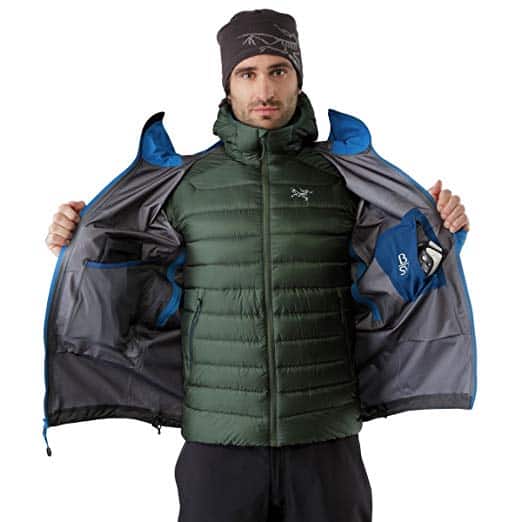
What Does a Slim-Fit Winter Jacket Mean?
A slim-fit jacket is designed to sit closer to your torso and arms.
That doesn’t automatically mean it should feel tight.
I own plenty of slim down and synthetic jackets because I personally prefer that style.
They work particularly well when I want to put a waterproof shell over the top without ending up with multiple bulky layers fighting each other.
The important thing is that a slim jacket still gives you full movement and doesn’t compress the insulation.
Parkas, heavy wool jackets and waxed cotton coats generally use a more relaxed cut because their fabrics and construction need more room.
How Should a Women’s Winter Jacket Fit?
The basic fit tests are exactly the same:
- Full shoulder movement
- Enough sleeve length
- Room for intended layers
- No pulling across the chest
- No excessive space around the waist and torso
The difference is that women’s jacket patterns normally add more shaping through the bust, waist and hips.
That can make choosing a size frustrating if one area fits perfectly and another doesn’t.
If the chest fits but the shoulders are huge — or the shoulders fit but the jacket pulls badly across the bust — I would try a different model rather than simply going up or down several sizes.
Different brands use very different patterns.
See my guide to the best women’s waterproof jackets for more examples.
Should You Size Up in a Winter Jacket?
Not automatically.
This is probably the most useful thing I would change from the original version of this guide.
Many good winter jackets and hardshells already include enough room for layering in their normal size.
Sizing up unnecessarily can leave you with overly long sleeves, a loose hood and lots of fabric around your torso.
Start with your normal size.
Then test it wearing the layers you genuinely expect to use.
Only size up if:
- Your layers are being compressed.
- You lose mobility.
- The jacket pulls across your chest or shoulders.
- You can’t comfortably zip it.
- The sleeves or hem become too short when you move.
My Final Fit Checklist
Before buying a winter jacket, I would do these seven things:
- Wear your normal winter layers underneath it.
- Zip it completely.
- Raise your arms above your head.
- Do the hug test.
- Bend forwards and crouch.
- Try the hood and collar fully closed.
- Put your backpack on if you will use one.
If the jacket passes all of those tests and still feels comfortably close to your body, the fit is probably right.
Final Verdict
A winter jacket should not be tight.
It should be close-fitting enough to trap warmth efficiently, but loose enough for your insulation to loft, your layers to fit and your body to move normally.
Down and lightweight synthetic jackets can fit fairly slim.
Parkas, wool jackets and heavy canvas coats usually need more room.
Hardshells should be sized around the insulation you expect to wear underneath.
The label on the jacket matters far less than the way it actually fits your body.
If you can zip it easily, move freely, wear your normal layers and still seal the neck, cuffs and hem properly, you have found the right size.
I hope this guide helps you work out how tight your winter jacket should be and choose a fit that actually works outside rather than just looking right in the changing room.






[…] an electric jacket heated by the battery, you would have to wear multiple layers of clothing underneath your winter jacket just to stay warm. People have been layering clothes to stay warm for thousands of years, it works […]