

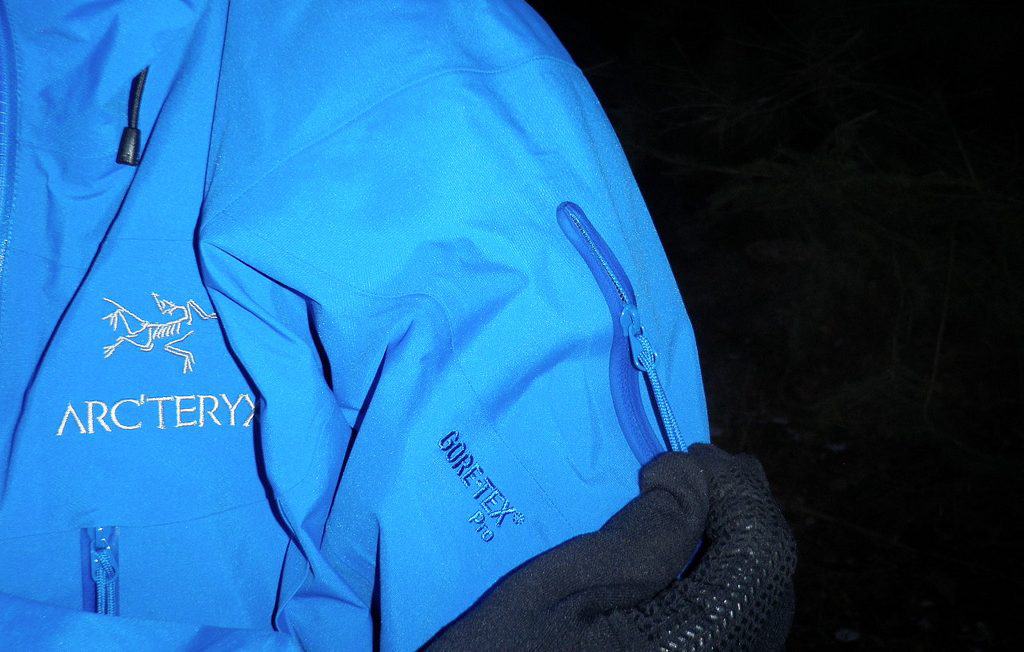
GORE-TEX and eVent are two of the best-known waterproof-breathable fabric technologies used in outdoor jackets, boots and equipment. I have used both over the years, including newer generations, and the simple answer is that neither is automatically “better”. GORE-TEX is usually my choice when durability, dependable weather protection and all-round performance matter most, while eVent can feel exceptionally breathable during high-output activity.
The comparison is more complicated than it used to be because both brands have changed their membrane technology substantially.
Older explanations of GORE-TEX vs eVent often boil the difference down to “GORE-TEX has a PU layer and eVent doesn’t”. That was useful shorthand years ago, but it is no longer an accurate way to describe the entire modern range.
GORE-TEX now uses both ePTFE and newer ePE membrane technologies depending on the product, while eVent has expanded beyond its classic Direct Venting membrane into newer PFAS-free technologies such as alpineST and plant-based stormST.
So rather than comparing two single fabrics, it makes more sense to compare the strengths of the two brands and then choose the specific laminate that suits what you’re doing.
| Feature | GORE-TEX | eVent |
| Waterproofing | Excellent | Excellent |
| Breathability | Very good; varies by laminate | Often excellent, especially classic air-permeable eVent |
| Durability | Excellent, especially GORE-TEX Pro | Very good; depends heavily on laminate and face fabric |
| Wind Protection | Totally windproof waterproof range | Windproof waterproof range |
| Maintenance | Regular washing and DWR care | Regular washing and DWR care |
| Best For | All-round use, harsh weather, durability | High-output activity and breathability |
What Is GORE-TEX?
GORE-TEX is not one single fabric.
It is a family of waterproof, windproof and breathable laminates built around an extremely thin membrane bonded to outer and inner textile layers.
For decades, GORE-TEX was most closely associated with expanded polytetrafluoroethylene, or ePTFE.
Modern GORE-TEX is more varied.
Many next-generation products now use an expanded polyethylene (ePE) membrane, which Gore introduced as a lighter, thinner membrane platform with a lower carbon footprint. Next-generation GORE-TEX Pro has also moved to ePE.
Other GORE-TEX products can still use ePTFE-based constructions, so if you are looking at an older jacket or a specific specialist product, don’t assume every piece of GORE-TEX clothing has exactly the same membrane inside it.
The important point for the person wearing it is simpler:
- The membrane provides the waterproof barrier.
- The laminate is designed to allow water vapour from sweat to escape.
- Seam tape prevents water entering through stitched seams.
- A DWR treatment on the outer fabric helps rain bead and roll off instead of soaking the face fabric.
GORE-TEX’s biggest strength has always been that the entire finished garment has to meet Gore’s performance requirements rather than a manufacturer simply buying some membrane and doing whatever it wants with it.
In my experience, that consistency is one of the reasons GORE-TEX remains the safe choice when I just want something I know is going to work.
What Is eVent?
eVent is another family of waterproof-breathable laminates.
The brand originally became famous for its Direct Venting technology.
Classic eVent waterproof membranes use microscopic pores and are air permeable, allowing heat and water vapour to move through the membrane without first relying entirely on a moisture-diffusion process.
That difference is why eVent gained such a strong reputation for breathability.
When I’m working hard uphill, particularly in mild or humid conditions, a good eVent shell can feel noticeably less clammy than some heavier waterproof shells.
But modern eVent is no longer just that one classic membrane.
The current range includes:
- eVent Waterproof – the classic high-breathability waterproof family.
- eVent alpineST – a durable PFAS-free waterproof laminate aimed at demanding conditions.
- eVent stormST – a PFAS-free plant-based membrane designed for waterproof and breathable protection.
- Other specialist waterproof, windproof, footwear and protective laminates.
So just as with GORE-TEX, the eVent logo alone doesn’t tell you everything about the exact construction.
GORE-TEX vs eVent: What Is the Main Difference?
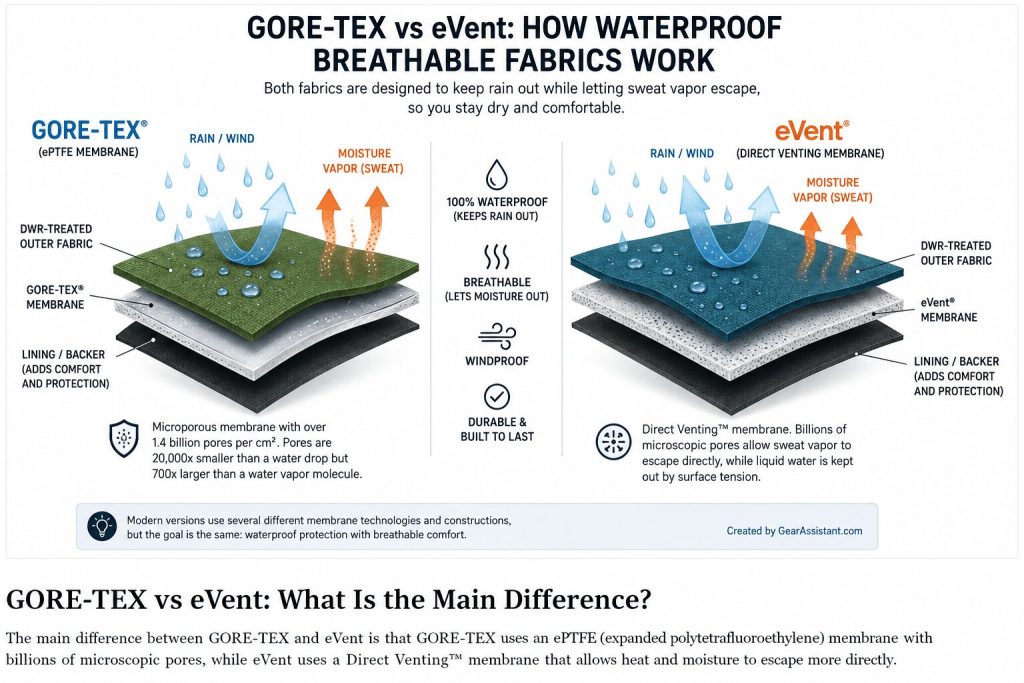
The traditional difference was membrane construction.
Classic GORE-TEX used a microporous ePTFE membrane with a protective polymer component, while classic eVent used an oleophobic treatment on its microporous membrane to allow more direct air and vapour movement through the material.
That distinction still helps explain why older eVent garments often feel unusually breathable.
But I wouldn’t use that explanation as a blanket description of every jacket being sold today.
GORE-TEX now has ePE technology.
eVent now has PFAS-free alpineST and plant-based stormST membranes alongside its more traditional Direct Venting products.
The face fabric, backer, membrane, number of laminate layers, DWR treatment, garment fit, vents and even the size of the jacket all affect how breathable the finished garment feels.
Which Is More Waterproof?
For normal outdoor use, I wouldn’t choose between GORE-TEX and eVent based purely on which membrane is supposedly “more waterproof”.
Both make properly waterproof laminates.
In the real world, the things that often determine whether you stay dry are:
- Seam construction and seam tape
- Hood design
- Zippers
- Cuffs
- Hem adjustment
- Whether the face fabric has wetted out
- Whether the jacket has been damaged
GORE-TEX does have one significant advantage in terms of confidence: the brand backs waterproof GORE-TEX products with its GUARANTEED TO KEEP YOU DRY promise and controls how approved finished products are constructed and tested.
For prolonged foul weather, mountaineering and situations where failure would really annoy me, I generally lean towards GORE-TEX Pro.
That isn’t because eVent can’t keep water out.
It is because I have consistently found rugged GORE-TEX shells to be a very dependable all-round package.
Which Is More Breathable?
This is where eVent has traditionally had the edge.
Classic eVent is air permeable, which can allow heat and moisture to escape quickly during strenuous activity.
In practical terms, I have found good eVent shells can feel very comfortable when I’m generating a lot of heat.
But there is no universal number that proves every eVent jacket breathes better than every GORE-TEX jacket.
A lightweight eVent shell and a heavyweight GORE-TEX Pro mountaineering shell are built for different jobs.
Likewise, a lightweight modern GORE-TEX laminate can feel dramatically more breathable than an old heavy three-layer jacket.
Garment design matters too.
A jacket with excellent pit zips can dump far more heat than any membrane can move through microscopic pores.
So my rule is:
If maximum breathability during high-output activity is my priority, I look closely at eVent. If I want the best balance of weather protection, durability and breathability, I tend to start with GORE-TEX.
Which Is More Durable?
I would give GORE-TEX the edge here, particularly at the rugged end of the range.
GORE-TEX Pro is specifically built for harsh conditions and abrasion-heavy use.
That doesn’t mean the membrane itself is magically indestructible.
Durability comes from the whole laminate, including the face fabric and backer.
A lightweight GORE-TEX hiking shell can still be less durable than a burly eVent mountaineering jacket.
But if I knew I was going to be scraping against rock, carrying a heavy backpack and wearing the jacket hard for years, GORE-TEX Pro would be one of my first choices.
eVent alpineST is now specifically aimed at the durable high-performance end of the market as well, so the gap is not as simple as it once was.
Does eVent Need More Washing Than GORE-TEX?

The old version of this guide said you may need to wash and re-waterproof eVent every four to six months.
I don’t think that is a useful rule.
Both GORE-TEX and eVent perform better when they are kept clean.
Body oils, sunscreen, dirt, smoke and other contamination can reduce breathability and interfere with the way a waterproof garment works.
The correct washing frequency depends on how often you use the jacket and how dirty it gets.
For both fabrics, I wash when the garment needs it rather than following an arbitrary calendar schedule.
Both brands also recommend maintaining the DWR treatment.
If water stops beading on the outside and starts soaking into the face fabric, the membrane underneath may still be waterproof, but the jacket can feel colder, heavier and much more clammy.
What Is DWR and Why Does It Matter?
DWR stands for Durable Water Repellent.
It is a treatment applied to the outside of most waterproof jackets to encourage rain to bead up and roll away.
This is separate from the waterproof membrane.
That distinction causes a lot of confusion.
If an old jacket suddenly starts looking dark and soaked on the outside, it doesn’t automatically mean the membrane is leaking.
Often the DWR has simply stopped working.
When the outer fabric becomes saturated — usually called wetting out — the membrane can still prevent rain passing through, but moisture vapour from inside escapes less effectively and the jacket starts feeling clammy.
That is why cleaning and restoring the DWR can make an old waterproof jacket feel dramatically better.
How to Wash GORE-TEX and eVent

Always follow the care label on the actual garment first.
For GORE-TEX outerwear, Gore currently recommends washing at around 40°C with a small amount of liquid detergent, avoiding fabric softener and bleach, and using appropriate drying/heat to reactivate DWR when the garment instructions allow it.
eVent similarly recommends warm washing at around 40°C, avoiding fabric softener and bleach, and low tumble drying to help rejuvenate the DWR.
The main difference I would pay attention to is the exact drying guidance printed on the individual garment.
I don’t assume every waterproof jacket can be treated identically just because the membrane brand is the same.
2-Layer vs 2.5-Layer vs 3-Layer Waterproof Jackets
A lot of people focus completely on the membrane brand and overlook laminate construction.
This can matter just as much.
2-Layer
The waterproof membrane is bonded to the outer fabric while a separate loose liner protects it from the inside.
These can be comfortable but are generally heavier and bulkier.
2.5-Layer
Instead of a full inner fabric, a thin printed or textured protective layer is applied to the membrane.
This saves weight and pack size.
These jackets are popular for hiking, backpacking and emergency rain shells, although they often feel less substantial against the skin.
3-Layer
The outer fabric, waterproof membrane and inner backer are laminated together.
This is what I prefer for hard use.
A good three-layer shell is normally tougher, feels more substantial and handles repeated backpack use better.
GORE-TEX Pro and eVent alpineST sit towards this serious-performance end of the market.
What Other Waterproof Fabrics Are There?
GORE-TEX and eVent aren’t the only options anymore.
There are now excellent proprietary and independent waterproof technologies including:
- Pertex Shield
- Polartec NeoShell
- Nikwax Analogy / Páramo
- Patagonia H2No
- The North Face DryVent
- Outdoor Research AscentShell
- Mountain Hardwear Dry.Q
The logo on the sleeve is only part of the story.
I would rather have a well-designed jacket using a slightly less famous membrane than a badly fitted jacket made from the technically “best” material.
Hood design, ventilation, cut, pockets and durability all matter once you’re actually outside.
GORE-TEX vs eVent for Hiking
For normal hiking, either can work extremely well.
If I was buying one jacket to use throughout the year, I would probably lean towards a good three-layer GORE-TEX shell because it is such a dependable all-round option.
If I knew I was going to be moving quickly, climbing steep ground and generating lots of heat, I would take a closer look at eVent because breathability becomes more important.
For summer backpacking where the jacket spends most of its life in my pack, I care much more about weight and packed size.
See GORE-TEX hiking jackets on Amazon.
GORE-TEX vs eVent for Mountaineering
For serious mountaineering, durability and weather protection become much more important.
This is where GORE-TEX Pro makes the most sense to me.
A proper Pro shell is designed to tolerate backpacks, harnesses, rock, snow and repeated use in nasty weather.
See GORE-TEX Pro shell jackets on Amazon.
I wouldn’t rule out a suitably rugged eVent jacket, particularly an alpineST shell, but I would judge the complete garment rather than selecting it purely because it says eVent.
GORE-TEX vs eVent for Running and Cycling
For running, fast hiking and cycling, I prioritise breathability much more heavily.
No waterproof membrane can magically keep you dry if you’re producing sweat faster than the garment can move moisture away.
That is why air permeability, mechanical ventilation and the ability to regulate temperature become so important.
This is traditionally where eVent has been strongest.
For high-output use, I would happily sacrifice a little bombproof durability for a shell that dumps heat more effectively.
GORE-TEX vs eVent for Lightweight and Packable Jackets
If packability matters, don’t automatically assume one membrane brand wins.
Look at the actual jacket.
Face-fabric denier, zipper size, hood construction and laminate type can change the packed size dramatically.
GORE-TEX has lightweight laminates specifically designed to reduce bulk, while eVent also appears in very light performance shells.
See lightweight GORE-TEX jackets on Amazon.
For an emergency shell that spends 90% of its life in my backpack, I would choose the lightest jacket that still has enough durability for the way I intend to use it.
Why Invest in a Good Waterproof Jacket?
A waterproof jacket isn’t just about being more comfortable in the rain.
If your insulating layers get soaked, their performance drops dramatically and you can lose heat quickly once you stop moving.
A decent shell protects the clothing underneath, blocks wind and gives you a much larger safety margin when the weather turns worse than expected.
That doesn’t mean everybody needs the most expensive GORE-TEX Pro jacket on the rack.
The best waterproof is the one that matches the conditions you actually use it in.
If you want some examples, see my guide to the best waterproof jackets for hiking.
Waterproof vs Water-Resistant Jackets
These terms are often used far too loosely.
A water-resistant jacket is designed to handle light rain or showers but isn’t necessarily built to keep water out indefinitely.
A proper waterproof shell normally combines:
- A waterproof membrane or coating
- Sealed or taped seams
- Weather-resistant zipper construction
- A DWR-treated outer fabric
A cheap water-resistant windbreaker can be perfect for a short shower.
It is not the same thing as a hardshell designed to spend hours in driving rain.
GORE-TEX vs eVent: Which Is Better?
If you forced me to choose one without knowing anything else about the jacket, I would choose GORE-TEX.
Not because it is automatically more breathable or because eVent isn’t waterproof.
I would choose it because GORE-TEX has an enormous range of proven products, excellent quality control, very strong waterproof performance and some of the toughest laminates available.
But there are situations where I would rather wear eVent.
For high-output activity where overheating and sweat are my biggest problems, the breathability and air permeability of a good eVent shell can be a real advantage.
My rough breakdown is:
- Best all-rounder: GORE-TEX
- Best for maximum ruggedness: GORE-TEX Pro
- Best for high-output breathability: eVent
- Best lightweight option: Depends on the actual jacket
- Best waterproofing: Both are excellent when properly constructed and maintained
The biggest change since I first wrote this comparison is that the technology has moved on.
Modern GORE-TEX is no longer simply the old ePTFE membrane everyone remembers, and modern eVent is no longer one single Direct Venting membrane either.
I have used upgraded versions of both and still wouldn’t shop by the membrane logo alone.
I start with what I’m actually doing, then choose the jacket construction that fits that job.
If you want to go deeper into waterproof outdoor gear, you can also read my guide to the best dry bags.




[…] WATERPROOF: First and foremost is how much rain it can take. You can get a rough idea of this by looking for a hydrostatic head rating in the linked product listings. Things to look for beyond the materials are; sealed seams, waterproof zips, adjustable hood, and a good fit. For more information on waterproof fabrics scroll down the page or check out this article comparing GORE-TEX and eVent side by side. […]