
7 Best Tent Carpets For Camping and RV Awnings in 2026


Best Tent Carpets for Camping and RV Awnings
A tent carpet is one of those completely unnecessary camping accessories that becomes surprisingly difficult to give up once you have used one. It makes a large tent feel warmer, cleaner and far more comfortable, especially when you can take your boots off and walk around in socks instead of directly on a cold tent floor.
I have used several different types of flooring in tents and RV awnings, and my favourites are still:
- Woven polypropylene outdoor mats
- Plastic straw-style camping rugs
- Foam tiles when insulation matters most
They all solve slightly different problems.
For a big family tent or RV awning, I generally prefer woven polypropylene because it is durable, easy to clean and doesn’t hold much water.
For maximum comfort inside a tent, a carpet-style mat with a waterproof backing feels much nicer under bare feet.
And if the ground is genuinely cold, interlocking EVA foam provides much more insulation than a thin carpet ever will.
QUICK PICKS
Best overall: CGEAR Original Sand-Free Camping Mat
Most comfortable: Drymate Tent Carpet Mat
Warmest tent floor: ProsourceFit EVA Foam Tiles
Best lightweight outdoor rug: SAND MINE Reversible Mat
Best for muddy porch areas: Artificial Grass Turf
Best for large RV awnings: EEZ RV Outdoor Patio Mat
Best for bell tents: nuLOOM Wynn Round Rug
7 Best Tent Carpets
CGEAR Original Sand-Free Camping Mat
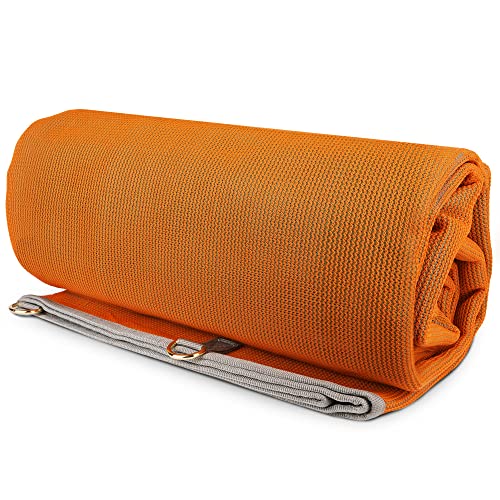
- MATERIAL: Woven synthetic mesh
- BEST FOR: Best all-round tent and awning mat
The CGEAR Original Sand-Free Camping Mat is still my favourite type of all-round camping floor.
What makes it different from a conventional carpet is the open woven structure.
Small particles such as:
- Sand
- Dust
- Fine dirt
can fall through the mat rather than sitting permanently on the surface.
That is particularly useful around:
- Beach camps
- Canvas tents
- RV awnings
- Large family tents
where people are constantly walking in and out.
The material doesn’t absorb water like a normal household carpet either.
If it gets wet, I can shake it out and let it dry rather than carrying around a giant wet sponge.
Another feature I like is the reinforced attachment points around the edges.
If I am using a mat outside an awning or tent, being able to peg it down stops corners lifting in the wind.
VERDICT: If I could only have one tent carpet for both indoor and outdoor use, I would choose this type of woven camping mat. It is tough, easy to maintain and much more practical around dirt and sand than a conventional carpet.

Drymate Tent Carpet Mat
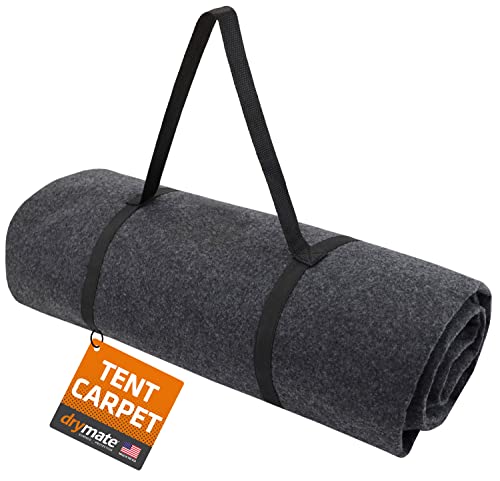
- MATERIAL: Polyester surface with waterproof backing
- BEST FOR: Most comfortable tent carpet
The Drymate Tent Carpet Mat is the option I would choose if I wanted the inside of my tent to actually feel carpeted.
The top has a soft textile surface while underneath is a waterproof backing.
That gives it two important advantages.
The top feels warm and comfortable under bare feet or socks.
The bottom prevents moisture underneath the mat from simply soaking straight through.
That makes it particularly good for large family tents where the living area is used almost like a temporary room.
You can:
- Sit on it
- Let children play on it
- Walk around in socks
- Put sleeping gear on it
without everything feeling like it is sitting directly on cold plastic.
I particularly like the fact that this material can be trimmed to fit awkward tent shapes.
The downside is exactly what you would expect.
It is heavier and bulkier than a woven polypropylene camping mat.
And if the textile surface becomes thoroughly wet from above, it takes longer to dry.
VERDICT: If comfort matters more than minimum packed size, the Drymate is one of the nicest tent flooring options. It feels much more like a real carpet than most outdoor mats.
ProsourceFit 1/2-Inch EVA Puzzle Exercise Mat
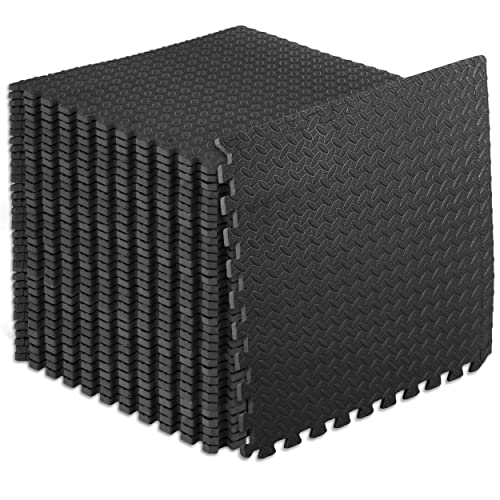
- MATERIAL: High-density EVA foam
- THICKNESS: Approximately 1/2 inch
- BEST FOR: Tent floor insulation and cushioning
The ProsourceFit Puzzle Mat isn’t actually designed as camping equipment.
It just happens to work extremely well as tent flooring.
Each tile is approximately:
24 x 24 x 1/2 inches.
The EVA foam creates a much more substantial barrier between you and the ground than a thin carpet.
That makes these excellent when the priorities are:
- Warmth
- Cushioning
- Children playing on the floor
- Making a large family tent feel comfortable
The tiles interlock like a jigsaw.
You can therefore cover:
- The entire tent
- Only the living area
- A section underneath a sleeping area
without carrying more than you need.
They are also water resistant and extremely easy to wipe clean.
The main problem is bulk.
A large stack of 24-inch foam squares takes up plenty of boot space.
I wouldn’t even consider carrying them backpacking.
For car camping, however, the packed bulk matters much less.
VERDICT: EVA puzzle mats are probably the best option in this guide if your priority is making a cold, hard tent floor warmer and softer.
SAND MINE Reversible Plastic Straw Rug
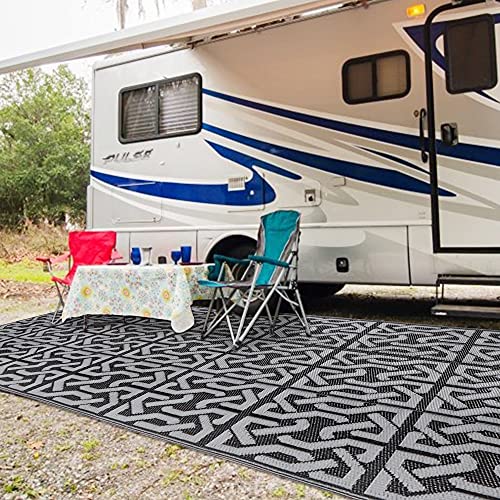
- MATERIAL: Woven polypropylene
- BEST FOR: Lightweight large camping rug
The SAND MINE Reversible Mat is representative of the large woven plastic outdoor rugs that have become extremely popular around RVs and campsites.
I originally chose this particular one because it had strong reviews, but there are now countless similar mats.
The concept is more important than the logo.
Woven polypropylene is very well suited to camping because it is:
- Lightweight for its size
- Water resistant
- Quick drying
- Easy to hose clean
- Resistant to mould compared with absorbent carpet
The patterns also make a campsite feel much less utilitarian.
Inside a big tent it creates a proper living area.
Outside an RV it gives you somewhere clean to:
- Put chairs
- Take shoes off
- Let children sit
- Keep muddy gear away from the vehicle
One correction I would make to my original description:
The woven mat itself is not a solid waterproof groundsheet.
Water can work through the weave.
That is actually useful outdoors because rain doesn’t necessarily pool on top.
If I need a genuinely waterproof barrier underneath me, I use a proper groundsheet or footprint.
VERDICT: These woven plastic mats are probably the best combination of size, weight, durability and price for large camping areas.
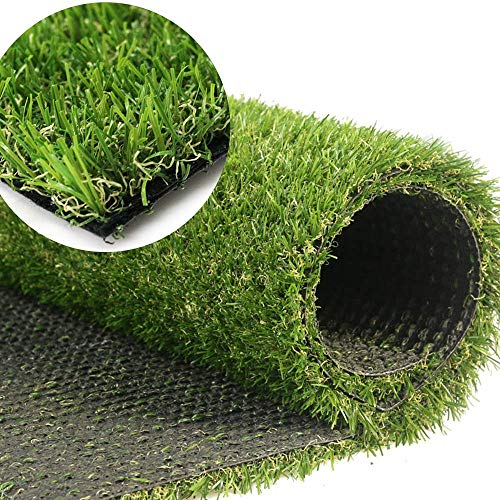
GL Artificial Grass Turf Indoor/Outdoor Mat
- MATERIAL: Synthetic grass pile
- BEST FOR: Muddy porch and awning areas
The GL Artificial Grass Turf is the strange one in this guide.
It isn’t a conventional tent carpet.
But it actually works surprisingly well.
I particularly like artificial turf in the porch area of a big tent.
That gives you somewhere to take off muddy boots before stepping onto the cleaner flooring inside.
The synthetic pile keeps your feet raised above small amounts of:
- Mud
- Damp grass
- Surface water
and it is tough enough that I don’t worry about walking over it in outdoor footwear.
It also feels surprisingly nice underfoot.
The disadvantages are bulk and cleaning.
Mud can work its way down between the plastic fibres, so cleaning it can require more than simply shaking it.
I normally hose artificial grass down and leave it to dry.
VERDICT: Artificial turf is not the most practical carpet for covering an entire tent floor, but it makes an excellent hard-wearing entrance or porch mat.
EEZ RV Heavy Duty Outdoor Patio Mat
- MATERIAL: Woven polypropylene
- BEST FOR: Large tents and RV awnings
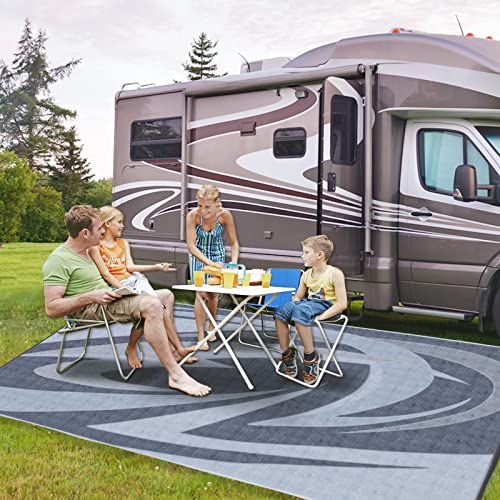
The EEZ RV Outdoor Patio Mat is aimed primarily at RV owners, but the same design works brilliantly with big tents.
It makes most sense for:
- Tunnel tents
- Canvas wall tents
- Large awnings
- Communal camping shelters
The rectangular shape gives you a huge usable floor area.
Like the SAND MINE mat, the woven polypropylene doesn’t behave like a normal absorbent household carpet.
It is far easier to deal with when wet or muddy.
Once the trip is over, I can:
- Shake it.
- Hose it down if necessary.
- Let it dry.
- Fold it away.
The material is also surprisingly light considering the amount of ground it covers.
Again, I wouldn’t describe the weave itself as a waterproof sheet.
Its advantage outdoors is that water can drain rather than becoming trapped on top.
VERDICT: If you need to cover a huge RV awning or family-tent living area, this type of large woven mat makes far more sense than trying to use a conventional carpet.
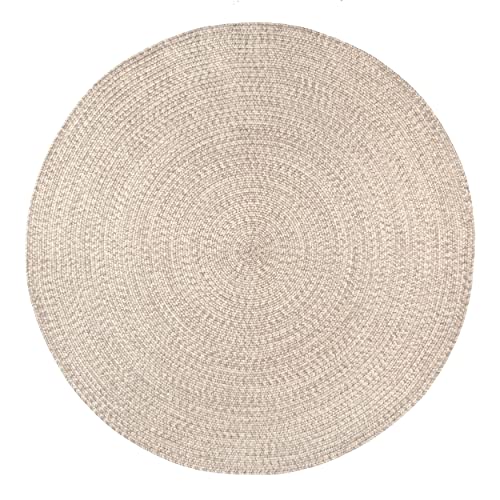
nuLOOM Wynn Braided Indoor/Outdoor Round Area Rug
- MATERIAL: 100% polypropylene
- CONSTRUCTION: Braided
- THICKNESS: Approximately 0.3 inches
- BEST FOR: Bell tents and circular shelters
The nuLOOM Wynn Braided Indoor/Outdoor Rug is still a current product and is available in round sizes as well as rectangular, square, oval and runner versions. :contentReference[oaicite:1]{index=1}
I particularly like the round version for a canvas bell tent.
Bell tents are awkward to carpet with rectangular rugs.
You end up:
- Folding corners
- Leaving strange gaps
- Overlapping several mats
A round rug solves that immediately.
I don’t necessarily want it right against the tent walls either.
Leaving bare flooring around the perimeter gives me somewhere to put:
- Boots
- Wet backpacks
- Firewood
- Dirty gear
while keeping the middle of the tent comfortable.
The Wynn is made from polypropylene and nuLOOM says it can be hosed down outdoors for cleaning. :contentReference[oaicite:2]{index=2}
The downside compared with a thin camping mat is that this is much more like a proper rug.
It is therefore bulkier.
VERDICT: For making a bell tent or tipi-style shelter feel genuinely homely, a circular outdoor rug like the Wynn is hard to beat.
Types of Tent Carpets and Camping Floor Mats
There isn’t one single material that works best everywhere.
The choice mainly comes down to whether you prioritise:
- Comfort
- Insulation
- Low weight
- Easy cleaning
- Outdoor durability
Woven Polypropylene Camping Mats
These are my favourite general-purpose option.
They are usually made from strips of polypropylene woven into a large reversible mat.
The main benefits are:
- Very durable
- Light for their size
- Don’t absorb much water
- Easy to hose clean
- Quick drying
- Available in enormous sizes
They work particularly well in RV awnings and outside large tents.
The downside is comfort.
They are much nicer than bare ground but don’t provide much cushioning.
Plastic Straw Rugs
“Plastic straw mat” is really another description for many of the woven polypropylene rugs above.
They are normally thinner and more flexible than true outdoor carpet.
This makes them:
- Easy to fold
- Easy to carry
- Inexpensive
- Quick drying
If I wanted a massive tent floor covering without filling half the car boot, this is where I would start.
Polyester Carpet Mats
Polyester mats feel much more like normal carpet.
That makes them excellent inside tents where everyone takes their shoes off.
Models with waterproof backing can prevent moisture underneath from reaching the upper carpet surface.
They also provide more warmth and comfort than thin woven mats.
The trade-off is drying time.
If you spill water onto the textile side or pack it away wet, it takes more effort to dry properly.
EVA Foam Tiles
Current ProsourceFit 1/2-inch tiles are made from high-density EVA foam, with each tile around 24 x 24 inches. The company describes them as water-resistant, cushioned and easy to disassemble. :contentReference[oaicite:3]{index=3}
They provide far more cushioning and insulation than thin carpets.
I like them for:
- Children
- Cold campsites
- Long stays
- Sleeping areas
Their weakness is packed volume.
Coir Tent Carpets

Traditional coir matting is made from coconut fibres.
It looks fantastic inside:
- Bell tents
- Yurts
- Tipis
- Glamping shelters
and creates a much more natural interior than synthetic plastic flooring.
I wouldn’t choose it for normal weekend camping though.
It is heavier, bulkier and slower to dry than polypropylene.
For a semi-permanent bell tent, however, the look can be worth it.
Artificial Grass
Artificial grass works best for me as transition flooring.
I use it somewhere dirty footwear is likely to be worn rather than as my main living-room carpet.
It is extremely durable and the pile keeps feet slightly above wet ground.
Its disadvantages are:
- Bulk
- Weight
- Dirt becoming trapped in the pile
What Is the Best Material for a Tent Carpet?
For most camping:
Woven polypropylene.
It gives the best combination of:
- Durability
- Low moisture absorption
- Packability
- Weight
- Easy cleaning
For maximum comfort:
Polyester carpet with waterproof backing.
For maximum insulation:
EVA foam.
For bell tents:
A proper outdoor rug or coir mat.
There isn’t one material that wins everything.

Does a Tent Carpet Keep You Warmer?
A little.
But don’t confuse a thin carpet with proper sleeping insulation.
Any layer between you and cold ground helps reduce the cold feeling underfoot.
Thicker materials such as:
- EVA foam
- Thick carpet
- Coir
make a more noticeable difference than thin polypropylene.
But if I am sleeping on the floor, my sleeping pad is still doing almost all the important insulation.
A tent carpet is comfort flooring, not a substitute for an insulated sleeping mat.
Should a Tent Carpet Be Waterproof?
Not necessarily.
If the tent already has a proper waterproof bathtub floor, the carpet doesn’t need to provide a second waterproof barrier.
In that situation I often prefer a breathable or draining woven mat.
For floorless shelters and awnings, the situation is different.
If I specifically need to prevent moisture rising from wet ground, I use:
- A waterproof groundsheet
- A tent footprint
- A carpet with waterproof backing
A woven outdoor rug isn’t the same thing as a tarp.
See my guide to using a tarp under a tent if ground moisture is the main problem.
Tent Carpet vs Tent Footprint
These do different jobs.
A tent footprint goes underneath the tent.
Its main purposes are:
- Protecting the tent floor
- Keeping mud away from the tent
- Adding another barrier against wet ground
A tent carpet normally goes inside.
Its job is:
- Comfort
- Cleanliness
- A little extra insulation
- Making the tent feel more like a living space
Using both makes sense on longer car-camping trips.
How Thick Should a Tent Carpet Be?
There isn’t a perfect thickness.
For simple floor coverage, thin woven polypropylene is enough.
For comfort, I want something more substantial.
For cold ground, 1/2-inch EVA foam makes a much more noticeable difference.
The thicker you go, the more space the flooring takes up when packed.
That is the main trade-off.
How Big Should a Tent Carpet Be?
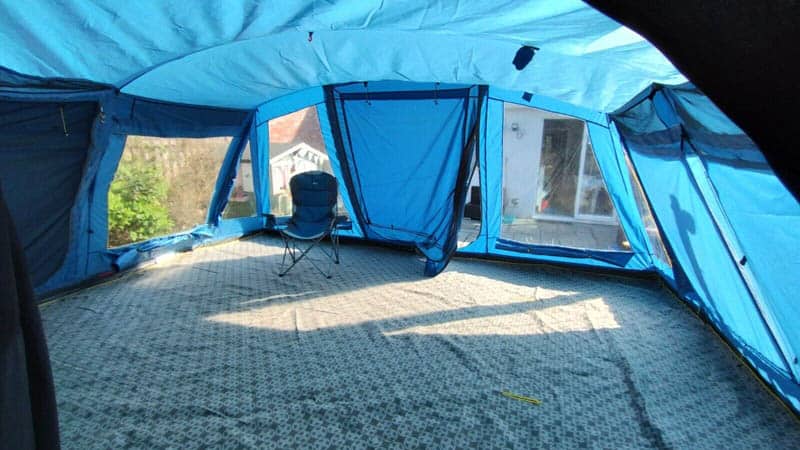
For an integrated-floor tent, I like the carpet slightly smaller than the usable floor.
I don’t want it:
- Folding up the walls
- Blocking doors
- Creating large wrinkles
If it doesn’t fit exactly, leaving a small gap around the edge is better than bunching excess carpet against the tent wall.
For floorless shelters, make sure the carpet doesn’t extend outside the shelter where rain can run onto it.
Can You Cut a Tent Carpet to Size?
Some can be cut easily.
EVA foam is particularly easy.
Many backed polyester mats can also be trimmed.
Woven rugs are different.
Cutting through a woven edge can cause fraying or unraveling unless you seal or bind it properly afterwards.
I therefore wouldn’t automatically cut every mat simply because it is slightly oversized.
Check how the edges are constructed first.
Are Tent Carpets Worth It?
For backpacking:
Usually no.
I wouldn’t carry a huge carpet into the hills.
For car camping:
Absolutely.
The weight and bulk barely matter when the car is twenty metres away.
And the improvement in comfort inside a large tent can be enormous.
This becomes even more noticeable when:
- Camping with children
- Camping for several nights
- Camping in cold weather
- Spending lots of time inside because it is raining
A carpet turns the tent into a living area instead of just a fabric shelter.
Best Tent Carpet for a Bell Tent
I like round rugs.
The shape makes much more sense than fighting with rectangular carpet inside a circular shelter.
The nuLOOM Wynn is useful because the current range includes multiple round sizes as well as other shapes, and the manufacturer confirms the rug is made from 100% polypropylene and designed for indoor/outdoor use. :contentReference[oaicite:4]{index=4}
Coir is another excellent choice if you want a more traditional glamping look.
Best Tent Carpet for an RV Awning
For RVs I prefer a large woven polypropylene mat.
The priorities here are slightly different from inside a sleeping tent.
I want something that:
- Can take shoes
- Handles mud
- Drains
- Can be hosed clean
- Folds reasonably flat
The EEZ RV and SAND MINE styles are both much better suited to that job than a conventional carpet.
Best Tent Carpet for Cold Weather
EVA foam wins.
A thin woven mat makes the floor feel nicer but provides very little meaningful insulation.
Half-inch foam physically puts a much thicker layer between you and the cold floor.
For a cold family camping trip, I would happily use:
Tent floor → EVA foam → thin carpet/rug
if I had enough room in the car.
That gives you both insulation and a nicer surface.
How to Clean a Tent Carpet
The cleaning method depends on the material.
For woven polypropylene:
- Shake out loose dirt.
- Hose it down.
- Use mild soap if needed.
- Allow it to dry completely.
For EVA foam:
- Wipe with warm soapy water.
- Rinse or wipe again.
- Allow it to air dry.
For textile carpet:
- Vacuum or shake first.
- Spot clean.
- Avoid saturating it unless the manufacturer allows washing.
- Dry it thoroughly before storage.

Never Store a Tent Carpet Wet
This is probably the most important maintenance rule.
If the trip ends in rain, I don’t worry about packing everything perfectly.
I get home first.
Then I unpack the carpet and dry it properly.
Leaving damp camping flooring rolled or folded for weeks can lead to:
- Mould
- Mildew
- Bad smells
- Staining
even with synthetic materials.
Do Tent Carpets Damage Grass?
They can.
Anything covering grass for long enough reduces:
- Light
- Airflow
- Evaporation
A breathable woven mat is generally kinder to grass than completely sealing it beneath an impermeable sheet, but any flooring left down for a long period can flatten or discolour the grass.
On campsites, follow whatever rules they have about awning groundsheets and mats.
My Favourite Tent Flooring Setup
For a normal large family tent with a sewn-in floor:
Woven or carpet-style mat directly inside the living area.
For a cold-weather family tent:
EVA foam underneath + carpet on top.
For an RV awning:
Large woven polypropylene mat.
For a bell tent:
Round outdoor rug.
For a muddy entrance:
Small artificial-grass or heavy-duty outdoor mat.
There isn’t really a reason to force one type of carpet to do every job.
Final Verdict
A tent carpet is absolutely a luxury.
But for car camping, it is a very worthwhile one.
The best all-round material for me remains woven polypropylene because it is:
- Tough
- Light
- Easy to clean
- Quick drying
- Available in large sizes
If comfort is the priority, I prefer something like the Drymate.
If warmth matters most, EVA foam beats all of them.
And if I am setting up a bell tent or glamping shelter, I would forget the ultralight mentality completely and put down a proper round outdoor rug.
The important thing is matching the flooring to the way you camp rather than simply buying the thickest carpet you can fit in the car.
I hope this updated guide helps you choose the best tent carpet for camping, family tents and RV awnings.




[…] you have a large tent and are camping with a group during a bad patch of weather, the addition of a tent carpet can really help to improve the internal comfort of a tent. Instead of the cold and glossy finish of […]