I have been using the DD Hammocks Tarp 3 x 3 for years in all four seasons, and it is still one of the most useful pieces of camping gear I own. I originally used it mainly for wild camping and hammock trips, including the Coast to Coast, but I now also regularly rig it from the side of my car as an awning when car camping. Despite years of tensioning, bad weather and repeated pitching, all the reinforced attachment points are still intact and going strong.
That longevity is probably the biggest compliment I can give it. I have owned lighter tarps and more specialist shelters, but the DD 3×3 is the one that keeps finding its way back into my camping kit because it is tough, waterproof and ridiculously versatile.
It isn’t particularly ultralight at 790 grams, and there are now lighter DD tarps if minimum pack weight is your priority. But for wild camping, hammock camping, bushcraft, festivals, car camping and general shelter-building, I still think the standard DD Tarp 3 x 3 is one of the best all-round tarps you can buy.
LONG-TERM VERDICT
Rating: 9/10
Best for: Wild camping, hammock camping, bushcraft and car-camping awnings
Biggest strength: Durability and 19 attachment points
Biggest weakness: Heavier than modern ultralight tarps
Would I buy it again? Yes
DD Hammocks Tarp 3 x 3 Review
The DD Tarp 3 x 3 has been around for years, which in this case is a good thing. DD hasn’t needed to reinvent the basic design because a square three-metre tarp with loads of reinforced attachment points is incredibly useful.
I’ve used mine as a straightforward A-frame shelter, over a hammock, as a lean-to, at music festivals and as general weather protection around camp. More recently I’ve been using it attached to the side of my car as a large improvised awning when car camping, which has probably made me appreciate the 3 x 3 metre size even more.
A lot of gear gradually becomes redundant as the way you camp changes. What I like about this tarp is that the opposite has happened. I might switch between tents, hammocks, sleeping pads and different cooking setups, but I keep finding another job for the DD tarp.
DD Hammocks currently still sells the original Tarp 3×3, and the fundamental specifications remain very close to the tarp I’ve been using for years.
Current DD Tarp 3 x 3 Specifications
- SIZE: 3 m x 3 m / 9.8 x 9.8 ft
- WEIGHT: 790 g / 27.9 oz excluding pegs and guy lines
- PACKED SIZE: Approx. 26 x 20 x 6 cm
- MATERIAL: 190T polyester
- WATERPROOFING: PU coating rated to 3,000 mm
- SEAMS: Taped central seam
- ATTACHMENT POINTS: 19 reinforced loops
- ATTACHMENT LAYOUT: 16 around the edges and corners plus 3 along the centre ridgeline
- UV PROTECTION: UV50+
- INCLUDED: 4 pegs, 4 guy lines and stuff sack
The packed dimensions DD publishes today are slightly larger than some of the older specifications that appeared with my original tarp, but the weight, material, waterproof rating and 19-point attachment layout are essentially the same.

Long-Term Durability
Durability is where this review has become much more useful with age. When I first wrote about the tarp, I thought it felt tough. Years later I can actually say that it has proved it.
Every one of the attachment points on my tarp is still intact and going strong. That includes the perimeter loops I regularly put under tension as well as the centre ridgeline points. None has ripped out or started separating from the surrounding fabric despite the tarp being repeatedly pitched, packed, stretched and used in bad weather.
I’ve never been particularly precious with it either. It has been used for wild camping, taken on the Coast to Coast, brought to festivals and thrown into camping bags rather than carefully folded into perfect little squares.
The only real damage on mine is a handful of small holes caused by sparks getting too close when I’ve had a fire nearby. Those are entirely down to me rather than the tarp failing. Polyester tarps and fire don’t make good friends, so I now give it far more clearance from sparks and naked flames.
For a piece of fabric shelter that has spent this long outdoors, the overall condition is remarkably good.
The 19 Attachment Points Are the Best Feature
This is still the feature that separates the DD 3×3 from basic rectangular camping tarps.
You get 16 reinforced attachment points around the edges and corners and another three running along the middle. That gives you enough options to create everything from a simple roof to surprisingly enclosed shelters.
More importantly, those extra points let me alter a pitch when the campsite doesn’t cooperate. I might arrive intending to build a perfect A-frame and discover that the trees are in completely the wrong place. Instead of fighting the campsite, I can move a guy line to another loop and improvise something else.
After years of using the tarp, I value those loops even more than I did when it was new because they are what make it genuinely multipurpose.
Using the DD Tarp 3 x 3 for Wild Camping
This is still one of my favourite uses for it.
For solo wild camping, 3 x 3 metres gives me plenty of space for myself and my equipment without getting into the territory of carrying a massive group tarp. I can create an open shelter in calm weather or pitch it much lower when wind and rain are expected.
My default setup is still some variation of an A-frame when the location allows it. A ridgeline between trees is the easiest option, but two hiking poles work well when there aren’t suitable trees available.
If neither is possible, I use whatever sensible anchor points the campsite provides and make a lean-to or lower shelter instead. The whole point of carrying a tarp rather than a fixed-shape tent is being able to adapt it to the ground you’re given.
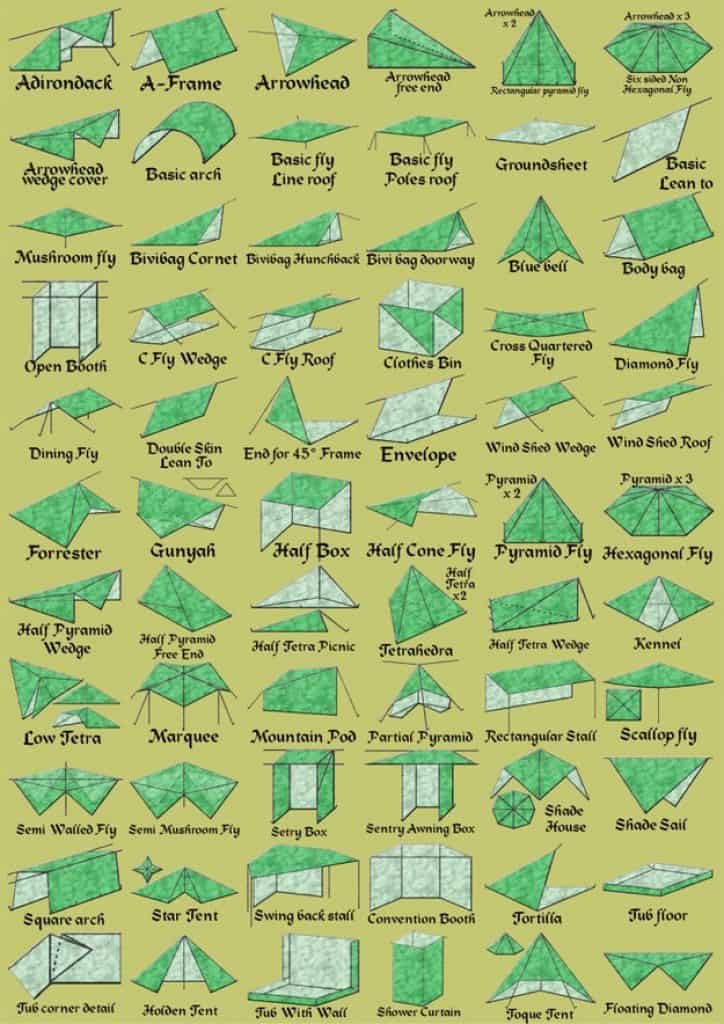
Different ways to pitch a camping tarp
Using the DD Tarp 3 x 3 as a Car Awning
This has become one of my favourite uses for the tarp and wasn’t something I was doing when I originally reviewed it.
When I’m car camping, I now use the DD 3×3 as an improvised awning from the side of the vehicle. The three-metre width creates a genuinely useful covered area rather than the tiny porch you get from some small camping shelters, and the multiple loops make it easy to adapt the pitch depending on where I can secure it.
The exact way I rig it depends on the car and the campsite. I’ll normally secure one side close to the vehicle and support the outer edge with poles and guy lines, creating a sloping roof so rain runs away instead of pooling in the fabric.
It gives me a dry area for chairs, boots, equipment and general camp life without bringing a dedicated awning. If the weather changes or I want to use the tarp for something else, I still have a normal 3 x 3 metre shelter rather than a piece of equipment that only works attached to a vehicle.
DD now actually makes a dedicated Campervan Tarp with awning-rail beading, but I haven’t felt the need to replace my standard 3×3 just for car camping. The normal tarp is less specialised, which is exactly why I continue using it for so many different jobs.
Setting Up the DD Tarp 3 x 3
Once you’ve used a tarp several times, setup becomes very quick. The first few attempts can take longer because you spend half the time deciding which configuration makes most sense, but an ordinary A-frame or lean-to is straightforward.
For a basic A-frame, I run a ridgeline between two trees or support the ridgeline with hiking poles, position the tarp over it and then guy the corners out. I normally use more than the four included guy lines because the tarp gives you far more attachment options than the supplied kit takes advantage of.
The important thing is getting useful tension across the fabric. A floppy tarp is noisier in wind, provides less usable space and is much more likely to collect rainwater. You don’t need to tension it like you’re trying to tear it in half, but I want the panels reasonably taut rather than sagging.
Waterproofing
My tarp has been consistently waterproof throughout the years I’ve owned it. DD currently rates the same 190T polyester fabric to a 3,000 mm hydrostatic head with a taped central seam, which is plenty for the kind of rain protection I expect from a camping tarp.

I haven’t needed to constantly retreat or reproof mine to keep it functioning. I may have treated it once during its life, but waterproofing simply hasn’t been something I’ve had to think about very often.
Pitch angle makes a huge difference. If I leave a wide section of tarp almost horizontal, water can pool regardless of how waterproof the fabric is. Give it a sensible slope and enough tension and rain runs straight off.
The central seam has also held up well. I’ve never had an ongoing leak develop along it, which is impressive considering how long the tarp has been repeatedly tensioned and packed away.
Size and Coverage
Three metres square is still my favourite general-purpose tarp size.
Nine square metres sounds enormous when you’re carrying it in a backpack, but once you start creating angled shelter walls the usable covered area reduces quickly. For one person it feels luxurious, while two people can comfortably shelter beneath it with equipment.
I’ve had considerably more people underneath it when using it as a basic overhead group shelter, although I wouldn’t describe it as a comfortable six-person sleeping shelter. For overnight use, I think one person plus gear or two people is where the size really works.
The square shape is also important. A square tarp gives me much more freedom than a highly shaped hammock rainfly because I can rotate it, fold sections, build symmetrical pitches or use the diagonal when I want maximum ridgeline length.
Using It Over a Hammock
The DD 3×3 is still an excellent hammock tarp and DD itself continues to recommend it for regular-sized hammocks.
A simple A-frame works perfectly well, but pitching the square tarp diagonally creates a longer covered ridgeline and gives more protection around the ends of the hammock.
The three attachment loops along the centre are particularly useful here. I can suspend the tarp along a ridgeline without having to rely solely on the four corners, which makes positioning it over the hammock much easier.
If hammock camping were my only use, I might consider one of DD’s lighter or more specialised shelters. The reason I still prefer the standard 3×3 is that I can take the hammock down the next morning and use exactly the same tarp as a lunch shelter, ground setup or car awning.
Weight and Pack Size
At 790 grams without the pegs and guy lines, nobody is going to mistake this for an ultralight tarp in 2026.
DD’s current SuperLight Tarp is almost the same size at 3 x 2.9 metres but weighs only 490 grams, saving roughly 300 grams. If I were building a genuinely lightweight backpacking kit and knew I only needed a tarp as shelter, that difference would be worth considering.
The reason I haven’t retired my standard 3×3 is durability and versatility. The 190T polyester feels substantial enough that I don’t worry every time I drag it around a rough campsite, and after all these years the tie-out points have proved they can take repeated use.
The current packed-size specification is approximately 26 x 20 x 6 cm. In reality I rarely worry about getting it into a perfectly neat manufacturer’s rectangle. I stuff or loosely fold it into the bag along with extra cordage and get on with packing.

DD Tarp 3×3 vs DD SuperLight Tarp
If I were choosing between these two today, the decision would mostly come down to how much I cared about saving 300 grams.
The standard DD Tarp 3×3 weighs 790 grams, measures a true 3 x 3 metres and uses 190T polyester. The SuperLight is 3 x 2.9 metres, weighs 490 grams and uses much lighter ripstop nylon. Both currently have a 3,000 mm waterproof coating and 19 reinforced attachment points.
For long-distance backpacking, I’d take the weight saving seriously. For bushcraft, wild camping where I’m not counting every gram, festivals and car camping, I still prefer the reassuring feel of the standard tarp.
The fact my attachment points are still intact after years of repeated use makes it difficult for me to argue with the heavier fabric.
DD Tarp 3×3 vs DD Tarp 3×3 PRO
DD now also sells a 3×3 PRO. The standard tarp has 19 attachment points, while the current PRO increases this to 21 and adds metal eyelets, attachment buckles and guy-line storage loops. The PRO weighs 875 grams compared with 790 grams for the normal version.
The PRO gives you even more elaborate setup possibilities, especially if you want to connect tarps or use poles directly through eyelets. It looks like a useful evolution of the design, but I wouldn’t replace a perfectly good standard 3×3 solely to gain those features.
The original’s simplicity is part of its appeal. Nineteen attachment points already give me far more configurations than I regularly use.
Wind Performance
The tarp itself has handled strong wind very well, but tarp performance in wind depends enormously on how you pitch it.
A high open-sided awning catches far more wind than a low A-frame. If conditions are rough, I drop the profile, use more attachment points and make sure the main load is spread through several properly anchored guy lines.
This is another area where the durability of my tie-out points has impressed me. They have spent years taking the loads generated by windy pitches and I still haven’t pulled one out.
I wouldn’t take that as permission to wildly overtension the tarp. A good pitch spreads the load instead of relying on one corner to hold everything together.
Fire and Spark Damage
The only meaningful damage to my tarp has come from sparks from campfires.
A few sparks have landed on the polyester over the years and created small holes. They haven’t stopped me using it, but they are a good reminder that a waterproof synthetic tarp is not something you want hanging close to flames.
I still enjoy having a fire when I’m camping where it is permitted and sensible, but I give the tarp much more clearance than I did when I first started using it. Wind can carry sparks surprisingly far and one unlucky ember is enough to melt a small hole straight through synthetic fabric.
DD itself recommends keeping its tarps away from fires and naked flames.
What I Like About the DD Tarp 3 x 3
- Extremely durable in my long-term use
- All 19 of my attachment points are still intact
- Excellent 3 x 3 metre all-purpose size
- Loads of different pitching configurations
- Reliable waterproofing
- Works brilliantly for hammock and ground camping
- Useful as a car-camping awning
- Simple square shape
- Strong enough that I don’t feel precious about it
- Still the same basic product DD sells today
What I Don’t Like
- 790 grams is heavy compared with modern ultralight tarps
- The four supplied guy lines don’t really exploit all 19 attachment points
- Polyester can easily be damaged by campfire sparks
- A tarp takes more practice to pitch well than a conventional tent
- No bug protection when used as a standalone shelter
Who Is the DD Tarp 3 x 3 Best For?
I would recommend the standard DD 3×3 most strongly to wild campers, hammock campers and bushcraft users who care more about durability and versatility than shaving every possible gram from a backpack.
It also makes much more sense for car camping than I originally realised. If you already carry hiking poles and some cord, the tarp can become a large awning beside the car without taking up anything like the space of a conventional drive-away awning.
If you’re exclusively doing long-distance lightweight backpacking, I’d probably look at the DD SuperLight instead. If you’re mainly car camping and want something permanently attached to an awning rail, a purpose-built vehicle awning will be easier.
For someone like me who wants one tarp that keeps finding new jobs, the standard 3×3 is difficult to beat.
Is the DD Tarp 3 x 3 Still Worth Buying?
Yes.
This review originally started as my opinion of a relatively new piece of gear. At this point it has become a long-term durability test, and that makes my recommendation stronger rather than weaker.
I am still using the same DD Tarp 3 x 3 for wild camping, and I now use it regularly as an awning beside my car when car camping. The waterproofing has remained reliable, the fabric is still perfectly usable apart from a few spark holes, and most importantly all of the reinforced tie-out points are intact and still going strong.
There are lighter tarps now. There are fancier tarps with buckles and eyelets. But I already own a square piece of waterproof fabric that has survived years of abuse and can become almost whatever shelter I need it to be.
That is exactly what I want from a tarp.
Where to Buy the DD Tarp 3 x 3
You can still buy the standard model directly from DD Hammocks:
View the DD Hammocks Tarp 3 x 3
Thanks for reading my DD Hammocks Tarp 3 x 3 review. After all these years, this is still one of those rare bits of camping kit I have no reason to retire.