10 Best Nuts for Hiking That Give You Energy


Best Nuts for Hiking
Nuts are one of my favourite hiking foods because they pack a huge amount of energy into very little weight, require no preparation and are easy to eat while walking. If your priority is maximum calories per gram, macadamias and pecans come out on top. If you want more protein, peanuts and pistachios are better choices. In practice, I normally mix several types together with dried fruit and a little chocolate.
The original reason I made this comparison was simple:
Which nuts actually give you the most useful hiking fuel for the weight you carry?
That matters when everything in your backpack has to earn its place.
Most nuts provide roughly 550-720 calories per 100 g, largely because they contain a lot of fat.
That makes them far more calorie-dense than most fresh foods.
But there are significant differences between them.
QUICK ANSWER
Most calories: Macadamias — around 718 kcal per 100 g.
Most protein: Peanuts — around 26 g per 100 g.
My best all-round trail mix nuts: Peanuts, almonds, cashews, walnuts and macadamias.
Best budget choice: Peanuts.
One to eat in moderation: Brazil nuts because they contain unusually high levels of selenium.
Best Nuts for Hiking Compared
The figures below are for approximately 100 g of raw edible nuts without shells.
| Nut | Calories | Protein | Best For |
|---|---|---|---|
| Macadamias | 718 kcal | 7.9 g | Maximum calories |
| Pecans | 691 kcal | 9.2 g | High-energy trail mix |
| Pine nuts | 673 kcal | 13.7 g | High calories, good in meals |
| Brazil nuts | 659 kcal | 14.3 g | Small amounts in trail mix |
| Walnuts | 654 kcal | 15.2 g | High-energy mixed nuts |
| Hazelnuts | 628 kcal | 15.0 g | Energy and flavour |
| Almonds | 579 kcal | 21.2 g | Excellent all-rounder |
| Peanuts | 567 kcal | 26.0 g | Protein and value |
| Pistachios | 560 kcal | 20.2 g | Protein and snacking |
| Cashews | 553 kcal | 18.2 g | Taste and trail mix |
The exact figures vary slightly between varieties, roasting methods and nutrition databases.
The important comparison is the overall pattern.
Macadamias give you enormous calories for their weight, while peanuts give you considerably more protein.
For hiking, I like combining both approaches rather than trying to find one perfect nut.
Why Are Nuts So Good for Hiking?
Nuts tick almost every box I want from trail food.
They are:
- Calorie dense
- Compact
- Easy to pack
- Easy to eat while walking
- Rich in fats
- A useful source of protein
- Far less fragile than most fresh foods
The biggest advantage is calories per gram.
If I am carrying all my food on my back, 100 g of food providing 600-700 calories is incredibly efficient.
Compare that with fresh fruit, which contains lots of water and therefore provides relatively few calories for its weight.
That doesn’t mean I want to live on nuts.
But as one part of a hiking diet they are extremely useful.
1. Macadamia Nuts

- ENERGY: Approximately 718 kcal per 100 g
- PROTEIN: Approximately 7.9 g per 100 g
- FAT: Approximately 75.8 g per 100 g
If your only goal were getting as many calories as possible into a lightweight food bag, macadamias would be difficult to beat.
They contain around 718 calories per 100 g.
That is an extraordinary amount of energy from something you can pour into a pocket-sized container.
The reason is fat.
Macadamias contain more fat than any of the other nuts in this comparison.
That makes them particularly appealing for:
- Long-distance hiking
- Backpacking
- Expedition food
- Cold-weather trips where calorie requirements are high
The downside is protein.
At roughly 7.9 g per 100 g, macadamias are one of the lowest-protein options here.
They are also expensive.
So rather than making a trail mix consisting entirely of macadamias, I normally combine them with cheaper and higher-protein nuts.

2. Pecans

- ENERGY: Approximately 691 kcal per 100 g
- PROTEIN: Approximately 9.2 g per 100 g
- FAT: Approximately 72 g per 100 g
Pecans are another brilliant option when calories per gram matter.
They contain nearly as much fat as macadamias and around 691 calories per 100 g.
They also taste excellent mixed with:
- Dark chocolate
- Raisins
- Dried cranberries
- Peanuts
I particularly like pecans in homemade trail mix because their softer, buttery texture makes a nice change from harder nuts like almonds.
The downside is that pecans can crush fairly easily in a packed food bag.
That isn’t much of a problem if they are already mixed with everything else.
3. Pine Nuts

- ENERGY: Approximately 673 kcal per 100 g
- PROTEIN: Approximately 13.7 g per 100 g
Pine nuts are technically seeds rather than true nuts, but they make sense in this comparison because nutritionally and practically they work in much the same way.
One important correction from my original article:
Pine nuts do not contain 31.1 g of protein per 100 g.
A more representative figure for raw pine nuts is around 13.7 g per 100 g.
They are still extremely calorie dense at roughly 673 kcal per 100 g.
I don’t normally eat handfuls of pine nuts on their own.
They are expensive and small.
Where I really like them is in backpacking meals.
They can be added to:
- Pasta
- Couscous
- Salads
- Pesto
- Savoury trail mixes
without much preparation.
4. Brazil Nuts

- ENERGY: Approximately 659 kcal per 100 g
- PROTEIN: Approximately 14.3 g per 100 g
Brazil nuts provide lots of calories and a decent amount of protein.
But they are very different from the other nuts here because of their extraordinarily high selenium content.
The US National Institutes of Health says an individual Brazil nut may contain roughly 68-91 micrograms of selenium.
That means I would not sit eating enormous handfuls of Brazil nuts all day simply because they are calorie dense.
A small number mixed in with other nuts is plenty.
For trail mix I might include a few Brazil nuts alongside:
- Peanuts
- Almonds
- Cashews
- Walnuts
rather than making them the main ingredient.
5. Walnuts
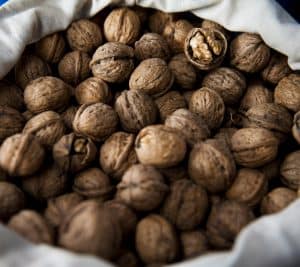
- ENERGY: Approximately 654 kcal per 100 g
- PROTEIN: Approximately 15.2 g per 100 g
Walnuts are another excellent high-energy trail food.
They contain a lot of polyunsaturated fat and are particularly well known as a plant source of alpha-linolenic acid, or ALA.
From a hiking point of view, I mainly like them because they taste good and provide roughly 654 calories per 100 g.
They work brilliantly with dried fruit.
My only complaint is that walnuts are softer and more fragile than almonds or peanuts.
After a few days stuffed inside a backpack, you may end up with walnut pieces rather than beautiful halves.
That makes absolutely no difference to me.
They taste the same.
6. Hazelnuts

- ENERGY: Approximately 628 kcal per 100 g
- PROTEIN: Approximately 15 g per 100 g
Hazelnuts are another very calorie-efficient option.
They provide around 628 calories and 15 g of protein per 100 g.
I particularly like them mixed with chocolate.
There is an obvious reason chocolate and hazelnuts appear together in so many foods.
The combination tastes brilliant.
Hazelnuts are also reasonably tough and hold up well inside trail mix without disintegrating.
7. Almonds

- ENERGY: Approximately 579 kcal per 100 g
- PROTEIN: Approximately 21.2 g per 100 g
Almonds are probably the best all-rounder on this list.
They don’t have the enormous calorie count of macadamias, but they combine:
- Good calorie density
- High protein
- Good durability
- Wide availability
- Reasonable price
They also survive being thrown around inside a backpack better than many softer nuts.
If I were making a big batch of trail mix, almonds would almost always be included.
I particularly like lightly salted almonds when I have been sweating all day.
8. Peanuts

- ENERGY: Approximately 567 kcal per 100 g
- PROTEIN: Approximately 26 g per 100 g
Peanuts are technically legumes rather than tree nuts.
I don’t care.
For hiking food they are brilliant.
They offer the most protein in this comparison at around 26 g per 100 g, while still providing roughly 567 calories.
And perhaps more importantly:
They are cheap.
A huge bag of peanuts often costs less than a tiny packet of premium macadamias.
That makes them the backbone of many of my trail mixes.
Then I add smaller quantities of more expensive nuts for variety.
Peanut butter is even more useful for backpacking because it is:
- Calorie dense
- Easy to eat
- Easy to add to breakfast
- Good on wraps
- Available almost everywhere
Peanut butter is one of the most useful calorie-dense foods I can think of for camping.
9. Pistachios

- ENERGY: Approximately 560 kcal per 100 g
- PROTEIN: Approximately 20.2 g per 100 g
Pistachios give you a particularly good combination of protein and calories.
For hiking, I buy them without shells.
Taking shelled pistachios into the mountains makes very little sense if you are carrying all your rubbish out again.
You are carrying useless shell weight into the wilderness and then carrying it back out.
Shelled pistachios can go straight into trail mix.
They are excellent with:
- Cashews
- Almonds
- Dried cranberries
- Dark chocolate
10. Cashews
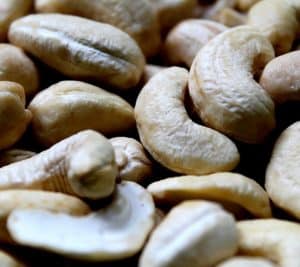
- ENERGY: Approximately 553 kcal per 100 g
- PROTEIN: Approximately 18.2 g per 100 g
Cashews are probably my favourite nuts to actually eat.
They have fewer calories per 100 g than most nuts on this list, but 553 calories is hardly low-energy food.
They also contain more carbohydrate than very fatty nuts such as macadamias.
I particularly like roasted and lightly salted cashews.
The biggest problem is stopping myself eating the entire bag on the first day.
Which Nut Has the Most Calories?
Macadamias win.
At around:
718 calories per 100 g
they are incredibly energy dense.
Pecans and pine nuts are not far behind.
For ultralight backpacking, calories per gram are worth considering because you can reduce your food weight while still carrying enough energy.
But I wouldn’t build my entire diet around whatever food has the highest number.
Taste matters enormously on longer trips.
Food you don’t want to eat isn’t very useful.
Which Nut Has the Most Protein?
Of the foods in this comparison:
Peanuts win at approximately 26 g protein per 100 g.
Almonds and pistachios are also strong choices at roughly 20-21 g per 100 g.
That makes peanuts particularly attractive because they combine:
- High protein
- High calories
- Low price
They may not be as glamorous as macadamias, but from a practical hiking perspective they are hard to beat.
Are Nuts the Best Food for Hiking?
They are one of the best.
But I don’t think nuts alone are perfect hiking fuel.
Their biggest strength is also a weakness:
They contain lots of fat.
Fat is extremely calorie dense, but when I am working hard and want something immediately satisfying, carbohydrates are useful too.
That is why trail mix works so well.
You combine:
Nuts = fats + protein + calories
with:
Dried fruit / sweets / chocolate = more readily available carbohydrate
You then get different foods, textures and flavours rather than eating handful after handful of plain nuts.

What Is Trail Mix?
Trail mix is basically whatever combination of bite-sized foods you want to carry.
My type of mixture might include:
- Peanuts
- Cashews
- Almonds
- Walnuts
- Macadamias
- Raisins
- Dried cranberries
- Dark chocolate
- M&M’s
- Seeds
I don’t think there is one correct recipe.
That is part of the point.
You make a mixture you actually want to eat.
My Hiking Trail Mix Recipe
For a basic mix I would start roughly with:
2 parts peanuts
1 part almonds
1 part cashews
1 part raisins or dried cranberries
1/2 part chocolate
A smaller handful of macadamias or walnuts
That gives you a relatively inexpensive base from the peanuts while adding better flavour and variety from the more expensive nuts.
I change it almost every time.
Are Nuts Better Than Chocolate for Hiking?
Neither is simply “better”.
They do different jobs.
Chocolate gives you:
- Lots of calories
- More sugar
- A useful psychological boost when you are tired
Nuts give you:
- More protein
- More fat
- More fibre
- Excellent calorie density
Combining them makes far more sense than turning it into a competition.
My only issue with chocolate is heat.
On a hot day, your carefully prepared trail mix can turn into one giant nut-and-raisin chocolate bar.
There are worse problems to have.
Should You Keep Nuts in Your Pocket While Hiking?
I do.
I like keeping a small portion somewhere I can reach without removing my backpack.
I have previously used recycled smoothie bottles around 250 ml because they are:
- Light
- Reusable
- Easy to open
- Much stronger than a thin plastic bag
The important thing is making the food easy to access.
If your snacks are buried underneath your sleeping bag at the bottom of your pack, you are much less likely to eat them regularly.
How Much Trail Mix Should You Carry?
This depends completely on the trip.
I wouldn’t use a rigid rule such as “one cup per day”.
My food requirements change depending on:
- Distance
- Elevation
- Temperature
- Pack weight
- Whether trail mix is a snack or a major calorie source
For a normal day hike I might only want a few handfuls.
For long-distance backpacking, nuts and trail mix can make up a much larger percentage of my food weight.
Do Salted Nuts Make Sense for Hiking?
Yes.
I often prefer lightly salted nuts on long, sweaty days.
They taste better to me after hours of walking than completely unsalted nuts.
I wouldn’t deliberately buy something covered in an absurd amount of salt purely because I am hiking.
But normal salted nuts are a perfectly sensible trail food for most people.
Raw vs Roasted Nuts for Hiking
I choose whichever I enjoy eating.
Roasting changes the flavour and can slightly alter nutritional values, but both are still excellent hiking foods.
From a purely practical perspective, roasted and salted nuts are often more appealing after several hours on the trail.
That matters.
If you enjoy the food, you will actually eat it.
Whole Nuts vs Nut Butter
Nut butter is another excellent backpacking option.
Peanut, almond and cashew butter can all provide lots of calories in a compact form.
They work particularly well with:
- Wraps
- Oats
- Crackers
- Bananas on shorter trips
- Straight from a squeeze packet when desperate
Peanut butter normally wins on value.
Fancy nut butters can become extraordinarily expensive for no obvious hiking advantage.
How to Pack Nuts for Hiking
For a day hike, almost anything works.
For longer trips I like:
- Zip bags
- Reusable lightweight containers
- Small screw-top bottles
Keep them dry.
Nuts contain lots of oil and can eventually become rancid, particularly when stored warm for long periods.
For a normal hiking trip measured in days rather than months, this generally isn’t a major concern.
A Note About Brazil Nuts
Brazil nuts deserve special treatment because they contain such enormous quantities of selenium.
According to the US National Institutes of Health, individual Brazil nuts can contain around 68-91 micrograms of selenium each.
That varies substantially between nuts.
I therefore wouldn’t use Brazil nuts as the main bulk ingredient in a trail mix that I was eating all day, every day.
A few mixed amongst everything else is more than enough.
Nut Allergies on Group Hikes
Peanuts and tree nuts are major allergens.
If somebody in your group has a serious nut allergy, don’t assume your open bag of trail mix only affects you.
Cross-contact matters.
For people who cannot eat nuts, useful calorie-dense alternatives include:
- Sunflower seeds
- Pumpkin seeds
- Seed butter
- Dried fruit
- Chocolate
- Energy bars specifically labelled nut-free
What Are the Best Nuts for Hiking?
If I had to build a hiking mix from this list, I would use several rather than picking one winner.
My choices would be:
Peanuts for protein and value.
Macadamias for huge calorie density.
Almonds for a good balance of calories and protein.
Cashews because they taste excellent.
Walnuts for variety.
Then I would add dried fruit and chocolate.
That is far more appealing to me than carrying 500 g of one type of nut.
Final Verdict
Nuts are close to perfect hiking snacks.
They provide enormous energy for their weight, don’t require cooking and are easy to eat while moving.
If you want maximum calories:
Macadamias and pecans are the winners.
If you want protein:
Peanuts, almonds and pistachios are stronger choices.
If you want the best balance of price, calories and protein:
Peanuts are probably impossible to beat.
But the best trail food isn’t decided entirely by a nutrition table.
It also needs to be something you genuinely want to eat after six hours of walking.
That is why I still prefer a mixture.
Nuts + dried fruit + a bit of chocolate gives you calorie density, protein, fat, carbohydrate and, most importantly, a snack I can keep eating day after day.
I hope this updated guide helps you choose the best nuts for hiking and build a trail mix that gives you plenty of calories without filling half your backpack with food.