
7 Best Tents With a Screen Porch 2026 | Bug-Free Tents With Mesh Rooms


In this guide to the best tent with a screen porch, I share the most reliable and spacious tents I have used with separate bug-proof lounging areas. Some screen rooms are little more than a mesh vestibule, while others are big enough for chairs, tables, gear or even extra sleeping space. One of the biggest differences I have found is what happens when it rains, because not every screened porch has waterproof walls.
My favourite tent with a screen porch for many years was the NEMO Wagontop. Unfortunately, that has been discontinued, so I wouldn’t build a current recommendation around finding old stock.
There are still some really good screen-room tents available, though. Coleman continues to make several different versions, while Gazelle, CORE, Wenzel and PORTAL all have their own take on the idea. If you are specifically looking for a tent for very warm conditions, then also have a look at my guide to the best tents for hot weather.
The main things I look for are how much of the screen room is actually usable, whether the porch floor stays dry, how fine the mesh is, how easily you can move between the porch and sleeping area, and whether the tent still makes sense once the weather turns bad.
QUICK PICKS
Best smaller tent with screen porch: Coleman Evanston 6-Person
Best all-round family tent: Coleman WeatherMaster 6-Person
Best large budget screen porch: PORTAL 8-Person Family Tent
Best instant screen-room tent: Gazelle T4 Plus Hub Tent Overland Edition
Best convertible screen room: Wenzel Klondike 8-Person
Best blackout tent with screen room: Coleman Skydome 8-Person Dark Room
Best huge cabin tent with screen room: CORE 11-Person Cabin Tent
7 Best Tents With a Screen Room
Coleman Evanston Screened 6-Person Tent


- WEIGHT: 19.2 lbs / 8.7 kg
- PACK SIZE: Approx. 28 x 10 x 8.4 in
- CAPACITY: 6 people maximum
- SEASON RATING: 3 season
- MAIN FLOOR: 10 x 9 ft
- MAX HEIGHT: 5 ft 8 in / 173 cm
- BEST FOR: Couples and smaller groups
The Coleman Evanston is still one of my favourite tents with a screen porch for couples and smaller groups. Coleman still sells both six and eight-person versions, but I think the six-person makes the most sense if you want a reasonably manageable family tent rather than something enormous.
The front screened vestibule isn’t huge. You can fit a couple of decent camping chairs in there, or use it as somewhere for boots, wet gear and bags instead of filling the sleeping area with clutter. The fact that the porch has a proper floor makes it much nicer to walk around in socks, although there is one important problem with it which I will come back to.
I think Coleman’s six-person capacity is optimistic if everyone expects to camp comfortably. Two queen air mattresses will fit inside the main tent, but they use most of the floor. I prefer it for two to four people if you also want somewhere to keep everyone’s gear.
VENTILATION: The screen room gives you a massive opening at the front of the tent, and the main body has several additional mesh-backed windows. On a hot night you can keep the internal door open while the screen porch remains zipped against insects, which noticeably improves airflow.
WEATHERPROOFING: One factual correction from the old version of this guide is that Coleman currently classifies the Evanston as a 3-season tent, not a 4-season tent. The WeatherTec system uses welded floor corners, protected seams and an included rainfly, and Coleman says the frame is tested to withstand winds over 35 mph when properly pitched.
The main sleeping compartment has always done a decent job of keeping weather outside when I have used it. The problem is the porch. The mesh sidewalls don’t have proper roll-down waterproof panels, so wind-driven rain can get straight through and collect on the screen-room floor.
That doesn’t necessarily make the design bad. It just means I treat the porch as a dry-weather living area rather than another waterproof bedroom. If rain is forecast and I really want to keep that area dry, a properly pitched tarp above it solves most of the problem.
VERDICT: The Coleman Evanston Screened 6-Person Tent is perfect for couples or small families who want a bug-free place to sit without buying a gigantic tent. It is lower and less luxurious than some of the options below, but it is also lighter, cheaper and much easier to manage.
PROS:
- Much smaller and lighter than most screen-room family tents.
- Full floor in the screen porch.
- Excellent ventilation in warm weather.
- Main sleeping compartment has good weather protection for normal 3-season camping.
CONS:
- Lower ceiling than most large family tents.
- Six adults would be very cramped with gear.
- Rain can enter through the mesh porch walls.
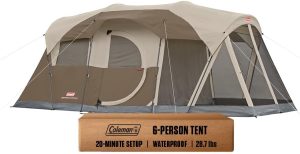
Coleman WeatherMaster 6-Person Tent With Screen Room
- WEIGHT: 35.9 lbs / 16.3 kg
- MAIN FLOOR: 11 x 9 ft
- CAPACITY: 6 people maximum
- SEASON RATING: 3 season
- MAX HEIGHT: 6 ft 8 in / 203 cm
- SETUP: Approx. 20 minutes
- BEST FOR: Best all-round family tent with screen room
The Coleman WeatherMaster 6-Person Tent with Screen Room replaces the old Elite WeatherMaster in this guide. The Elite version with the built-in lighting system is no longer the model I would deliberately hunt down, while the standard WeatherMaster with screen room is still in Coleman’s current US range and is also available through Amazon.
This is still one of the best layouts I have used for a family tent with a screened porch. It feels much more like a small temporary house than a normal dome tent, with enough height to walk around, a proper main sleeping cabin and a separate porch where you can sit without getting chewed to pieces by mosquitoes.
The current main sleeping area measures 11 x 9 feet and Coleman says it fits two queen airbeds. The screened porch sits outside those dimensions, so you aren’t sacrificing the advertised sleeping floor in order to get the extra living area.
SPACE: The 6-foot-8-inch centre height makes a massive difference compared with the Evanston. Unless you are very tall, you can stand properly and move around instead of spending half the trip bent over. Six people will technically fit, but again I think four people plus their gear is a much more pleasant way to use it.
The screened porch is large enough for chairs and a small table, and because it is directly connected to the main tent it works brilliantly as a place to dump muddy shoes and damp gear before going into the sleeping compartment.
FUNCTIONALITY: One feature I really like is the hinged main door. It behaves far more like a normal door than the floppy D-shaped zip openings on most tents, which is particularly useful when people are constantly moving in and out.
You also get an E-Port for bringing electrical power inside, storage pockets and angled windows that can still provide some ventilation when the weather isn’t perfect.
WEATHERPROOFING: Coleman’s WeatherTec system uses welded corners, inverted seams and a separate rainfly, and the current frame is tested for winds around 35 mph. I have always thought the WeatherMaster feels more substantial than the cheaper Coleman family tents, although it is still a big 3-season shelter rather than something I would choose for exposed winter camping.
Like several tents in this guide, the screen room itself is more vulnerable than the sleeping cabin. The mesh porch is brilliant when it is warm and buggy, but it isn’t the same thing as having a second fully waterproof room.
VERDICT: The Coleman WeatherMaster 6-Person is one of the best compromises here if you want plenty of comfort without moving into enormous 10 or 11-person tents. I like the headroom, hinged door and big screen porch, and the current model keeps the useful parts of the old WeatherMaster without making the integrated lighting system the reason to buy it.
PROS:
- Excellent standing height.
- Large separate screen room.
- Main sleeping floor fits two queen airbeds.
- Hinged door is much nicer than a normal floppy tent entrance.
- Good ventilation and WeatherTec protection.
CONS:
- Far too heavy for backpacking.
- Screen room isn’t as weatherproof as the main cabin.
- Twenty-minute setup is slower than the instant tents below.
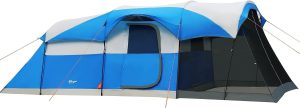
PORTAL 8-Person Family Camping Tent With Screen Porch
- WEIGHT: 25.8 lbs / 11.7 kg
- PACK SIZE: Approx. 27.7 x 8.8 x 8.8 in
- CAPACITY: 8 people maximum
- OVERALL SIZE: 20 x 8 ft
- SCREEN PORCH: Approx. 8 x 6 ft
- MAX HEIGHT: 76 in / 193 cm
- SEASON RATING: 3 season
- BEST FOR: Large screen porch on a budget
The PORTAL 8-Person Family Camping Tent replaces the Ozark Trail 10-person model from the original article because the Ozark Trail is no longer a product I would rely on being available through Amazon.com. The PORTAL is currently sold through Amazon and gives you much the same thing I liked about the Ozark: a big sleeping cabin followed by a genuine separate mesh porch.
This is a long tunnel-style shelter measuring around 20 feet from end to end. Roughly 14 feet of that is the main tent and the remaining six feet forms the screen porch, giving you about 48 square feet of bug-free outdoor space before you even enter the sleeping cabin.
SPACE: PORTAL rates it for eight people, but like most family tent ratings that means sleeping mats arranged tightly across the available floor. I think six people is much more realistic if you actually want space for bags and movement.
The porch is one of the reasons I like this tent. At around 8 x 6 feet it is large enough for a couple of proper camping chairs and a table, or it can swallow coolers, shoes, children’s toys and all the other crap that normally ends up scattered around inside the tent.
FUNCTIONALITY: There are two external entrances, including one through the screen porch and a second side door. That is much better for a group than forcing every single person through the same porch whenever they want to come or go.
The main body has mesh windows and a large mesh ceiling beneath the rainfly, so airflow is excellent in warm weather. There are also storage pockets, an E-Port and a removable mud mat.
One thing worth knowing is that the screen porch is floorless. For me that isn’t necessarily a disadvantage. If I am using the porch primarily for chairs, muddy boots and equipment, I don’t have to worry about destroying or cleaning a sewn-in floor.
WEATHERPROOFING: This is a three-season family tent rather than something I would deliberately take into a serious storm. Current versions use polyester taffeta with taped seams and a separate rainfly, but the fly coverage is relatively small and the huge tunnel body presents plenty of surface area to the wind.
The porch also has mesh walls, so wind-driven rain can enter that section. I treat it as sheltered outside space rather than waterproof living space.
VERDICT: The PORTAL 8-Person is exactly the kind of tent I would choose for a warm-weather family trip where the screen room will actually get used every day. It gives you a huge bug-free porch, lots of ventilation, enough height to stand and a surprisingly compact packed size for a 20-foot-long shelter. I would rather have six people in it comfortably than attempt to cram in the advertised eight.
PROS:
- Huge 8 x 6-foot screen porch.
- Good standing height.
- Excellent ventilation and mesh coverage.
- Two entrances make life easier with a group.
- Very compact packed size considering the overall tent dimensions.
CONS:
- Eight-person rating is optimistic if everyone has gear.
- Screen porch is floorless.
- Not something I would choose for exposed or seriously stormy campsites.
Gazelle T4 Plus Hub Tent Overland Edition

- WEIGHT: Approx. 56 lbs / 25.4 kg
- PACK SIZE: Approx. 64 x 12 x 12 in
- CAPACITY: 4-8 people
- FLOOR SPACE: Approx. 110 sq ft
- MAX HEIGHT: 78 in / 198 cm
- SHELL: 210D Oxford polyester, 2,000 mm HH
- FLOOR: 300D Oxford polyester, 5,000 mm HH
- BEST FOR: Fast setup and a huge convertible screen room
The Gazelle T4 Plus Hub Tent Overland Edition is the extended version of Gazelle’s T4 hub design and is best known for two things: a massive interior and an absurdly fast setup. It remains available through Amazon, while Gazelle has also moved the same basic concept forward with the newer T4 Tandem Overland Edition.
The reason the hub design works so well is that the walls pop outward instead of hanging loosely between normal tent poles. That gives you more usable internal space and a surprising amount of tension in the structure. It still looks like a boxy tent, but it behaves much better in wind than its shape initially suggests.
SETUP: This is easily one of my favourite parts of the Gazelle. Get it out of the bag, unfold it, pop the wall hubs outward and push the roof hub into place. Gazelle’s current version of this platform is still marketed around a 90-second setup, and once you know what you are doing it makes normal giant family tents feel painfully slow.
Putting it away isn’t quite as satisfying. Getting a large hub tent folded and back into its long bag takes more patience than making it spring open.
SPACE: The main sleeping area is very comfortable for four people, while the second half functions as a huge screen room or additional sleeping space. I would much rather use it for four people plus furniture and equipment than deliberately squeeze eight bodies inside, but the capacity is there if you need it.
The walls bow outward, so unlike many dome tents you don’t lose a load of usable room around the edge. At 78 inches high, most people can also walk around inside normally.
SCREEN ROOM: This is one of the best screen rooms in the guide because it feels like a genuine second room rather than a mesh flap stuck on the front. It is roughly comparable in size to the sleeping section and has a waterproof floor running underneath it.
If I want to use it as another bedroom, the privacy panels can be closed. If I want it as a porch, I open everything up and get a huge bug-free lounge.
WEATHERPROOFING: The 210D Oxford shell is rated to 2,000 mm HH and the heavier 300D floor to 5,000 mm. The outward-tensioned walls also help stop large loose panels from repeatedly smacking you in the face every time the wind blows.
Gazelle’s newer T4 Tandem Overland uses essentially the same formula and adds an included footprint, upgraded all-terrain stakes and a heavier water-resistant storage bag, so the design certainly hasn’t been abandoned.
VERDICT: The Gazelle is my favourite choice if you want a genuinely huge screen room but don’t want a 20 or 30-minute pitching routine every time you arrive at camp. The floor runs through the living area, the ventilation is excellent, there are two entrances and the hub structure is far more solid than it initially looks.
PROS:
- Massive screen room that can become another bedroom.
- Waterproof floor runs through the whole shelter.
- Extremely fast hub setup.
- Outward-tensioned walls create lots of usable space.
- Good waterproof ratings for a large family tent.
CONS:
- Very long and bulky when packed.
- Heavy enough that this is firmly a car-camping tent.
- Easier to erect than it is to fold neatly away.
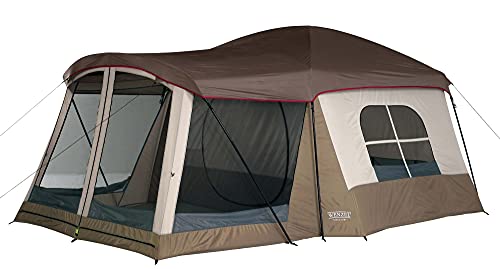
Wenzel Klondike 8-Person Tent
- WEIGHT: Approx. 27-28 lbs depending on current variant
- SIZE: Approx. 16 x 11 ft overall
- CAPACITY: 8 people maximum
- SEASON RATING: 3 season
- MAX HEIGHT: 78 in / 198 cm
- ROOMS: Main sleeping room + convertible screen room
- BEST FOR: Affordable convertible screen room
The Wenzel Klondike is perfect for longer warm-weather camping trips where you expect to spend a decent amount of time around the tent. Whether it is hot and you need somewhere shaded or the bugs are out in force and you want somewhere to sit without being bitten, this layout works brilliantly.
Unlike the open-sided screen porch on something like the Evanston, the Klondike’s front room has mesh windows with zippered fabric panels. That means I can close it down and make the porch much more like another room when the weather turns or when somebody needs to sleep there.
The Klondike remains available through Amazon and other major US retailers, even though Wenzel’s own old product URL has moved or disappeared. I wouldn’t remove a genuinely useful tent solely because the manufacturer has reorganised its website while the actual product is still being sold.
SPACE: The main cabin gives you plenty of room for four or five people comfortably, while the front room can take more sleeping positions if necessary. With an eight-person tent like this I still prefer using some of the theoretical capacity for gear rather than covering every square inch with sleeping mats.
The 78-inch peak height gives most people proper standing room, and the almost vertical rear walls make much more of the floor usable than you get in a normal low dome tent.
VENTILATION: This is one of the Klondike’s strongest features. The front room is almost entirely screened when its panels are open, while the main cabin has additional windows, roof mesh and a rear vent.
On a clear night you can remove the fly and expose much more of the mesh roof. It makes a huge difference in hot weather and is also brilliant for looking up at the stars without volunteering yourself as mosquito food.
WEATHERPROOFING: The porch’s closable panels give the Klondike an advantage over tents with permanently exposed mesh walls. I still treat this as a three-season family tent rather than some storm shelter, but being able to close the front room means I can actually use more of the tent when the temperature drops or rain starts blowing sideways.
VERDICT: The Wenzel Klondike is one of the best-value tents here if you specifically want a screen room that can be converted into more enclosed living or sleeping space. It is roomy, tall, well ventilated and still surprisingly affordable considering how much tent you get.
PROS:
- Screen-room windows have closable fabric panels.
- Excellent ventilation from walls, roof and rear vent.
- Enough height to stand comfortably.
- Front room can be used as extra sleeping space.
- Excellent value for the amount of usable room.
CONS:
- Still a large car-camping tent rather than something you carry far.
- Not designed for serious winter or exposed storm use.
- Original manufacturer product page appears to have been retired even though the tent remains widely sold.
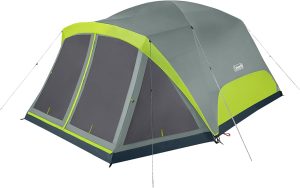
Coleman Skydome 8-Person Screen Room Tent With Dark Room Technology
- WEIGHT: 26.7 lbs / 12.1 kg
- CAPACITY: 8 people maximum
- OVERALL SIZE: 12 x 13.5 ft
- SCREEN ROOM: Approx. 12 x 4.5 ft
- MAX HEIGHT: 6 ft 4 in / 193 cm
- SETUP: Around 5 minutes
- SEASON RATING: 3 season
- BEST FOR: Best blackout tent with screen room
The Coleman Skydome 8-Person Screen Room Tent with Dark Room Technology replaces the Coleman Vail in this guide. I still like the Vail design, but it is primarily a European-market tunnel tent and isn’t a particularly sensible recommendation for an article where I want the products to be readily buyable on Amazon.com.
The current Skydome gives me something more useful to recommend anyway: a proper weather-protected screen room combined with Coleman’s Dark Room material. Coleman says the fabric blocks around 90% of sunlight compared with a similar Coleman tent, and after using its newer blackout tents I think this is one of the most useful family-camping features they have come up with.
DARK ROOM: I don’t expect any blackout tent to remain cool indefinitely in direct summer sun, but the difference in morning light is enormous. If you have children who wake up the second daylight hits the tent, or you personally don’t want sunrise deciding when your camping day starts, the dark interior is genuinely useful rather than just marketing.
It can also make daytime naps much easier and gives you more privacy than pale tent fabric.
SPACE: The tent measures around 12 x 13.5 feet overall with a 6-foot-4 centre height. Coleman gives the screen room roughly 12 x 4.5 feet of that area, which is large enough for chairs, equipment or an additional sleeping position.
The walls are more upright than a conventional Coleman dome, so the usable internal volume is good and you can get mattresses closer to the edges without immediately hitting the roof.
SCREEN ROOM: One important difference between this and the Evanston is that Coleman describes the Skydome’s screen room as weatherproof and says it can convert into an additional sleeping area. That makes the porch far more useful once the weather stops being perfect.
I still prefer the screen room as a lounge and gear-storage area when I don’t need the extra capacity, but it is nice knowing that it isn’t automatically written off as soon as rain appears in the forecast.
FUNCTIONALITY: Preattached poles help bring setup down to around five minutes. There is also an E-Port, gear pockets and a loft, and the wide entrance makes moving large mattresses and bags inside much less irritating.
VERDICT: If I wanted a current family tent with a screen room and cared about sleeping past sunrise, this is the Coleman I would choose. The combination of a usable weather-protected porch, quick setup, decent standing room and blackout fabric gives it a very different purpose from the cheaper Evanston.
PROS:
- Dark Room fabric blocks most early morning light.
- Large weather-protected screen room.
- Preattached poles make setup much faster.
- Good standing room and relatively upright walls.
- Screen room can become extra sleeping space.
CONS:
- More expensive than basic Coleman family tents.
- Still a large 3-season car-camping shelter.
- Blackout fabric can make it very dark inside even during the day, so bring a decent light.
CORE 11-Person Cabin Tent With Screen Room
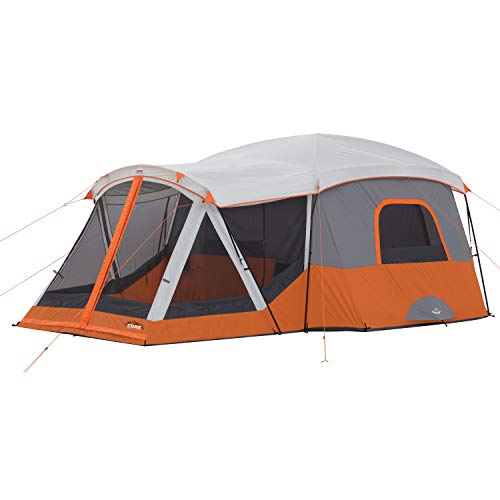
- WEIGHT: 36 lbs / 16.4 kg
- PACK SIZE: Approx. 29 x 14 x 14 in
- CAPACITY: 11 people maximum; around 5 + gear comfortably
- OVERALL FLOOR: 17 x 12 ft
- MAIN CABIN: 12 x 10 ft
- MAX HEIGHT: 86 in / 7 ft 2 in
- FABRIC: 68D polyester, 1,200 mm
- BEST FOR: Huge family tent with screen room
The CORE 11-Person Cabin Tent with Screen Room is still current and remains one of the biggest tents in this guide. CORE’s latest specifications are actually more useful than the old marketing because the company now gives two capacity figures: it can theoretically sleep eleven, but CORE itself says five people plus gear is the more comfortable arrangement.
I completely agree with that approach. I don’t care how many human-shaped rectangles somebody can draw on a floor plan; I care whether I can get out of bed without standing on somebody else’s head.
The tent measures 17 x 12 feet overall, with a 12 x 10-foot main cabin and a large tapered screen-room section at the front. The straight walls and 86-inch centre height make the inside feel enormous.
SPACE: You can fit multiple queen airbeds if capacity is the priority, but the reason I like a tent this big is being able to leave proper living space between the beds. With five or six people there is enough room for everybody’s luggage, a clear walkway and a usable porch instead of turning every floor panel into sleeping accommodation.
The straight-wall cabin design also lets you push furniture and mattresses much closer to the edges than you could in a strongly curved dome.
SCREEN ROOM: The attached screen room is big enough to work as a genuine sitting area. I can put a couple of chairs and equipment in here while keeping the main sleeping cabin cleaner and less cluttered.
The downside is the same one that appears repeatedly in this guide: this is a mesh porch, not another fully waterproof cabin. It is excellent for bugs and ventilation but needs to be treated accordingly if rain is blowing through the sides.
VENTILATION: CORE uses lower intake vents to pull cooler air in while the large mesh ceiling gives hot air somewhere to escape. Remove the rainfly on a clear night and you get excellent airflow and a huge view of the sky.
This is exactly what I want from a large summer family tent. Eleven people breathing inside a poorly ventilated polyester box would be horrendous.
WEATHERPROOFING: The current fabric is rated to 1,200 mm and uses CORE’s H2O Block system with water-repellent fabric, sealed seams and a taped rainfly. I have no problem using this for ordinary three-season campsite weather when properly staked and guyed.
What I wouldn’t do is mistake its sheer size for strength. Huge near-vertical walls catch a lot of wind. If the forecast is properly nasty, I would rather be in a much smaller aerodynamic tent.
VERDICT: The CORE 11-Person Cabin Tent with Screen Room is as much a small screen house as it is a sleeping tent. Both sections give you a ridiculous amount of space and headroom, and I think it makes far more sense for five or six people living comfortably than eleven people sleeping shoulder to shoulder.
PROS:
- Huge main cabin and separate screened living area.
- 86-inch centre height gives excellent standing room.
- Very good ventilation from lower vents and mesh roof.
- Room divider helps separate the huge internal space.
- CORE publishes a much more realistic “5 + gear” comfort capacity.
CONS:
- Far too large and heavy for anything except car camping.
- Screen-room walls aren’t fully protected from wind-driven rain.
- Large straight walls aren’t my first choice for seriously windy campsites.

What Is a Screened Porch Tent?
A tent with a screened porch combines a normal enclosed sleeping area with an attached space surrounded largely by insect mesh. It gives you somewhere that feels outdoors while still keeping mosquitoes, midges, flies and other bugs away.
For me, having a bug-free zone to relax, eat, organise gear and socialise is the main reason to buy one. Once you have spent an evening beside water while mosquitoes are out in force, the appeal becomes fairly obvious.
Not every screen porch works in the same way, though. Some are open mesh rooms that are really only intended for fair weather. Others have zip-down fabric panels and can become additional enclosed sleeping space when necessary.
Tent With Screen Porch vs Separate Screen House
A standalone screen house is normally larger and gives you better views because the entire structure is designed as a bug-proof outdoor room. The disadvantage is that you then have two shelters to transport, pitch and pack away.
An integrated porch is much more convenient. You can walk directly from your sleeping area into the screen room, your gear stays close to you, and there is only one main shelter to set up.
If I already own a tent I really like, I wouldn’t replace it purely to gain a screen porch. I would probably buy a separate screen house. If I am buying a big new family tent anyway, having the porch built in makes a lot of sense.

Guide to the Best Tent With Screen Porch
If you are going on a family camping holiday somewhere warm, a screen room is one of those features that can completely change how much time you spend around the tent. There aren’t thousands of genuinely good options, so these are the things I pay the most attention to when comparing them.
Sleeping Capacity
The stated capacity of a tent is only a rough guide. This becomes especially ridiculous once you get to eight, ten or eleven-person tents because manufacturers are normally calculating how many narrow sleeping positions can physically be placed across the floor.
That isn’t how I want to camp.
If I buy an eight-person tent for six people, I get somewhere to keep backpacks, boots and clothes and can actually walk between the mattresses. Put the full eight people inside and most of that comfort disappears.
The type of bed also matters. A six-person tent might technically hold six narrow foam mats, but two queen air mattresses can use almost exactly the same floor area. Camping cots can be even more awkward because the frame needs clearance from sloping tent walls.
Screen Room Capacity
The advertised sleeping capacity tells you very little about how useful the actual porch will be. On the Evanston you get a relatively small mesh area that works for a couple of chairs. On the Gazelle, the screened section is almost another complete room.
Think about what you actually want to put there. Two people sitting in chairs need far less floor space than two people sleeping on mattresses, so the porch does not necessarily need to be as large as the main cabin.
I also pay attention to wall angle. A screen room may look huge on a floor plan but feel much smaller when half of the roof is too low to sit underneath comfortably.
Does the Screen Porch Have a Floor?
A sewn-in floor sounds automatically better, but it depends what you want the porch for. If I’m sitting around in socks, letting children play in there or possibly sleeping in it, I definitely prefer a floor.
If I mainly want somewhere for muddy boots, bicycles, a cooler and wet equipment, a floorless screen room can actually be easier to live with because I don’t have to keep cleaning it.
What I don’t like is a permanently sewn-in floor combined with completely exposed mesh walls. Heavy rain comes through the mesh and then gets trapped on the floor. That is exactly the problem I have found with several Coleman porch designs.
Weatherproofing
Most tents with screen porches are intended primarily for spring, summer and autumn because an open mesh room isn’t particularly useful in freezing weather. If you expect bad weather, pay attention to whether the screen room has solid panels as well as mesh.
The main sleeping tent should have a proper rainfly, sealed seams and a waterproof floor. Hydrostatic-head ratings can help when manufacturers publish them, but I don’t use one number to decide whether an entire tent is weatherproof.
The Gazelle’s 2,000 mm shell and 5,000 mm floor are reassuring, for example, but frame shape and how well the fly overlaps doors and windows still matter.
And I would ignore wildly optimistic “4 season” claims on large marketplace family tents unless the construction genuinely supports them. A huge vertical-sided screen-room tent is not suddenly a winter expedition shelter because somebody added that phrase to a product title.
Screen Room and Bug Mesh
Not all mesh is equal. I want it fine enough to stop tiny midges and no-see-ums as well as the larger mosquitoes and flies.
I also look at how the mesh joins the floor and doorway. A beautiful fine mesh panel doesn’t achieve much if there are gaps around the corners big enough for insects to walk through.
Fine mesh is also relatively easy to damage, so I pay attention to where the zippers run and whether the fabric gets dragged into them.
Weight and Pack Size
If you want to camp somewhere cars can’t reach, most of the tents in this guide are the wrong tool. A 36 or 56-pound family tent is not something I want strapped to a backpack.
The Evanston is about as far towards the portable end of this category as I would go, and even that isn’t a lightweight hiking shelter.
For normal car camping, packed length can matter more than weight. Hub tents such as the Gazelle collapse into a very long bag that can be awkward in a small car even though setup at the campsite is incredibly easy.
Space and Height
Once I know the floor is large enough, I look at how much of that space I can actually use. Head height is a big factor for me on any tent designed for longer stays.
If I am living in a tent for a week, I want to stand up while getting changed and move between rooms without crawling. I also look at the angle of the walls because a 6-foot-6 peak means much less when that height only exists in a tiny strip through the centre.
Ventilation
Tents with screen rooms normally have excellent ventilation because the entire porch acts like one gigantic vent. You can often leave the door between the sleeping area and porch open while keeping the external mesh zipped against bugs.
I still want windows and vents on the sleeping cabin itself. Lower vents are particularly useful because they bring cooler air in near ground level while warm damp air escapes through higher mesh sections.
Many of these tents also have huge mesh roofs underneath the removable rainfly. On a dry clear night, taking the fly off can make the inside feel almost as open as sleeping outside.
Windows and Doors
Windows on big tents are underrated. They let in light, give you a view from your bed and are one of the easiest ways to improve airflow.
I also prefer at least two entrances when several people are sharing a tent. Having everybody climb over the same bed whenever they need the toilet at 3 a.m. gets old very quickly.
The PORTAL and Gazelle are particularly useful here because you don’t have to make every journey through exactly the same doorway.

10 Benefits of Screened Porches on Tents
Bug Protection
The most obvious reason to buy a tent with a screen room is to enjoy sitting outside without constantly swatting mosquitoes, flies, gnats and midges. This becomes especially useful near lakes, rivers and damp woodland where the insects can suddenly appear in ridiculous numbers around dusk.
Instead of retreating into the sleeping tent and sealing yourself away, you can sit in the porch and still feel as though you are outside.
Ventilation
A screened porch creates a huge ventilated area at the entrance to the tent. During hot weather I can leave the door between the porch and main cabin open while the bug mesh remains closed, which massively increases airflow without inviting every insect on the campsite inside.
This can also help reduce condensation because warm moisture has a much easier path out of the tent.
Extended Living Space
This is probably the second biggest benefit after bug protection. A screen room gives you somewhere for chairs, a table, toys, shoes and all the other equipment that would otherwise clutter the sleeping area.
On something like the Gazelle or CORE, the porch is large enough that it becomes a genuine second living room rather than just an entrance vestibule.
Views
Sitting behind insect mesh is about as close as you can get to being fully outdoors while still having a physical barrier around you. If the campsite has a lake, mountain or woodland view, I deliberately orient the screen porch towards it.
That way the nicest part of the view becomes the place where everyone naturally sits.
Gear Storage
The porch is one of the best places to keep muddy shoes, damp jackets and bulky equipment. It stops all that stuff migrating into the sleeping cabin and gives wet items more airflow than stuffing them into a sealed bag.
I particularly like a floorless porch for this because I don’t care nearly as much about wet boots or a dirty bike wheel touching the ground.
Food Preparation and Eating
A bug-proof porch is brilliant for preparing and eating food because flies aren’t constantly landing on everything.
What I don’t do is assume mesh makes it safe to run a fuel-burning camping stove inside the tent. A screen porch is still part of an enclosed or partially enclosed shelter, and carbon monoxide can build up despite open mesh and doors.
I use the porch for storing ingredients, preparing food and eating, but use normal fuel-burning camping stoves outside unless the shelter and appliance have been specifically designed and approved for another arrangement.
Extra Sleeping Area
Some screen rooms can become useful extra bedrooms on warm nights. The Wenzel has zippered wall panels, the Gazelle can be closed for privacy, and Coleman specifically designs the Skydome’s weatherproof screen room to convert into another sleeping area.
On permanently open mesh porches such as the Evanston, I only treat this as a dry-weather option. A sleeping bag sitting in a puddle at three in the morning isn’t much fun.
Wet-Gear Transition Zone
A porch gives you somewhere between “outside in the rain” and “inside the sleeping tent.” You can get through the first door, take off wet boots and jackets, then enter the bedroom without dragging water and mud across everyone’s beds.
This is one of those features that seems minor until you are trying to get an entire family inside during a downpour.
Pet Space
I enjoy camping with dogs, and a screened porch can be useful as somewhere they can lie down without filling the main sleeping room with wet fur and dirt.
Obviously whether I actually leave a dog sleeping there depends on the dog, temperature and how secure the particular screen room is, but as a daytime area it works brilliantly.
Stargazing
Several tents in this guide have huge mesh roof sections underneath removable rainflies. If the forecast is clear, taking the fly off gives you an almost completely open view of the sky while the mesh still keeps insects outside.
Sleeping literally under the stars sounds romantic until you discover that mosquitoes also stay awake after dark. A mesh roof gives you most of the view without that particular problem.

4 Problems I Have Found With Screened Porch Tents
After using different screen-room tents, there are a few recurring problems that I don’t think manufacturers always make obvious. The biggest one is waterproofing. A tent can have an excellent sleeping cabin while the porch effectively becomes a paddling pool as soon as rain starts blowing through the mesh.
Unprotected Mesh Walls
Several tents I have used don’t provide any waterproof cover for the porch walls. Rain simply comes through the mesh.
On a floorless screen house this isn’t necessarily disastrous because the water disappears into the ground. On a porch with an integrated floor it can collect inside and eventually make its way towards the main tent.
If keeping the porch dry is important, I would choose something with closable wall panels or a genuinely weather-protected room. Otherwise I accept that it is an outdoor space and keep anything important away from the exposed mesh.
A tarp can also be useful if you already own a tent with an open porch and know several days of rain are coming.
Mesh Is Easy to Damage
Very fine mesh is fantastic at stopping tiny biting insects but is much easier to damage than the main tent fabric. The biggest culprit for me is getting it caught in a zipper and then trying to yank the zipper free.
You can use a tent repair kit for smaller damage, but a heavily patched screen is never quite the same again.
Ways I have managed to damage bug mesh include:
- Tripping over a guyline and falling into the tent hard enough to rip mesh along a seam.
- Getting the mesh caught on a bike while packing up in windy conditions.
- Walking through a door with a backpack still on and catching it.
- Getting too close to heat and melting it.
- Trapping the mesh in its own zipper.
If the screen room is the main reason you bought the tent, protecting the mesh is worth a little bit of effort.
Maximum Capacity Can Include the Screen Room
One of the most misleading things about large screen-room tents is that the advertised capacity can rely on people sleeping in areas you probably intended to use as a porch.
That can work perfectly well in warm, dry weather. It becomes much less appealing if the porch has exposed mesh walls and rain is forecast.
The easiest way to avoid disappointment is to ignore the big capacity number for a minute and look at the actual floor dimensions of the protected sleeping cabin. Work out where your mattresses or cots are going to fit before assuming an eight-person tent gives eight people a comfortable waterproof bedroom.
Screen Porches Are Mainly a Warm-Weather Feature
Screen rooms make the most sense when bugs and heat are the problem. That is why nearly every tent in this guide is fundamentally a 3-season family camping shelter.
Once temperatures drop properly, I am not desperate for an enormous mesh room attached to my bedroom. At that point I would rather have a smaller, more enclosed and more aerodynamic shelter.
That doesn’t make screen porches a gimmick. It just means they solve a particular camping problem exceptionally well rather than being the perfect design for every season.
Are Tents With Screen Rooms Worth It?
If you do most of your camping in the warmer months and regularly deal with mosquitoes, midges or flies, I think a tent with a screen porch is absolutely worth it. The extra room makes the campsite more comfortable, keeps insects away and gives you somewhere to separate dirty gear from the sleeping area.
They also make far more sense on longer family trips than they do for one-night camps. If I’m pitching next to the car and staying in the same place for a week, I don’t particularly care about carrying another ten pounds of tent if it gives me a proper bug-free lounge for the entire holiday.
If you already own a tent you love, though, I wouldn’t replace it purely to gain a porch. A separate screen house can give you the same basic benefit and may actually provide more usable space.
What Is the Best Tent With a Screen Porch I Would Pick?
For a smaller group, I still like the Coleman Evanston 6-Person because it gives you a genuine screened porch without forcing you into a gigantic family shelter. For more space and standing height, the Coleman WeatherMaster 6-Person is the better all-round family option.
If I wanted maximum screen-room space with almost no setup hassle, I would choose the Gazelle T4 Plus Hub Tent. The screen section is enormous, the floor runs through both rooms and the hub frame is ridiculously fast to erect.
The Wenzel Klondike is probably the best affordable option if I want the porch to close up more securely, while the Coleman Skydome 8-Person Dark Room is the one I would choose if sleeping past sunrise matters.
For a huge family base camp, the CORE 11-Person Cabin Tent gives you the most house-like amount of space. And if I want a big conventional tent with a giant floorless screen porch without spending loads of money, the PORTAL 8-Person makes far more sense today than chasing the old Ozark Trail.
I hope this guide helps you find the best tent with a screen room for the way you actually camp. The important thing is to decide whether you want the porch mainly for sitting, storing gear or sleeping, because that determines whether features such as a waterproof floor and closable walls are genuinely important.






[…] one reason to use a screen house when camping. But what is a screen house, and is it the same as a tent with a screen porch? That’s what we are here to […]