In this guide to the best spoon carving knives, I compare the hook knives I have found easiest to control, most comfortable to use and best at holding a sharp edge. If you are buying your first spoon knife, I still think the Morakniv 164 is one of the safest recommendations, while the Focuser FC007 and hand-forged S. Djärv are the tools I would look at once you know you enjoy carving.
Spoon carving is a bit like knitting for bushcrafters. Give me a piece of green wood, a couple of decent knives and somewhere comfortable to sit around camp and I can happily disappear into it for hours.
You don’t need a workshop full of tools either. In practice, I normally use a straight carving or sloyd knife for shaping the outside of the spoon and a curved hook knife for hollowing the bowl. You can make an entire spoon with very little equipment, and once you get used to a really good hook knife, the difference between hacking chunks out of the bowl and taking smooth controlled shavings becomes very obvious.
One thing I would change from the old version of this guide is the idea that a handmade knife is automatically better than anything factory produced. Some hand-forged spoon knives are absolutely beautiful to use, but blade geometry, heat treatment, sharpness and handle design matter more than whether somebody physically hit the steel with a hammer.
QUICK PICKS
Best overall: Morakniv Hook Knife 164
Best premium for soft and green wood: Focuser 2.0 FC007
Best for hardwood: Flexcut KN52 Single Bevel Sloyd Hook Knife
Best double-edged: Morakniv Hook Knife 162
Best budget: BeaverCraft SK1
Best hand-forged: S. Djärv Standard Spoon Knife
6 Best Spoon Carving Knives
Morakniv Hook Knife 164

- BLADE LENGTH: 55 mm / 2.2 in
- BLADE THICKNESS: 2 mm / 0.08 in
- WEIGHT: 62 g / 2.19 oz
- STEEL: Swedish 12C27 stainless steel
- BEST USE: Best overall and best beginner spoon carving knife
The Morakniv Hook Knife 164 is the knife I would recommend to most people buying their first proper hook knife. Mora has refined the current 164 into a very straightforward tool: a 55 mm single-edged Swedish stainless-steel blade with a tight curve, a comfortable oiled birch handle and a leather edge protector.
The current blade is 12C27 stainless steel hardened to around 56.5 HRC. That isn’t ridiculously hard, which I actually think works well for a carving knife because it is straightforward to maintain and doesn’t feel excessively brittle. The full rat-tail tang also gives the blade plenty of support through the handle.
I particularly like the curve for normal eating spoons, scoops and moderately deep bowls. It is tight enough to excavate the centre of a spoon bowl without forcing the cut, but not so aggressive that I feel like the knife constantly wants to dive deeper into the wood than intended.
Mora now sells separate right-handed and left-handed versions, which is worth checking carefully when ordering. With the right-hand model, the blade is ground specifically for a right-handed pulling cut rather than being a generic knife that just happens to work better in one direction.
One of the biggest advantages of the 164 is simply how easy it is to replace, sharpen and live with. I don’t feel precious about it, and for bushcraft that matters. I can take it camping, get sap and dirt on it, strop it back up and carry on carving instead of treating it like a collector’s piece.
VERDICT: The Morakniv 164 remains my best overall recommendation because it is good enough to make excellent spoons without costing specialist blacksmith money. If you are completely new to spoon carving and only want to buy one hook knife to find out whether you enjoy it, I would start here.

Focuser 2.0 Wooden Spoon Carving Middle Knife FC007

- BLADE LENGTH: Approx. 55 mm / 2.16 in
- HANDLE LENGTH: Approx. 175 mm / 6.9 in
- STEEL: O1 tool steel
- HARDNESS: 59-60 HRC
- BEST USE: Premium carving in soft and green wood
The Focuser 2.0 Wooden Spoon Carving Middle Knife FC007 is still one of the nicest hook knives I have used when the wood suits it. What immediately separates it from most mass-market carving knives is the long beech handle and the amount of control it gives me through several different grips.
The double-tapered handle means I can choke right up towards the blade for delicate finishing work or move my hand farther back when I want more leverage. I have fairly normal-sized hands, but the extra handle length gives noticeably more freedom than the compact Mora handle, especially when working around the shoulder and deeper parts of a bowl.
The O1 tool-steel blade is hardened to around 59-60 HRC and the back of the blade has been properly rounded, which I really appreciate when using my thumb for extra control. Small details like that are the difference between a carving knife that looks good and one that stays comfortable after an hour of repetitive cuts.
I also like the rounded tip. Some pointed hook knives have a habit of trying to catch on sheaths, tool rolls and anything else they can find, whereas the FC007 is much less annoying to transport. The curvature is excellent for that rocking, slicing action I use when gradually hollowing the centre of a spoon instead of digging straight down and tearing fibres out.
There is one important limitation I didn’t make clear enough before. Focuser itself currently says the FC007 is not intended for hardwood carving and specifically recommends softer wood such as basswood. That means I wouldn’t make this my universal recommendation if you regularly carve hard, seasoned timber. For the green and softer wood I normally associate with spoon carving, though, it is an extremely pleasant knife.
VERDICT: The Focuser FC007 remains one of my favourite knives for the actual feel of carving. The handle, rounded spine and blade geometry are excellent, but the manufacturer’s hardwood limitation is the reason I now put the Mora 164 ahead of it as the safer all-round recommendation.
VIEW ON FOCUS CARVING
Flexcut KN52 Single Bevel Sloyd Hook Knife
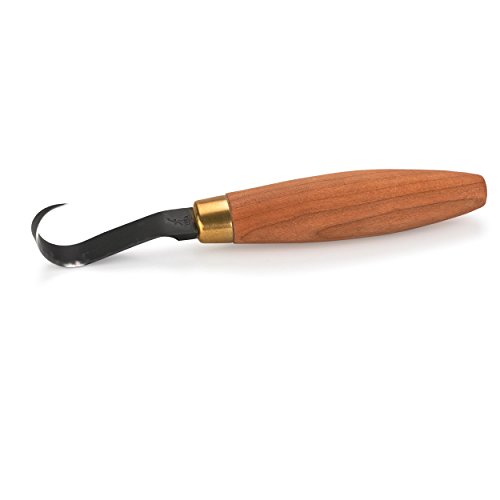
- OVERALL LENGTH: 8 in / 203 mm
- BLADE RADIUS: 0.5 in / 13 mm
- HANDLE: Cherry hardwood with brass ferrule
- STEEL: High-carbon steel
- BEST USE: Hardwood and deeper spoon bowls
The Flexcut KN52 Single Bevel Sloyd Hook Knife is the one I like when I want something more substantial and aggressive than the Focuser. Flexcut makes the KN52 in the USA with a deeply curved single-edged blade, a full-length tang running through the cherry handle and a brass ferrule reinforcing the front of the handle.
The overall length is eight inches with a half-inch blade radius, so you get quite a bit of handle to work with. I find that useful when carving harder material because I can generate leverage without gripping the knife ridiculously tightly, and the full tang makes the whole tool feel reassuringly solid.
The pointed tip is useful for getting into the transition between the bowl and handle or cleaning up tight areas where a more rounded hook struggles. Along the broader part of the curve, I can take controlled shavings and gradually smooth the bowl rather than simply gouging chunks out.
In my experience this is also one of the better commercial hook knives for tougher wood. That doesn’t mean I deliberately reach for dry oak every time I want to relax around camp, but the Flexcut feels more suited to harder work than the relatively delicate FC007.
Flexcut currently lists the KN52 as part of its range, although its own web store is periodically showing it out of stock due to demand. It remains available through retailers, so I wouldn’t replace it purely because Flexcut doesn’t always have stock on its own website.
VERDICT: If you carve harder woods or simply like a more substantial hook knife with a long handle and pointed working tip, the Flexcut KN52 is an excellent choice. It costs more than the Mora, but the handle, full tang and strong blade construction make it feel like a serious carving tool rather than a beginner’s compromise.
Morakniv Hook Knife 162 Double Edge

- BLADE LENGTH: 55 mm / 2.2 in
- BLADE THICKNESS: 2 mm / 0.08 in
- WEIGHT: 62 g / 2.19 oz
- STEEL: Swedish 12C27 stainless steel
- BEST USE: Best double-edged spoon carving knife
The Morakniv 162 is essentially the double-edged alternative to the 164. It uses the same 55 mm tight-curved Swedish 12C27 blade and oiled birch handle, but both edges are sharpened so the knife can cut in either direction.
That gives the 162 some genuine advantages. I can change between push and pull cuts as the grain changes direction, and because the knife isn’t dedicated to one hand in the same way as the 164, it is much more versatile for left-handed or ambidextrous carving.
The trade-off is control. With a single-edged hook knife I can safely use the unsharpened spine as part of certain supported cuts, whereas doing that absent-mindedly with a double-edged 162 is a particularly efficient way of discovering how sharp the other edge is.
I also don’t think the double edge automatically makes carving twice as fast or means the knife stays sharp twice as long. What it really gives you is another cutting direction and another working edge, which is useful when grain direction makes one particular cut awkward.
The current 162 is made in Mora from 12C27 stainless steel at around 56.5 HRC, with a blunt tip, full rat-tail tang and leather edge protector. Like the 164, it is a proper long-running carving design rather than something Mora has quietly replaced.
VERDICT: I still prefer the 164 for most beginners because I find a single edge easier to control. Once you understand hook-knife grips and want to work comfortably in both directions, though, the Morakniv 162 becomes a very useful tool.
BeaverCraft SK1 Spoon Carving Knife

- BLADE LENGTH: 50 mm / 2 in
- BLADE WIDTH: 17 mm / 0.7 in
- HANDLE LENGTH: 105 mm / 4.1 in
- STEEL: 1066 high-carbon steel
- HARDNESS: 57-59 HRC
- BEST USE: Best budget spoon carving knife
The BeaverCraft SK1 remains one of the cheapest hook knives I am happy recommending to somebody who genuinely wants to learn. BeaverCraft has kept improving its carving range, and the current SK1 uses a 50 mm single-bevel blade made from 1066 high-carbon steel with a simple ash handle.
At around twenty dollars, it is still remarkably inexpensive for a dedicated carving tool. The blade is hardened to approximately 57-59 HRC and the 20-degree edge comes sharp enough to start carving without immediately rebuilding the bevel yourself.
The flatter, relatively compact handle gives good control for small spoons and cups, although I prefer the longer handles on the Focuser and Flexcut once I am carving for a long time. The SK1 also has quite a pronounced hook, so it works nicely for hollowing tighter curves.
BeaverCraft currently recommends this particular edge geometry primarily for softer wood because the fine edge can dull faster in hard timber. That is worth knowing because the old article implied it was a cheap knife you could simply attack anything with.
I still think it represents excellent value. There is also a left-handed SK1L, an oak-handled version and an SK1S supplied with a leather sheath, so you can choose the variation that makes the most sense rather than being stuck with one model.
VERDICT: The BeaverCraft SK1 is the one I would buy if I wanted to try spoon carving for as little money as possible without dropping into anonymous bargain-bin tools. It isn’t as refined as the premium knives above, but at this price it gives you a genuinely usable hook knife rather than something likely to put you off carving altogether.
S. Djärv Standard Spoon Knife

- TYPE: Hand-forged spoon knife
- OPTIONS: Right-handed or left-handed
- ORIGIN: Sweden
- BEST USE: Best hand-forged spoon carving knife
The S. Djärv Standard Spoon Knife is the step up I would look at once you already know spoon carving is something you are going to stick with. S. Djärv has been producing hand-forged carving tools in Sweden for decades, and the Standard remains one of the core tools in the range rather than an old model hanging around in clearance stock.
What I like about it is that the blade isn’t trying to impress you with some bizarre extreme shape. It is a narrow, carefully formed spoon knife with a very usable curve, and the handle gives enough leverage without making the whole tool feel oversized.
The cutting feel is where a good handmade hook knife starts to justify itself. With a properly sharpened edge and well-finished blade geometry, I can take extremely controlled slices instead of feeling the knife chatter or suddenly dig into the grain. That becomes more noticeable the better your carving gets.
S. Djärv currently sells the Standard in both right- and left-handed versions and describes it as the most versatile spoon knife in its range. If it isn’t already sitting on the shelf, the company currently estimates roughly two to four weeks to forge and prepare one, which is much better than the year-plus waiting lists you sometimes hear associated with specialist carving tools.
VERDICT: The S. Djärv Standard is the knife here I would buy as a treat once I knew I was going to carve regularly. The Mora can still make an equally usable spoon, but the Djärv has the hand-finished geometry and feel that make the process itself more enjoyable.
Do You Need a Hook Knife to Carve a Spoon?
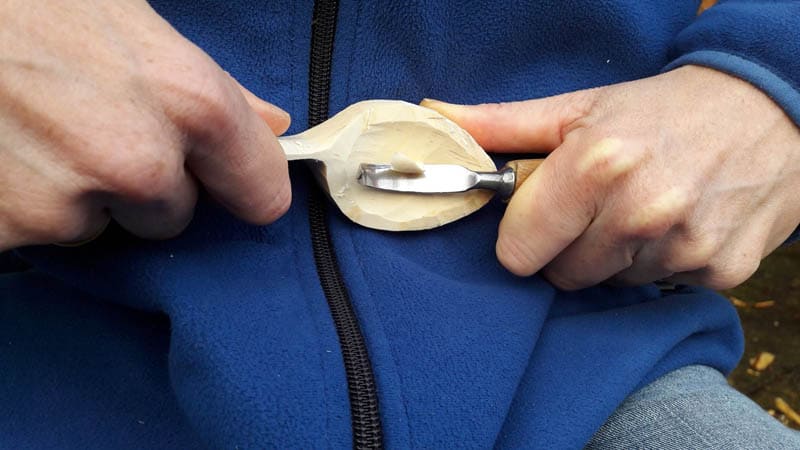
Technically, you can hollow a spoon using gouges or other curved carving tools, but a hook knife is the traditional and most portable option. The curved blade lets you work inside the concave bowl while keeping the handle somewhere your hand can actually use it.
I wouldn’t normally claim that the hook knife is the only tool you need from start to finish. For most spoons I prefer a small axe or hatchet for rough shaping, a straight sloyd knife for the outside and handle, and the hook knife for the bowl. If I am sitting around camp and starting with a roughly shaped blank, however, a straight knife and hook knife will do almost everything.
Hand-Forged Spoon Carving Knives
Once you start getting properly into spoon carving, handmade tools become dangerously tempting. A beautifully forged hook knife feels far more exciting than it has any right to considering that its entire purpose is essentially removing the inside of a wooden spoon.
I still think some of the best hand-forged knives are nicer to use than mass-produced tools, but I wouldn’t now make the blanket statement that every forged knife is automatically superior. A badly designed handmade knife is still a badly designed knife, while Mora can manufacture an extremely consistent blade by the thousand.
Where specialist makers often excel is in the small details: the way the spine is rounded, the curve and twist of the blade, the smoothness of the inside surface, the edge geometry and the exact position of the blade in relation to the handle. Those things become much more noticeable once your technique improves.
Several makers worth looking at today include:
- S. Djärv – Swedish hand-forged carving tools with Standard, Mini, Large and newer Hollow spoon knives.
- Deepwoods Ventures – Individually forged W1 tool-steel hook knives made in Minnesota, including several curves and handle lengths.
- Pinewood Forge – Del Stubbs’ carving tools remain highly regarded among spoon carvers and are normally sold in small batches or made to order.
- Temple Mountain Woodcraft – Matt White’s hook and straight carving knives are small-batch tools and availability varies.
- The Solo Blacksmith – New Zealand-made hand-forged hook knives with a compound curve and right- or left-handed versions.
- Gui Siqueira – Beautiful Brazilian carving tools, although US shipping can currently be difficult.
Deepwoods is particularly interesting because the old assumption that every handmade knife involves a year-long waiting list simply isn’t true anymore. Its current hook knives are individually forged and the maker says it normally aims to ship handmade orders in roughly two weeks.
How to Choose a Spoon Carving Knife
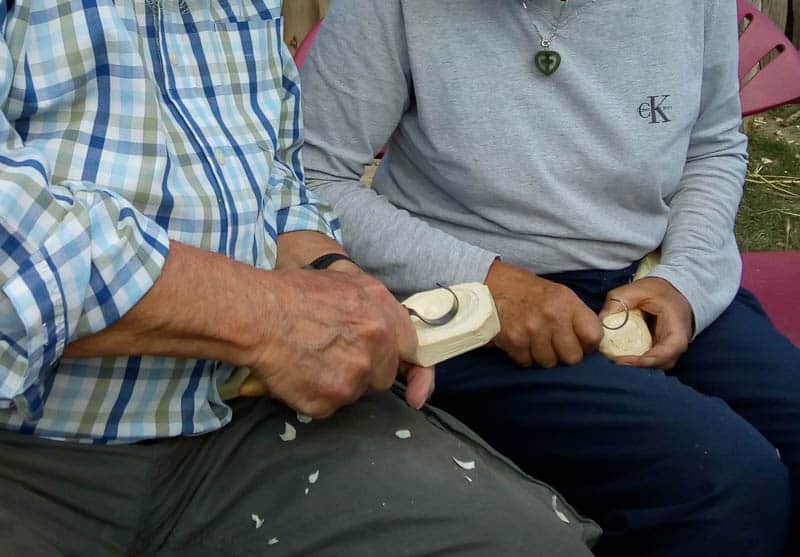
Most hook knives look deceptively similar in photographs. Once you start using them, though, small differences in blade curve, bevel, handle length and spine shape can completely change how the tool feels.
These are the features I pay most attention to.
What You Want to Carve
A tight hook is useful for small eating spoons and deeper hollows, while a broader, shallower curve makes smoothing the inside of larger bowls and kuksas much easier. If I am buying one knife as a beginner, I want something in the middle rather than an extremely tight specialist hook.
This is one reason the Mora 164 works so well as a first knife. Its 55 mm blade and tight but usable curve can handle normal eating spoons, scoops and small bowls without forcing you into one particular project.
Green Wood vs Dry Wood
Fresh green wood is generally much nicer to carve than fully seasoned timber. The fibres cut more easily, I can remove material with less force and the whole process feels more like slicing than scraping.
This also affects which knife I choose. The Focuser FC007 and BeaverCraft SK1 manufacturers both specifically steer their finer edges towards softer carving material, whereas I find something like the Flexcut happier when the wood becomes tougher.
Blade Curve
The curve determines both the depth of hollow you can reach and how much of the cutting edge contacts the wood.
A very tight radius reaches deeply into small spoon bowls but can leave a slightly uneven surface if you try to use it across a broad shallow bowl. A more open curve produces long smooth shavings but may struggle to reach tight corners.
Compound curves try to give you both by changing radius along the blade, and they can be brilliant once you understand which section of the edge to use.
Blade Steel
Good carbon steel and good stainless steel both work perfectly well for spoon carving. I no longer think it makes sense to declare one automatically superior.
Carbon steels such as O1, W1 and 1066 can take excellent edges and are common among specialist carving tools. The trade-off is that they can stain and rust if I leave them damp.
Morakniv’s 12C27 stainless is much less demanding around wet camps and green timber. It doesn’t mean I never sharpen it, but corrosion maintenance is basically nonexistent compared with an untreated carbon blade.
Blade Hardness
Hardness matters, but bigger numbers aren’t automatically better.
A harder blade can retain a fine edge for longer, while a slightly softer one can be easier to maintain and less prone to chipping. The Mora’s 56.5 HRC works perfectly well, while the Focuser sits closer to 59-60 HRC.
I care far more about how the blade has actually been heat treated and ground than chasing the highest Rockwell figure on a specification sheet.
Handle Shape
Handle preference is incredibly personal. I like enough length to change grip position and enough thickness that I don’t have to squeeze hard, which is why the long Focuser handle works particularly well for me.
A short barrel handle like the Mora is extremely nimble and easy to rotate in the hand. Longer handles provide leverage. Neither is universally better, so if you get the opportunity to handle somebody else’s knives before buying, take it.
The Spine
This is one of those details you barely notice until you use a knife where somebody has done it properly.
On single-edged hook knives I sometimes use my thumb as part of a controlled grip, so a rounded and polished spine is considerably more comfortable than a sharp square edge. The Focuser does this particularly well.
Obviously, don’t assume you can do the same thing with a double-edged Mora 162. There is a blade exactly where the safe spine would normally be.
Right-Handed vs Left-Handed
Check this before ordering a single-bevel hook knife.
A right-handed carving knife isn’t simply the same tool with a different label. The bevel orientation determines which direction the blade cuts effectively, so buying the wrong version can make an otherwise excellent knife feel awkward.
The double-edged Mora 162 avoids most of that problem because both sides cut, but with tools such as the 164, Focuser and S. Djärv you need the correct orientation.
Single-Edge vs Double-Edge Hook Knives
I prefer single-edged hook knives most of the time because I feel like I have more options for controlled grips. The unsharpened side gives me somewhere safe to support the knife in techniques where my thumb or finger is used to guide the cut.
A double-edged hook such as the Mora 162 gives you cutting edges in both directions instead. That makes grain changes easier to deal with and means one tool can make push and pull cuts that would otherwise require switching grip, direction or knife.
Neither is objectively better. For a beginner, I would start with single edge; for somebody already comfortable with hook-knife technique, a double edge is useful enough that I understand why some carvers prefer it.
Advantages of a Single-Edge Hook Knife
- More options for supported thumb grips
- Usually easier for beginners to understand
- Less chance of accidentally putting a finger against a cutting edge
- Excellent control during detailed finishing cuts
Advantages of a Double-Edge Hook Knife
- Cuts in two directions
- Useful when grain direction changes
- Can be used more naturally from either side
- Gives you two usable cutting edges on one tool
How to Sharpen a Spoon Carving Hook Knife
Sharpening a hook knife is more awkward than sharpening a straight blade because you can’t simply lay the whole edge on a normal flat stone. Once I understood the geometry, though, I stopped treating it as some mysterious specialist job.
The important thing is to look at the actual bevel on your knife before sharpening it. Different hook knives use different edge geometries, so the old advice to always sharpen one particular side was too simplistic.
For example, the Mora 164 has an outside bevel and a flatter inside surface, while Flexcut sells shaped hones and strops specifically designed to work around the inside curves of its hook knives. Follow the geometry that is already there rather than trying to turn every knife into the same edge.
I use three main tools: a shaped abrasive or slip stone when the edge actually needs repairing, a fine ceramic or abrasive rod for lighter sharpening, and leather with polishing compound for normal maintenance.
Strop More, Sharpen Less
Most of the time I don’t want to remove much steel at all. If the knife is still cutting but has lost that effortless feel, a proper strop is usually enough to bring it back.
I load leather with a fine polishing compound and draw the edge away from the cutting direction so I don’t slice into the leather. Around the curved side, I use a rounded strop, shaped piece of wood or leather-wrapped dowel that matches the blade radius.
Flexcut’s own sharpening advice is much the same: polish regularly and save more aggressive abrasives for when the edge is actually damaged or has become rounded.
Using a Slip Stone or Shaped Hone
When stropping no longer restores the edge, I move to something more abrasive. A rounded slip stone or shaped hone can follow the hook without flattening parts of the curve.
I work slowly around the complete edge and try to maintain the existing bevel angle rather than creating a new one. The easiest mistake is concentrating pressure in one place and gradually changing the curve of the blade.
Start finer than you think you need. I would rather spend slightly longer restoring an edge than remove a load of steel unnecessarily.
Using a Ceramic Rod
A small round ceramic rod is handy in a bushcraft kit because it works around curves without taking up much room. I use light pressure and move along the entire edge instead of grinding the same point repeatedly.
Again, I follow the original bevel. Once the edge is clean and consistent, I finish with a strop rather than trying to polish everything with the ceramic.
Removing the Burr
After sharpening, a tiny wire edge or burr often forms on the opposite side. That needs to be removed or the knife may feel sharp for several cuts and then suddenly become dull when the burr folds over.
A shaped leather strop is ideal for this because it can polish the inside curve without aggressively changing the blade geometry. I alternate sides carefully until the edge feels clean and the burr has disappeared.
What Is the Best Spoon Carving Knife for a Beginner?
I would buy the Morakniv 164.
It is affordable enough that you don’t have to convince yourself spoon carving is going to become a lifelong obsession before ordering one, but it is good enough that the tool won’t be the thing holding you back. You also get proper Swedish steel, sensible geometry, right- and left-handed options and a leather edge protector.
If your budget is really tight, the BeaverCraft SK1 is the cheaper alternative I would choose. Once you know you enjoy carving, then tools such as the Focuser, Flexcut, S. Djärv or one of the specialist forged makers become much easier to justify.
What Is the Best Spoon Carving Knife Overall?
For most people, I now give the overall recommendation to the Morakniv Hook Knife 164. It doesn’t have the boutique feel of the S. Djärv or the long comfortable handle of the Focuser, but it has very few weaknesses and works across a much broader range of situations.
For pure carving enjoyment in suitable softer or green wood, I still prefer the feel of the Focuser FC007. For harder material I would choose the Flexcut KN52, and if I wanted a really nice hand-forged knife to keep for years, the S. Djärv Standard would be high on my list.
The more spoons you carve, the more likely you are to end up owning several hook knives anyway. Different curves suit different bowls, and eventually choosing which knife to use becomes half the fun.
I hope this guide to the best spoon carving knives helps you choose a hook knife that actually suits the kind of carving you want to do rather than simply buying whichever one looks most impressive in the photograph.