In this guide, we answer the question, are heated jackets safe? You will learn the risks of wearing a heated jacket or heated vest and what the worst-case scenario is. Can a heated jacket set on fire, and what happens if they get wet? Find out below.
Disclaimer: We don’t know the first thing about electrics. We aren’t doctors. This article is based on our experience, opinions, and research, not professional electrical or medical advice.
Heated jackets are amazing in cold weather. I look forward to putting mine on when the air is so cold outside your breath turns into a million tiny icicles. If you work outdoors or live somewhere where the temperatures drop well below freezing, then a heated jacket can be a real lifesaver.
The only problem I have with heated jackets is that the batteries are still quite bulky, and they don’t last all day on full power. Thankfully these problems are improving every year, and heated jackets are becoming a much more common thing in winter. But how safe are heated jackets?
Are Heated Jackets Safe?
You may be wondering, are heated jackets safe? The short answer is yes. Heated jackets from reputable manufacturers are generally very safe to wear when used correctly.
Modern heated jackets use low-voltage batteries, insulated heating elements, and electronic controls to regulate the temperature. Many also have safety features designed to prevent overheating and protect the battery from electrical faults.
However, that doesn’t mean they’re completely risk-free. There is still a lithium-ion battery powering heating elements positioned close to your body, and like any electrical appliance, things can go wrong.
The most realistic concerns aren’t actually getting electrocuted. They are overheating, burns from prolonged contact with heating elements, damaged batteries, and wearing a jacket that has become wet or electrically damaged.
So why are people so skeptical about the safety of heated jackets and vests?
I think it might come from a misunderstanding of electricity and the early horror stories electric blankets got for catching fire and burning down your house. This can happen with electrical appliances, but modern safety systems have made reputable products much safer than they used to be.
My experience with heated jackets has been overwhelmingly positive, and I wouldn’t hesitate to recommend a good one. I would, however, be much more cautious about buying an unbranded heated jacket with a suspiciously cheap battery pack.
What Are the Risks of Heated Jackets?
For most people, heated jackets are very safe when used as instructed and don’t pose any major threats during normal use, other than maybe dropping the battery pack on your toe.
Some of the more important risks involve people who have pre-existing health conditions, reduced sensitivity to heat, or circulation problems that make it difficult to notice when something is getting too hot. If you have a condition that could affect your ability to feel heat or use electrically heated clothing safely, check with your healthcare professional and the manufacturer’s instructions.
With risks being relatively minimal for most healthy adults using reputable equipment, what are people worried about?
After speaking to a group of outdoor enthusiasts, I found that most of the younger generation were not worried at all about the safety of a heated jacket. Whereas the few concerns came from one or two people over the age of 40.
Here are some of the main concerns or perceived risks of heated jackets:
- Overheating and catching fire
- Getting wet and causing an electrical fault
- Lithium-ion battery malfunction
- Burns from prolonged heat exposure
- Running out of battery and becoming cold
We break down these risks further down the page, including which are realistic and what you can do to prevent them.

How Do Heated Jackets Work?
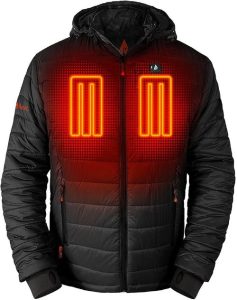
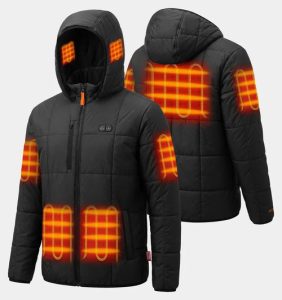
Heated jackets work a little bit like electric blankets. Heating elements are laid out in patterns which are then sewn into panels and distributed around the jacket.
When the elements are connected to a power source like a lithium-ion battery or power bank, electrical current passes through them and generates heat, making the jacket toastie warm inside.
Older heated jackets typically used thin wires, while many modern jackets use carbon-fibre heating elements that are lightweight, flexible, and designed to spread warmth across a larger area.
The wires and heating elements are insulated and protected inside the clothing, although the level of water resistance depends on the particular jacket.
The batteries normally sit in an internal pocket, but some jackets have them in one of your handwarmer pockets for easy access. Many jackets work differently from the next, but most operate via a button on the chest, which turns the heat off and on as well as controls the heat settings.
The batteries are rechargeable and need to store a fair amount of energy, which still leaves plenty of room for improvement. The power also doesn’t last that long when you have it on full power, so you may need multiple spares to last all day.
One important distinction is that a heated jacket isn’t usually designed to become extremely hot. The heating elements should produce controlled warmth rather than temperatures that could burn your skin.
If a particular area becomes uncomfortably hot or starts behaving differently from the rest of the jacket, switch it off and investigate rather than assuming it is normal.
What Happens if Heated Jackets Get Wet?
Most reputable heated jackets are designed to cope with at least some exposure to rain, snow, and sweat. The heating elements and electrical connections are generally protected inside the garment, but the level of protection varies between manufacturers.
This doesn’t mean every heated jacket is completely waterproof.
Some have water-resistant softshell materials with a DWR treatment, while others have more substantial weatherproofing. The battery itself is often much less resistant to water than the surrounding jacket.
Although, if you were to go for a swim with a heated jacket on, don’t be surprised if it stops working. They are designed for particular outdoor conditions, not necessarily for being submerged.
Most heated jackets are also outdoor jackets designed for use in cold weather. Some have synthetic insulation, others use down, and some are relatively thin softshells that rely more heavily on the heating elements.
In heavy rain, you would usually be better off covering your heated jacket with a waterproof hardshell jacket to keep you dry and comfortable inside, provided that arrangement is suitable for your particular jacket.
A good rule of thumb is to keep your insulating clothing layers dry as much as possible so they can retain as much warmth as possible.
What should you do if your heated jacket gets soaked?
If your jacket becomes saturated, switch the heating system off and disconnect the battery when it is safe to do so.
Allow the jacket to dry fully according to the manufacturer’s instructions before reconnecting the battery. Don’t use a radiator or direct heat to speed up the drying process unless the manufacturer specifically permits it.
If the battery itself has been submerged, soaked, or shows signs of water damage, don’t attempt to charge or use it. Contact the manufacturer for guidance on replacement and safe disposal.
A damp outer fabric is one thing. Water inside a lithium-ion battery pack is something you should take much more seriously.
Can Heated Jackets Electrocute You?
I personally spent over an hour looking through endless search results and newspaper websites looking for any evidence of someone being shocked or electrocuted by heated clothing. I couldn’t find a single case where a heated jacket or vest had caused somebody an injury through electric shock.
That doesn’t mean it can’t happen or it hasn’t happened, it just means I couldn’t find evidence of it during my research.
But why is electric shock not usually the biggest concern with heated jackets?
Most battery-powered heated jackets operate at relatively low voltages, commonly around 5V, 7.4V, or 12V depending on the battery system. This makes a dangerous electric shock much less likely than with appliances connected directly to household mains electricity.
Compare that with a basic electric chicken-wire fence with an output of several thousand volts. If you have ever touched an electric fence, then you will know it’s not necessarily as bad as the number sounds.
However, voltage alone doesn’t tell you how dangerous an electrical system is. Current, contact conditions, electrical design, and how long you are exposed all make a difference. Electric fences, for example, deliver brief, controlled pulses rather than a continuous supply like a battery.
Again, I don’t know anything about electricity safety professionally, but I wouldn’t personally worry about electrocution from a properly functioning heated jacket made by a reputable manufacturer.
I would be far more concerned about a damaged battery overheating or a faulty heating element becoming hot enough to burn my skin.
Do Heated Jackets Set on Fire?
While it is uncommon for a properly functioning heated jacket to catch fire, electrical faults and lithium-ion battery failures can happen.
There have been reports of heated clothing malfunctioning and causing overheating or burns. Here is one thread from a guy who reported visible red marks after wearing a heated vest that became excessively hot.
This may have happened for any number of reasons, but it just goes to show that the danger is there.
Many more people report their jackets becoming too hot for comfort, but that doesn’t automatically mean there is an electrical fault. The heating setting, how tightly the jacket fits, and the layers underneath can all affect how warm it feels.
The bigger concern is a faulty or damaged lithium-ion battery.
These batteries store a surprising amount of energy in a relatively small package. If they are crushed, punctured, exposed to water, or charged incorrectly, they can potentially overheat and enter a process called thermal runaway.
Thermal runaway is when a battery becomes dangerously hot and the internal chemical reactions generate even more heat. In serious cases, this can lead to fire, smoke, or an explosion.
This is why I would always recommend buying heated clothing from a reputable manufacturer that uses properly designed battery packs and compatible chargers.
The London Fire Brigade’s battery safety advice is worth reading if you want to understand how to charge and handle rechargeable batteries safely.
Can Heated Jackets Burn Your Skin?
Yes, a heated jacket can potentially burn your skin if a heating element becomes too hot or remains pressed against one area of your body for too long.
This is particularly important if you wear a heated jacket very tightly, sleep in it while the heating is switched on, or have reduced sensitivity to temperature.
Even heat that doesn’t initially feel painful can cause problems if it is applied continuously for an extended period.
Reputable manufacturers provide heat controls and safety instructions to help prevent this. For example, ORORO warns that excessive heat over prolonged periods can cause burns.
My advice is to use the lowest comfortable setting, wear the jacket as intended, and turn it off if a particular area feels excessively hot.
I also wouldn’t recommend sleeping with a battery-powered heated jacket switched on unless the manufacturer specifically states that it is safe to do so.
Do Heated Jackets Emit EMF?
Because heated clothing uses electrical current, it produces electric and magnetic fields, commonly referred to as EMF.
All electrical appliances generate some level of electromagnetic field, and the same applies to heated clothing. The fact that the power comes from a small battery doesn’t mean absolutely no EMF is produced.
However, it is important to distinguish between different types of electromagnetic fields and the levels of exposure involved.
Battery-powered heated jackets use low-voltage electrical systems, and there is currently no convincing evidence that normal use of reputable heated clothing causes cancer or other long-term health problems through electromagnetic field exposure.
The World Health Organization explains that research into low-level electromagnetic fields has not established harmful health effects at typical everyday exposure levels, although scientists continue investigating some possible long-term associations.
Some research has examined possible links between higher long-term exposure to certain low-frequency magnetic fields and childhood leukaemia. That research does not establish that heated jackets cause cancer, and it would be misleading to apply findings from completely different exposure conditions directly to heated clothing.
The electrical frequency and magnetic field strength of a heated jacket also depend on the way its electronic controller operates, so describing every jacket as producing exactly 0 Hz isn’t accurate.
Personally, EMF exposure isn’t something I worry about when using my heated jacket. I am much more interested in whether the battery is safe, the wiring is in good condition, and the heating elements are working as intended.
How to Use a Heated Jacket Safely
There are a few simple precautions I would recommend to anyone buying their first heated jacket or vest:
- Buy from a reputable manufacturer: Avoid suspiciously cheap batteries, counterfeit chargers, and jackets with no clear safety instructions.
- Use the correct battery and charger: Don’t assume any USB power bank or tool battery is compatible unless the manufacturer confirms it.
- Inspect the battery regularly: Stop using it if it becomes swollen, leaks, smells unusual, or gets excessively hot.
- Keep the battery dry: A water-resistant jacket doesn’t automatically mean the battery can safely be submerged.
- Don’t sleep with the heat switched on: Unless the manufacturer explicitly permits it, avoid prolonged heating when you cannot monitor the temperature.
- Remove the battery before washing: Follow the care instructions for the exact jacket rather than assuming all heated clothing is machine washable.
- Charge the battery safely: Use a hard, clear surface away from flammable materials and avoid leaving it charging while you’re asleep or away from home.
- Keep conventional warm layers available: Don’t rely entirely on electrical heating when you’re camping or working in dangerously cold conditions.
These precautions might sound excessive for something as ordinary as a jacket, but most of them are no different from the steps you should take with any rechargeable power tool or electronic device.
One thing I would never do is modify the wiring or replace a damaged battery with an unverified alternative just to save a few dollars.
Are Heated Jackets Safe to Wear All Day?
For most healthy adults, wearing a properly functioning heated jacket throughout a working day is generally reasonable, provided you follow the manufacturer’s instructions.
You don’t need to leave the heating switched on constantly, though.
When I use a heated jacket, one of the biggest advantages is being able to warm up when I start feeling cold and then turn the heating down again once I’m comfortable.
This saves battery life and avoids getting unnecessarily hot.
If you’re working outdoors for eight hours, the real limitation is probably going to be battery life rather than how long you can physically wear the jacket.
Just remember that you can become cold quite quickly once the battery runs out if you’re relying on the heating elements instead of wearing enough normal insulation.
For more about the benefits, battery-life limitations, and whether these jackets justify their price, see our guide to whether heated jackets are worth it.
Are Heated Jackets Worth the Risk?
For me, absolutely.
The risks of a reputable heated jacket are relatively small when you use it properly, and the comfort benefits can be massive if you regularly spend hours outdoors in freezing weather.
There are sensible precautions you should take, particularly around battery charging, water exposure, and overheating, but these aren’t reasons to avoid heated jackets altogether.
I still think they’re one of the best developments in winter clothing, especially for people who work outdoors, fish, hunt, or spend long periods sitting still in cold weather.
The thing I would stress is that a heated jacket should complement your normal winter clothing rather than replace it entirely. You still need to stay warm if the battery fails, and in extreme conditions, conventional insulation is essential.
After reading this guide, would you feel comfortable wearing a heated jacket? Let us know in the comments below.