
Sleeping Pad R-Value Chart in Celcius and Fahrenheit | R-Value Season Ratings

Sleeping pad R-value tells you how well a camping mat resists heat loss into the ground. The higher the number, the more insulation the pad provides. What R-value does not give you is an exact temperature rating, because your sleeping bag, clothing, shelter, ground conditions, metabolism and weather all affect how warm you actually sleep.
That distinction is important.
When I first wrote this guide, it was common to see sleeping pad R-values converted directly into temperatures such as “R-value 5 = 20°F”. After looking again at the current ASTM testing system and the guidance from major manufacturers, I don’t think that is a good way to use R-value.
R-value is extremely useful for comparing one sleeping pad with another.
It just isn’t a standalone temperature rating.
QUICK GUIDE
R 1-2: Warm-weather and summer camping.
R 2-4: General three-season use.
R 4-6: Cold three-season use and mild winter conditions.
R 6-8: Proper winter camping and sleeping on frozen ground.
R 8+: Very cold winter and expedition-style use.
Sleeping Pad R-Value Chart
This is the way I now think about sleeping pad R-values:
| R-Value | Typical Use | My View |
| Below 2 | Warm summer camping | Fine when the ground is genuinely warm, but limited once nights turn cool. |
| 2-3 | Summer / mild three-season | A useful lightweight backpacking range for warm conditions. |
| 3-4 | General three-season camping | A good all-round range for spring through autumn in moderate conditions. |
| 4-5 | Cold three-season / shoulder season | Much more reassuring when ground temperatures start dropping. |
| 5-6 | Cold weather / light winter | Where I start looking for regular use around freezing conditions. |
| 6-8 | Winter camping | A strong winter range for frozen ground and cold camps. |
| 8+ | Severe winter / expedition use | Maximum insulation where weight and pack size are secondary to warmth. |
These are practical use ranges, not guaranteed temperature limits.
A cold sleeper may want more insulation.
A warm sleeper, sheltered campsite and thick sleeping bag may let someone comfortably use less.
Sleeping Pad R-Value in Celsius and Fahrenheit
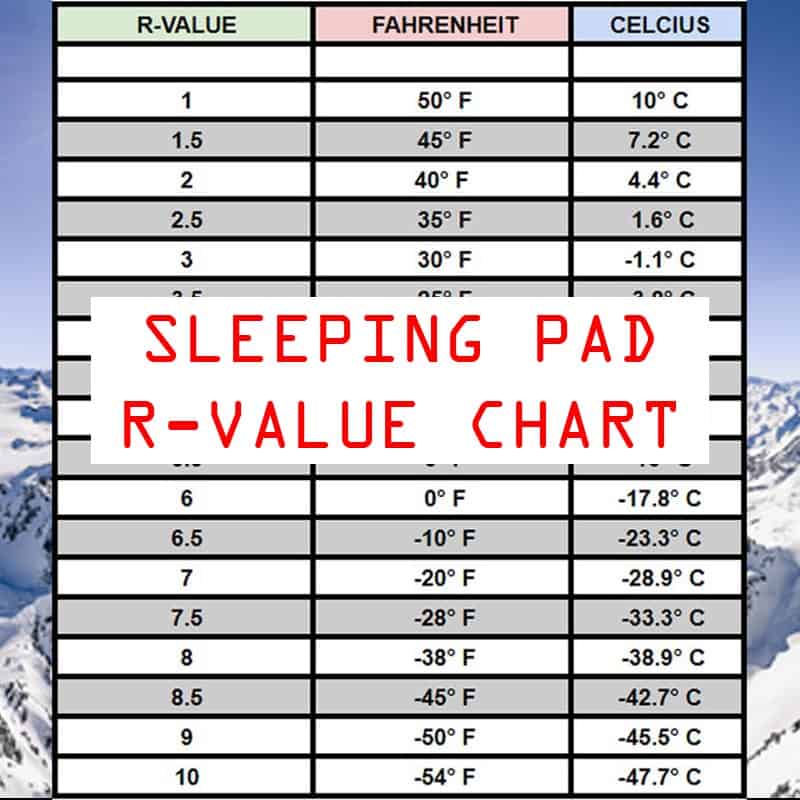
A lot of people want a simple way to translate R-value into the sort of temperatures they might encounter outdoors, which is why I originally made the chart below.

I still think the chart is useful as a rough practical guide, especially when comparing summer, three-season and winter sleeping pads.
Just don’t treat each temperature as a hard limit.
An R-value measures thermal resistance, not the exact lowest air temperature at which every person will sleep comfortably.
Your real-world comfort also depends on:
- Your sleeping bag or quilt
- Your clothing
- Whether you sleep warm or cold
- Wind and shelter
- Ground temperature
- Snow, rock, frozen soil or vegetation beneath you
- Humidity
- How inflated the pad is
- Your body size and sleeping position
So I would use the Fahrenheit and Celsius figures in the image as an approximate planning reference rather than a guaranteed temperature rating.
That is also why the broader seasonal ranges in the table above are more useful when choosing a pad.
What Does R-Value Actually Mean?
R-value is a measure of resistance to heat flow.
When you sleep outside, your sleeping bag insulation underneath your body gets compressed.
Compressed insulation doesn’t trap air nearly as effectively.
That leaves the sleeping pad responsible for slowing heat loss from your body into the ground.
A higher R-value means the pad offers greater resistance to that heat transfer.
So:
Higher R-value = better insulation from the ground.
It doesn’t necessarily mean:
Higher R-value = a warmer or more comfortable bed in every situation.
A very high-R pad can still be uncomfortable if it is too narrow, badly inflated or paired with the wrong sleeping bag.
How Are Sleeping Pad R-Values Tested?
Modern sleeping pads from major manufacturers are commonly tested using ASTM F3340.
This was a major improvement for the industry.
Before standardized testing, one manufacturer could publish an R-value using one method while another used something completely different.
Comparing the numbers wasn’t always meaningful.
Therm-a-Rest was one of the companies involved in developing the standardized method.
The basic idea is simple:
- The sleeping pad is placed between controlled hot and cold plates.
- A known temperature difference is maintained.
- The equipment measures how much energy is required to maintain that difference.
- That result is used to calculate the pad’s thermal resistance.
The higher the resistance, the higher the R-value.
The ASTM standard means pads tested to the same method can be compared much more reliably across brands.
When Did Sleeping Pad R-Values Become Standardized?
The industry began developing a common sleeping-pad test in the second half of the 2010s.
ASTM F3340 was finalized around 2019 and began appearing widely on sleeping pads from 2020 onwards.
That matters when you are looking at old reviews.
An R-value quoted for an older sleeping pad may have been produced using a manufacturer’s own test rather than the standardized ASTM method.
The pad itself may not have changed at all, but the published R-value can change when retested using the newer standard.
What R-Value Do I Need for Summer Camping?
For genuinely warm summer conditions, an R-value around 1-3 is often enough.
This is where ultralight sleeping pads make the most sense.
You can save a surprising amount of weight by removing insulation that you don’t need.
I wouldn’t automatically choose the lowest possible R-value, though.
Summer nights can still get cold, especially:
- At altitude
- On exposed campsites
- In northern climates
- During clear nights
- When sleeping directly on cold rock
If I wanted one lightweight pad for general summer backpacking rather than only hot-weather trips, I would prefer some margin rather than chasing the absolute lowest R-value.
What R-Value Do I Need for 3-Season Camping?
For general three-season use, I normally look around R 3-5.
That is a broad range because “three season” can mean very different things.
A summer-to-early-autumn campsite at low elevation is nothing like camping high in the mountains in March.
Around R 3 gives you a lightweight setup for relatively mild conditions.
Moving towards R 4-5 gives you much more flexibility when the ground becomes cold.
For someone buying only one sleeping pad, I think this is one of the most useful ranges.
What R-Value Do I Need for Winter Camping?
For genuine winter camping, I start looking around R 6 and above.
That isn’t a magic safety threshold.
It is simply where sleeping pads become much better suited to regular use on frozen or snow-covered ground.
EXPED currently recommends a sleeping mat with an R-value of at least 6.5 if you want to make sure an ISO-rated sleeping bag can deliver the warmth it is rated for.
That is particularly interesting because standardized sleeping-bag testing uses a highly insulated mat underneath the test system.
Your sleeping bag’s temperature rating therefore assumes the ground insulation isn’t the weak link.
This is one reason people sometimes buy an expensive cold-weather sleeping bag and still wake up freezing.
The bag isn’t necessarily the problem.
The sleeping pad can be.
Sleeping Pad R-Value Season Ratings
If you prefer to think in seasons rather than numbers, this is my simplified guide:
- R 1-2 = SUMMER / WARM 2-SEASON USE
- R 2-3 = SUMMER TO MILD 3-SEASON
- R 3-4 = GENERAL 3-SEASON
- R 4-5 = COLD 3-SEASON / SHOULDER SEASON
- R 5-6 = COLD WEATHER / LIGHT WINTER
- R 6-8 = WINTER
- R 8+ = SEVERE WINTER / EXPEDITION
Again, don’t treat these as fixed temperature ratings.
They are just a useful way to narrow down the kind of pad you should be looking at.

Is a Higher R-Value Sleeping Pad Always Better?
For warmth, yes.
For everything else, not necessarily.
A higher R-value normally means more insulation.
That can also mean:
- More weight
- A larger packed size
- A higher price
- More complicated internal construction
If you only camp during warm summer nights, carrying an expedition pad with an enormous R-value isn’t particularly clever.
You are hauling insulation you don’t need.
On the other hand, having more R-value than necessary does not make you overheat in the same way that an excessively warm sleeping bag can.
The sleeping pad mainly slows heat loss into the ground.
So if the extra weight and cost don’t bother you, buying a warmer pad gives you more flexibility.
Can a Sleeping Pad Have Too Much R-Value?
From a thermal point of view, not really.
There isn’t a point where a sleeping pad becomes “too insulated” and starts actively heating you.
It is resistance, not a heater.
The disadvantages are practical:
- Weight
- Bulk
- Cost
For car camping, I am much less concerned about having excessive R-value because carrying weight barely matters.
For ultralight backpacking, I want enough insulation for the conditions with a sensible safety margin and no more than I need.
Can You Add the R-Values of Two Sleeping Pads Together?
Yes, approximately.
This is one of the most useful things about R-values.
If you stack two sleeping pads, their thermal resistances are approximately additive.
For example:
R 2 foam mat + R 4 inflatable pad = roughly R 6 combined.
That makes a closed-cell foam pad extremely useful in winter.
It can:
- Add extra insulation
- Protect your inflatable pad from punctures
- Provide emergency insulation if the inflatable fails
- Work as a sit mat around camp
For serious winter camping, I often like the redundancy of two pads rather than relying entirely on one inflatable mattress.
Does Sleeping Pad Thickness Determine R-Value?
No.
Thickness and insulation are related, but they aren’t the same thing.
A thick inflatable air mattress can have a surprisingly poor R-value if the inside is just a large chamber of moving air.
A thinner pad containing reflective layers, foam or other insulation can perform much better.
This is why using pad thickness as a shortcut for warmth doesn’t work.
Look at the tested R-value.
Why Does an Uninsulated Air Mattress Feel So Cold?
A big air mattress looks as though it should provide excellent insulation because you are several inches above the ground.
But large internal air spaces can allow heat to move around through convection.
Without foam, reflective barriers or another insulation system, the mattress may provide much less resistance than you expect.
That is why a relatively thin insulated backpacking pad can feel dramatically warmer than a huge cheap air bed.
If you are looking for alternatives, see my guide to air mattress alternatives.
What Is the Highest R-Value Sleeping Pad?
This changes as manufacturers introduce new pads, so I wouldn’t permanently crown one model as “the highest in the world”.
EXPED currently sells several very high-insulation mats, including its 10R backpacking models and high-R-value MegaMat products.
Check EXPED Dura 10R on Amazon USAn R-value around 10 is already extraordinary insulation for a sleeping pad.
For most people, the more useful question isn’t “what is the highest R-value available?” but “what is the lightest and most comfortable pad that gives me enough insulation for where I actually camp?”
What Does Therm-a-Rest Say About R-Value?
Therm-a-Rest has been one of the major forces behind standardized sleeping pad R-values.
The company was part of the ASTM working group that developed the common testing procedure now used across much of the industry.
Therm-a-Rest’s explanation is useful because it emphasizes what R-value actually measures:
Resistance to heat loss.
It doesn’t try to pretend the number is an exact temperature rating.
The company tests sleeping pads using controlled equipment that measures how much energy passes through the pad while maintaining set temperatures on either side.
This standardized process lets you compare a Therm-a-Rest pad with another ASTM-tested sleeping pad on a much more like-for-like basis.
If you want an example of how modern pads have developed, see my Therm-a-Rest NeoAir UberLite review, which now also discusses the current NeoAir XLite NXT.
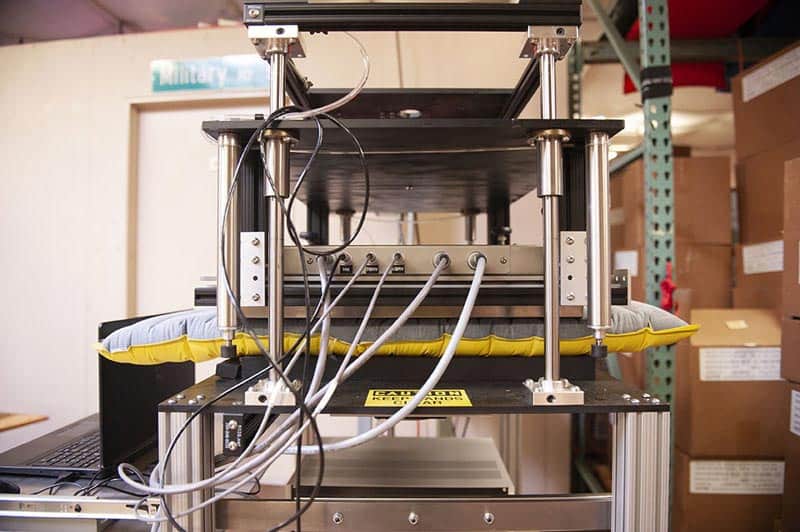
Image credit: Therm-a-Rest
What Does EXPED Say About R-Value?
EXPED also uses ASTM F3340 R-values across its current sleeping mat range.
Its naming system makes the warmth particularly easy to understand.
Products such as:
- Ultra 3R
- Ultra 6.5R
- Ultra 8R
- Ultra 10R
- Dura 10R
put the approximate R-value directly into the model name.
EXPED also makes an important point that is easy to overlook:
ISO-rated sleeping bags are tested using very highly insulated mats.
EXPED currently recommends at least an R-value of 6.5 if you want your sleeping system to give your sleeping bag the best chance of performing around its published rating.
That doesn’t mean everyone needs an R 6.5 mat.
It means you shouldn’t assume a sleeping bag’s laboratory rating includes the effect of sleeping on a poorly insulated pad.
Does Your Sleeping Bag Rely on the Sleeping Pad?
Absolutely.
When you lie on a sleeping bag, your body compresses most of the insulation underneath you.
Down and synthetic insulation work primarily by trapping air.
Flatten them and they lose much of that ability.
The sleeping pad therefore becomes a major part of the insulation underneath your body.
I think of a winter sleeping system as two separate halves:
Sleeping bag or quilt = insulation above and around you.
Sleeping pad = insulation between you and the ground.
You need both.
Buying an extremely warm sleeping bag and pairing it with an R 1 summer mat is a badly unbalanced system.
What R-Value Should Side Sleepers Use?
You don’t necessarily need a different R-value just because you sleep on your side.
R-value is the pad’s measured thermal resistance.
But side sleepers often put more concentrated pressure through the hips and shoulders.
That makes pad thickness and inflation level particularly important.
If your hip is almost touching the ground through an underinflated pad, the theoretical R-value isn’t the only thing affecting comfort.
I would choose the R-value for the expected conditions first, then make sure the pad is thick enough to keep your hips and shoulders properly supported.
Do Closed-Cell Foam Pads Have R-Values?
Yes.
Foam mats can be tested and given R-values just like inflatable pads.
Their biggest advantage isn’t usually enormous warmth.
It is reliability.
They cannot puncture and completely deflate.
This makes them excellent as:
- Summer pads
- Backup mats
- Extra winter insulation beneath an inflatable
If you like simple equipment, see my guide to the best foam sleeping pads.
My Sleeping Pad R-Value Rule of Thumb
If I wanted to simplify this entire article into one rough guide, it would be:
- Hot summer: R 1-3
- General three-season: R 3-5
- Cold shoulder season: R 4-6
- Winter: R 6+
- Severe winter: R 8+
Then I would adjust upwards if I:
- Sleep cold
- Expect frozen ground
- Am camping at altitude
- Want a larger safety margin
I would adjust downwards only when I know the conditions will be mild and reducing pack weight really matters.
Final Verdict
Sleeping pad R-value is one of the most useful specifications in camping gear because the ASTM standard now lets us compare insulation between major brands far more reliably than we could in the past.
Just don’t make the mistake of treating it as an exact temperature rating.
R-value tells you resistance to heat loss through the sleeping pad. It does not tell you the exact air temperature at which you will feel comfortable.
For most people:
- R 1-3 works for warm-weather camping.
- R 3-5 covers a lot of three-season use.
- R 6+ is where I would look for genuine winter camping.
- R 8+ gives you serious insulation for very cold conditions.
And remember that you can stack pads and approximately add their R-values together.
That makes it much easier to build a sleeping system around the trips you actually take instead of buying a different sleeping pad for every season.
I hope this updated sleeping pad R-value chart makes the system easier to understand and, more importantly, stops you relying on misleading R-value-to-temperature conversions when choosing a camping mat.






[…] 30º Fahrenheit, and you plan to camp, you need a 4-season sleeping pad with insulation and a high R-value rating to keep you warm. For most people, this will be an R-value of 5, which will keep you warm […]
[…] sleeping on the ground and so to combat the winter weather you need an insulated pad. Check out our guide to R-values if you want to learn […]
[…] resistance testing machine like the one at Thermarest headquarters it is impossible for us to know the R-value of a wool blanket. But, just from having tested dozens of different sleeping pads over the last 20 […]
[…] low a temperature a sleeping pad or other equipment will continue to keep us warm. We have a chart here that explains the correlation between the R-Value and the outside temperature. The majority of […]