
Osprey Exos 48 Backpack Review | Most Comfortable Ultra-Lightweight Backpack


The Osprey Exos 48 is still one of my favourite lightweight framed backpacks for thru-hiking and multi-day trips. I have used both older and updated versions of the Exos, and the reason I keep coming back to it is simple: it gives you the ventilation and comfort of a proper suspended-frame backpack without the weight of a traditional heavy hiking pack.
The Exos isn’t the lightest 48-litre backpack available, and that is actually part of why I like it. Instead of stripping away the frame, hipbelt structure and useful features just to save a few hundred grams, Osprey has kept the things that make a backpack comfortable when you are carrying it all day.
The current Exos 48 has also fixed some of the weaknesses of older versions. It now has two zipped hipbelt pockets, a stronger AirSpeed mesh back panel, four inches of torso adjustment and tougher recycled fabrics while still weighing only around 2.8 lb.
QUICK VERDICT
Best for: Lightweight backpacking, thru-hiking and multi-day trips with loads around 25-30 lb.
What I like: Exceptional comfort, superb back ventilation, useful external storage and a proper frame without excessive weight.
What I don’t like: The front stretch pocket is still the part I am most careful with, and the recommended load range is lower than heavier backpacking packs.
Would I buy it again? Yes. If I wanted one lightweight framed backpack for long-distance hiking, the Exos 48 would still be near the top of my list.
Is the Osprey Exos 48 Worth It?
Yes.
The Exos 48 sits in a sweet spot between genuinely ultralight frameless backpacks and heavier traditional backpacking packs.
There are four reasons I rate it so highly:
- It is very light for a framed backpack. The current S/M weighs about 2.77 lb / 1.255 kg.
- The AirSpeed suspension is exceptionally comfortable. I still rate it as one of the best back systems I have used.
- The pack sits away from your back. Air can move through the gap rather than your shirt being pressed against a slab of sweaty fabric all day.
- It still feels like a complete backpack. You get a removable lid, hipbelt pockets, side pockets, trekking-pole attachment, compression straps and a proper frame.
That combination is why I prefer it to a lot of lighter packs. Saving 300 or 400 grams stops feeling clever if the backpack is digging into your shoulders after eight hours.
Osprey Exos 48 Backpack Review


Current Exos 48 Specifications
- VOLUME: 48 L S/M; 51 L L/XL
- WEIGHT: 2.767 lb / 1.255 kg S/M; 2.853 lb / 1.294 kg L/XL
- RECOMMENDED LOAD RANGE: 25-30 lb / 11-14 kg
- S/M DIMENSIONS: 29.53 x 14.17 x 11.81 in / 75 x 36 x 30 cm
- MAIN FABRIC: bluesign-approved recycled 100D high-tenacity nylon ripstop
- HIGH-WEAR FABRIC: recycled 400D high-tenacity nylon
- DWR: PFC/PFAS-free
- FRAME: 4 mm powder-coated LightWire
Key Features
- Adjustable AirSpeed suspended mesh back panel
- Four inches of torso adjustment
- Two zipped hipbelt pockets
- Removable floating lid with top and under-lid pockets
- Integrated FlapJacket for lidless use
- Internal hydration sleeve
- Large front stretch pocket
- Dual-access stretch side pockets
- Side compression straps
- Removable sleeping-pad straps
- Dual ice-axe loops
- Stow-on-the-Go trekking-pole attachment
- Sternum strap with safety whistle
The feature list is fairly restrained compared with Osprey’s heavier trekking backpacks, which is exactly what I want from the Exos. There are enough pockets and attachment points to make the bag convenient without covering it in zippers, compartments and unnecessary material.
Also Available From

My Experience With the Osprey Exos 48
My first impression of the Exos was how quickly it felt comfortable. I stuffed one of mine with bulky camping gear and took it out almost immediately after it arrived.
The suspended mesh back panel moulds around your back while keeping the main body of the pack physically separated from you. That gives the Exos a very different feeling from a lightweight frameless pack.
Instead of the contents of the backpack creating the structure, the LightWire frame holds everything in shape and transfers the load into the hipbelt.
After using the Exos over a much longer period, that initial comfort wasn’t just a good first impression. It is the reason I still rate it so highly.
Size and Weight
The current Exos 48 is slightly heavier than some older versions. The S/M is now approximately 1.255 kg / 2.767 lb, while the L/XL is around 1.294 kg / 2.853 lb.
That extra weight isn’t wasted. The current generation has a stronger back-panel mesh, proper zipped hipbelt pockets, more durable materials and an adjustable torso system.
For me, that is worth carrying.
The Exos family is also available in different capacities, including the Exos 38 and Exos 58.
I still think the 48 is the sweet spot. It is large enough for a normal lightweight multi-day setup without encouraging me to fill a massive bag with things I don’t need.
One detail worth knowing is that Osprey’s stated volume changes with the frame size. The S/M is a true 48 L while the taller L/XL is around 51 L.
How Much Weight Can the Exos 48 Carry?
This is one area where I would correct my older review.
I previously talked about carrying around 35 lb in the Exos 48. You can physically put that much gear into it, and I have carried the pack heavily loaded, but Osprey’s current recommended load range for the Exos 48 is 25-30 lb / 11-14 kg.
That is the range I think suits the backpack best.
Around those weights, the suspension feels excellent and the pack still behaves like a lightweight backpack. Once you start pushing well beyond 30 lb, you are moving away from what the Exos was designed to do.
If I expected to regularly carry heavier loads, I would either look at the Exos 58 or move into one of Osprey’s heavier load-hauling ranges.
For normal thru-hiking loads, 48 litres gives me plenty of room for camping equipment, clothing, food and water.

Comfort
Comfort is still the main reason I recommend the Exos.
I have used backpacks with dramatically thicker shoulder straps and huge padded hipbelts that aren’t as comfortable as this.
The clever part is the suspended AirSpeed mesh. Instead of simply adding more foam between the backpack and your body, Osprey stretches a supportive mesh surface across the frame.
It acts almost like a miniature hammock for your back.
The pressure feels evenly distributed and the actual body of the backpack never sits directly against your spine.
The current ExoForm harness and hipbelt are relatively minimal to look at, but I don’t think they need more padding. With the pack loaded sensibly, the frame and suspension are doing most of the clever work.
Back Ventilation
This deserves its own section because the ventilation is exceptional.
The AirSpeed back panel creates a genuine air gap between your back and the backpack.
That doesn’t mean you will never sweat while hiking uphill in hot weather. Nothing can do that.
But compared with packs where the back panel sits directly against you, I find the difference very noticeable.
Air can enter from the sides and move behind the mesh while you walk. For long-distance hiking in warm weather, this is one of the Exos’s biggest advantages.
Durability
The Exos is a lightweight backpack, so I don’t treat it exactly like an Osprey Kestrel or another heavyweight trekking pack.
That said, mine have held up well.
The part I have always watched most carefully is the large stretch pocket on the front. It is incredibly useful, but stretchy mesh is naturally more vulnerable to snagging against branches, rock and other sharp objects than solid 400D fabric.
My older Exos developed a few snags there without suffering any serious structural failure.
Osprey has strengthened the current generation. The latest AirSpeed back panel uses stronger mesh with fewer seams specifically to improve reliability for thru-hiking, and high-wear sections use 400D recycled nylon.
The main body and bottom remain 100D high-tenacity ripstop to keep the weight down.
That is a sensible compromise. I don’t want Osprey making the entire Exos from heavy fabric just because one area might eventually pick up a scuff.
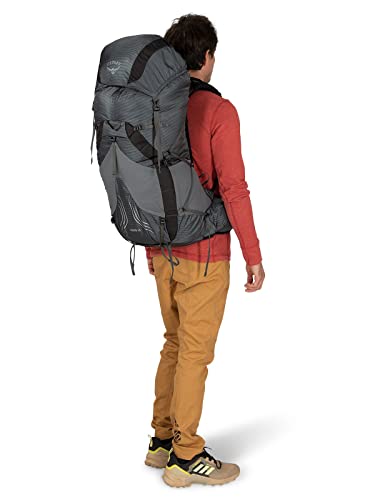
Adjustability and Fit
The current Exos is available in S/M and L/XL.
Within those sizes, the AirSpeed suspension provides around four inches of torso-length adjustment.
This is a major improvement over genuinely minimalist ultralight packs that often rely on simply buying the correct fixed torso size.
You can then fine-tune the fit using the shoulder straps, load lifters, sternum strap, hipbelt and torso adjustment.
I think fit is one of the reasons some people love the Exos while others don’t immediately understand the hype.
Get the torso length and hipbelt position right before judging it.
When properly adjusted, I want most of the load transferred into the hipbelt while the shoulder straps hold the pack close rather than carrying all the weight.

Organization
Organization isn’t the Exos’s strongest feature, but I actually prefer it that way.
Inside the main compartment, there isn’t a complicated collection of dividers and pockets. You basically get the main storage area plus the hydration sleeve.
Most of the useful organization is outside.
Hipbelt Pockets
The current Exos has two zipped hipbelt pockets. This was a welcome return after an older generation removed them.
I use hipbelt pockets for the things I want without taking the pack off: snacks, small items and anything I am likely to reach for while walking.
Side Pockets
The two stretch side pockets have dual access. That makes it possible to angle a smaller water bottle so you can remove and replace it without taking the backpack off.
They are also useful for poles, wet equipment or anything I don’t want buried inside the main compartment.
Front Stretch Pocket
This is probably my most-used pocket.
I stuff rainwear, litter, wet clothing and other frequently used items into it.
The downside is that it is also the area most likely to catch on something, so I avoid stuffing hard or sharp objects into the mesh.
Removable Lid
The floating lid gives you top and under-lid zipped storage.
For shorter or lighter trips, you can remove the lid completely. Osprey’s integrated FlapJacket then covers the top of the main compartment.
I really like this because it lets the Exos behave almost like two different backpacks.
Keep the lid when you want the extra organization. Remove it when you want the simplest and lightest setup.
Weather Resistance

The current Exos fabrics use a PFC/PFAS-free DWR treatment.
That helps the outer fabric shed light rain, but the Exos 48 is not a waterproof backpack.
For sustained rain, I protect anything important inside with dry bags or a waterproof pack liner.
That is actually my preferred system even when a backpack has a rain cover, because a pack cover can still allow water in around the harness and it doesn’t help if the backpack gets dropped in water.
If you prefer an external cover, Osprey sells compatible rain covers separately.
One advantage of the AirSpeed suspension in wet weather is that the body of the pack remains away from your back instead of trapping a layer of rain and sweat directly against you.
Frame and Suspension
The Exos uses a 4 mm powder-coated LightWire frame.
It is rigid enough to keep the pack’s shape and tension the AirSpeed mesh without feeling like you have a metal frame pressed against your body.
That is one of the cleverest things about the design.
You get the load transfer of a framed backpack while the suspended mesh prevents you actually feeling the frame against your spine.
I wouldn’t remove or modify it to save weight. The whole point of buying an Exos instead of an ultralight frameless pack is that you get this suspension system.
Access
The Exos is primarily a top-loading backpack.
There is no giant suitcase-style panel zip or bottom sleeping-bag compartment.
I am completely fine with that.
Every additional opening needs zippers, seams and reinforcement, all of which add weight.
The top opening is wide enough that packing isn’t difficult.
I normally put sleeping equipment and things I won’t need during the day towards the bottom, then keep food, rainwear and other frequently used kit higher up or in the external pockets.
If you need constant access to everything inside your backpack, another design may suit you better. For thru-hiking, the simplicity works.
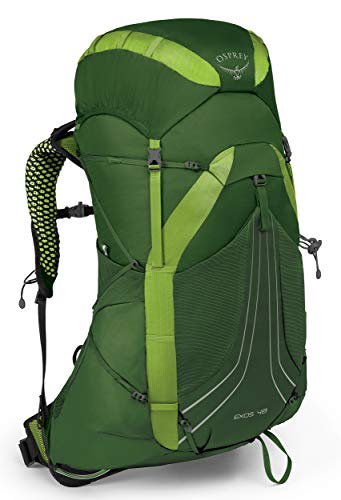
Exos 48 vs Exos 58
If your gear is reasonably compact, I would choose the Exos 48.
If you routinely carry bulkier cold-weather equipment, several days of food or heavier loads, the Exos 58 gives you more breathing room.
The 58 is also rated for a slightly higher load range than the 48.
I wouldn’t automatically buy the larger pack “just in case”. Give me extra volume and I have a bad habit of finding things to fill it with.
For most lightweight three-season backpacking, 48 litres is enough.
Exos 48 vs Frameless Ultralight Backpacks
A frameless backpack can easily save another pound compared with the Exos.
That doesn’t automatically make it better.
With a very light and compact load, I understand the appeal of a frameless pack.
Once the load gets heavier, I prefer having an actual frame and hipbelt transferring weight away from my shoulders.
The Exos gives up some weight to provide a proper LightWire frame, excellent ventilation, an adjustable torso, a structured hipbelt and more useful external storage.
For me, that is a worthwhile trade on long trips.
If you want to go further in the other direction, see my guide to the best frameless backpacks.
Osprey Exos 48 Pros and Cons
- Exceptionally comfortable AirSpeed suspension
- Excellent ventilation
- Very light for a fully framed backpack
- Current version has two zipped hipbelt pockets
- Four inches of torso adjustment
- Removable floating lid
- Useful front and side stretch pockets
- Good balance between features and weight
- 25-30 lb recommended load range is lower than heavier packs
- Front stretch mesh needs more care than solid fabric
- No included rain cover on the current model
- Minimal internal organization
Who Is the Osprey Exos 48 Best For?
I think the Exos 48 makes the most sense for:
- Thru-hikers
- Lightweight backpackers
- Multi-day hikers
- People who run hot and value back ventilation
- Anyone who wants to reduce pack weight without going frameless
- Loads that generally stay below about 30 lb
I would look elsewhere if you regularly carry very heavy expedition loads, need lots of separate internal compartments or want an indestructible bushcraft pack.
Final Verdict
The Osprey Exos 48 is still one of the easiest backpacks for me to recommend because it gets the difficult things right.
It is light without feeling flimsy.
It is ventilated without giving up proper load support.
It has enough features without becoming cluttered.
Most importantly, it remains incredibly comfortable.
The AirSpeed suspended back panel is still the feature that separates it from many competing lightweight packs for me.
The current generation is slightly heavier than some earlier Exos models, but I think the trade is worthwhile. You now get stronger mesh, adjustable suspension, recycled fabrics and proper hipbelt pockets while remaining well below the weight of most traditional framed backpacking packs.
I would keep the load around Osprey’s recommended 25-30 lb range and use it for exactly what it was designed for: covering long distances with a lightweight multi-day setup.
For that job, I still think the Osprey Exos 48 is excellent.
I hope you found this Osprey Exos 48 backpack review helpful. I genuinely rate this pack and am not paid by Osprey to say that; the commercial links on this page are my own affiliate links.




[…] The Karrimor SF Sabre 45 Backpack first started gaining popularity among bushcrafters in 2019, and here’s why. It is the perfect size for overnight or weekend bushcraft trips, It is practically bombproof in terms of durability and is designed to fit two large rocket pouches on either side for expanded storage. If I were to design my own bushcraft backpack, I would probably base the design on the Sabre but with the frame of an Osprey Exos. […]
[…] used the Osprey Exos 48 liter backpack and found that I could fit my tent, sleeping pad, and sleeping bag in a row at the bottom of my […]
[…] Read the full Osprey Exos 48 backpack review here […]