Lansky QuadSharp Review

I have had the Lansky QuadSharp long enough for some of the blue paint to chip off the metal body, but the important part hasn’t really aged at all: it still sharpens my blades as well as it did when it arrived.
That sums up this sharpener fairly well.
It isn’t a delicate precision system that needs setting up on a workbench.
It is a small lump of metal containing four preset carbide sharpening angles and a ceramic finishing stone.
You pick the angle, pull the blade through a few times and then refine the edge on the ceramic.
It is fast, simple and extremely convenient.
I have used mine on everything from pocket knives and bushcraft knives to kitchen knives and larger blades, and it remains one of the easiest sharpeners I own to grab when I just want to restore an edge quickly.
LONG-TERM VERDICT
What I like: Four preset angles, extremely fast sharpening, useful ceramic finishing stone, solid metal construction and almost no learning curve.
What has aged: Some of the blue paint has chipped off the casing.
What hasn’t aged: The sharpening performance. Mine still sharpens blades as effectively as it did when new.
Would I buy it again? Yes. Especially as a compact field sharpener rather than my only sharpening system.
Lansky QuadSharp Features and Specifications
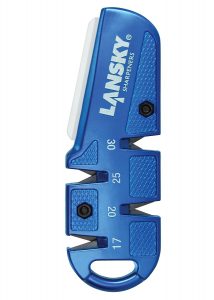
- SHARPENING ANGLES: 17°, 20°, 25° and 30°
- MAIN SHARPENER: Tungsten-carbide V-grooves
- FINISHER: Built-in 800-grit ceramic benchstone
- SERRATIONS: Tapered ceramic edge can sharpen individual serrations
- BODY: Rugged metal construction
- LENGTH: Approximately 4.2 in / 10.7 cm
- PORTABILITY: Pocket-sized with lanyard/keyring hole
- COMPATIBILITY: Uses the same 17°, 20°, 25° and 30° angles as the Lansky Controlled-Angle system
One thing I found while updating this review is that published weights vary between retailers.
I have seen figures around 113 g, 140 g and even higher depending on the listing.
Rather than pretend one of those is definitive, I would simply describe it as small but noticeably heavier than a plastic pocket sharpener because the body is metal.
That is exactly how it feels in the hand.

How the Lansky QuadSharp Works
The QuadSharp is basically two sharpeners in one.
You get:
- Four aggressive carbide V-slots for quickly setting or restoring an edge.
- An 800-grit ceramic benchstone for refining, touching up and polishing the edge.
The four carbide slots are permanently set at:
- 17°
- 20°
- 25°
- 30°
That takes one of the hardest parts of freehand sharpening out of the equation.
Instead of trying to hold a blade at exactly 20° over a stone, you simply use the corresponding slot.
This is why I think the QuadSharp is so easy for beginners.
How to Use the Lansky QuadSharp
If the knife is genuinely dull, choose the carbide slot that best matches the existing edge.
Hold the QuadSharp firmly with one hand.
Keep your fingers well away from the path of the blade.
With the knife in your dominant hand:
- Place the heel of the blade into the correct sharpening slot.
- Pull the knife smoothly towards you through the slot.
- Use moderate rather than excessive pressure.
- Repeat only as many times as necessary.
- Finish the edge using the ceramic benchstone.
- Test the blade on paper.
Lansky itself says the carbide slots can restore an edge in around three or four strokes.
That has always been one of the things I like about it.
You get results almost immediately.

The Carbide Sharpeners Are Very Aggressive
This is probably the most important thing to understand about the QuadSharp.
The carbide slots work quickly because they remove steel quickly.
That is brilliant when you have a genuinely dull knife.
It is unnecessary when the knife only needs a small touch-up.
Lansky itself recommends using the carbide section for quickly resetting or restoring an edge and using the ceramic section for general maintenance.
That matches how I use mine now.
If the knife is already fairly sharp:
I go straight to the ceramic.
There is no point removing more blade steel than necessary.
For more detail on sharpening technique, see my updated guide to sharpening a pocket knife.
Initial Impressions vs Long-Term Use
When I first reviewed the QuadSharp, one of the things that impressed me was the metal construction.
That opinion hasn’t really changed.
It feels substantial.
There are no hinges, springs or complicated moving parts.
It is basically a metal frame holding the carbide and ceramic sharpening surfaces.
After plenty of use, the most obvious sign of age on mine is cosmetic.
The blue paint has chipped away in places.
I don’t really care.
If anything, I quite like tools that start looking used.
More importantly:
- The carbide slots still work.
- The ceramic still works.
- The body is still solid.
- Nothing important has broken.
And it still puts a sharp edge on a blade as effectively as it did when new.
For something designed to live in toolboxes, backpacks and pockets, that matters much more to me than perfect paint.
Four Preset Sharpening Angles

This is what separates the QuadSharp from the countless little one-angle pull-through sharpeners available.
Most cheap pocket sharpeners give you one predetermined angle.
The QuadSharp gives you four.
That makes it much more useful if, like me, you sharpen several different types of knife.
17° Angle
Lansky recommends 17° when you want an extremely fine but relatively delicate edge.
Typical uses include:
- Razors
- Very fine slicing blades
- Other delicate cutting edges
I wouldn’t automatically put an outdoor knife at 17° just because a lower angle sounds sharper.
A very acute edge can roll or chip more easily during hard use.
20° Angle
The 20° slot works well for fine slicing knives, kitchen knives and fillet knives.
It also suits many lighter pocket knives.
This gives you a very sharp cutting edge without going as extreme as 17°.
25° Angle
This is probably the most useful QuadSharp setting for general outdoor knives.
Lansky recommends 25° for:
- Hunting knives
- Outdoor knives
- Utility knives
You sacrifice a little ultimate slicing performance compared with a very acute edge, but gain durability.
For bushcraft and general outdoor use, that is normally a trade I am happy to make.
30° Angle
The 30° setting is for harder-working edges.
Think:
- Heavy utility knives
- Blades cutting tough materials
- Edges where toughness is more important than delicate slicing performance
This produces a much stronger but less refined edge.
Use the Angle That Matches Your Knife
This is something I would change from my original review.
Back then I wrote that on badly damaged knives I sometimes started at 30° and then dropped down to 20°.
I would not recommend doing that now as a general sharpening technique.
Changing from 30° to 20° means you are effectively reprofiling the blade and removing far more steel.
If your knife already has an appropriate edge geometry, the better approach is:
Match the existing bevel as closely as possible.
If it is approximately 25°, use 25°.
If it is around 20°, use 20°.
Only deliberately change the angle if you actually want to reprofile the knife and understand what that involves.
Ceramic Benchstone

The ceramic benchstone remains my favourite feature on the QuadSharp.
It is approximately 800 grit and lets you sharpen freehand.
Unlike the aggressive carbide slots, it removes relatively little material.
I use it for:
- Regular edge maintenance
- Touch-ups
- Refining an edge after the carbide slots
- Serrated blades
Once you already have a good bevel, this is the part of the QuadSharp I use most.
The ceramic can gradually become covered with dark marks.
Those are steel particles collecting on the abrasive surface.
That doesn’t mean the ceramic has worn out.
Clean it and its cutting performance returns.
How to Clean the Ceramic Stone
Over time, the white ceramic becomes grey or black where blade steel builds up.
Lansky recommends cleaning ceramic sharpeners with its EraserBlock or a suitable kitchen cleanser.
I wouldn’t leave it completely loaded with metal.
Once the ceramic surface becomes clogged, it stops cutting as efficiently.
A quick clean exposes the abrasive again.
The ceramic itself is extremely durable.
The main thing you need to avoid is dropping it hard enough to crack the ceramic.
Sharpening Serrated Knives
The tapered shape of the ceramic section also lets you sharpen serrations.
For a serrated blade, don’t drag the entire edge through one of the carbide V-slots.
Instead, sharpen the individual scallops.
Use the tapered ceramic edge that best matches the curve of the serration.
Work one serration at a time.
For larger grooves, a gentle rolling movement lets the ceramic contact more of the curved surface.
It takes longer than sharpening a plain edge.
But the QuadSharp gives you the tool to do it without carrying a separate serration sharpener.
See my full guide to sharpening serrated knives for more detail.
How Fast Is the Lansky QuadSharp?
Very.
That is probably its biggest advantage.
With a traditional stone, I need to:
- Find the angle
- Maintain it
- Work both sides evenly
- Check the burr
The QuadSharp removes most of that effort.
Choose the slot and make a few controlled passes.
For quickly restoring a working edge, it is hard to beat.
I wouldn’t claim it produces a more refined edge than a well-used whetstone or controlled sharpening system.
It doesn’t.
What it gives you is speed and repeatability.
How Sharp Can You Get a Knife?
Sharp enough that I have always been able to get clean cuts through paper.
With a few carbide passes followed by careful work on the ceramic, I can get an extremely sharp practical edge.
I have successfully sharpened:
- Kitchen knives
- Pocket knives
- Bushcraft knives
- Larger outdoor blades
with mine.
That doesn’t mean I would choose the QuadSharp for every expensive knife I own.
For a premium blade where I wanted to preserve a specific factory bevel or produce an extremely polished edge, I would use a proper stone or controlled-angle system.
For tools I actually use and want sharp again quickly, the QuadSharp is excellent.
Is the Lansky QuadSharp Good for Expensive Knives?
This depends on what you want.
The carbide inserts physically scrape steel from the edge.
They work incredibly quickly, but they aren’t subtle.
If I owned an expensive knife with a beautiful factory edge that only needed touching up, I would not immediately attack it with the carbide slots.
I would use the ceramic section or a finer sharpening system first.
The QuadSharp is at its best when:
- The knife is actually dull.
- You want a working edge quickly.
- You know roughly what angle the blade needs.
- You value convenience over a perfect mirror polish.
Portability
The QuadSharp is small enough to put in a pack or pocket.
I wouldn’t call it an ideal keyring sharpener.
The metal body makes it heavier and larger than the tiny plastic sharpeners that genuinely disappear among your keys.
But for:
- Hunting packs
- Fishing kits
- Camping equipment
- Toolboxes
- Vehicle kits
it is ideal.
The extra weight is also part of what makes it comfortable to hold.
Durability
This is one area where I can now give a much better answer than I could in the original review.
The QuadSharp has aged very well.
Mine no longer looks new.
Some of the blue coating has chipped away from the casing.
Functionally, that has made no difference whatsoever.
It still sharpens blades exactly as I expect it to.
There isn’t much to go wrong because there are no complicated moving parts.
The main risks are:
- Physically damaging the carbide inserts
- Breaking the ceramic
- Losing the sharpener altogether
Normal cosmetic wear doesn’t matter.
This is one of those tools where I would much rather have scratched paint and a sharp knife than a pristine sharpener sitting unused in a drawer.
Pros
- Four useful preset sharpening angles
- Extremely fast
- Very easy to use
- Useful 800-grit ceramic finishing stone
- Can sharpen serrations
- Solid metal construction
- Compact enough for a backpack
- Still works extremely well after plenty of use
Cons
- Carbide slots remove steel aggressively
- Heavier than plastic pocket sharpeners
- Not as refined as a proper whetstone or controlled-angle system
- Paint on mine has chipped with use
- You still need to know which sharpening angle your knife requires
QuadSharp vs a Whetstone
I don’t think one replaces the other.
A whetstone gives you more control.
You can:
- Match almost any edge angle
- Control how much metal you remove
- Progress through multiple grits
- Create a much more refined edge
The QuadSharp gives you:
- Speed
- Convenience
- Preset angles
- Portability
If I am at home and want to spend time producing the best edge possible, I prefer stones.
If I want a knife sharp again in a minute, I reach for something like the QuadSharp.
Who Is the Lansky QuadSharp Best For?
I think it makes most sense for:
- Campers
- Hunters
- Anglers
- Bushcrafters
- People who own several different types of knife
- Anyone who struggles to maintain a freehand sharpening angle
If you only own one expensive kitchen knife and enjoy sharpening it carefully on Japanese water stones, you probably don’t need this.
If you regularly use knives and want a compact tool capable of putting a working edge back on them quickly, it makes a lot more sense.
Is the Lansky QuadSharp Still Available?
Yes.
The QuadSharp is still available through Lansky retailers, including Lansky’s UK distributor.
The basic design hasn’t really needed to change:
- 17° carbide slot
- 20° carbide slot
- 25° carbide slot
- 30° carbide slot
- 800-grit ceramic benchstone
- Metal housing
That is pretty much exactly what mine has always had.
Final Verdict
The Lansky QuadSharp is one of those pieces of gear that has become more convincing with time.
When I first reviewed it, I liked:
- The four angles
- The ceramic stone
- The speed
- The metal construction
I still like all of those things.
The difference now is that I know it lasts.
The blue paint has chipped away in places, but mechanically the QuadSharp still performs as well as it did when I first got it.
For badly dulled knives, the carbide slots restore an edge extremely quickly.
For normal maintenance, I use the ceramic.
And having four angles makes it considerably more versatile than the typical one-slot pocket sharpener.
I wouldn’t use the aggressive carbide slots every time a knife needs a tiny touch-up, and I wouldn’t pretend it gives you the precision of a good sharpening stone.
But as a fast, compact and extremely durable field sharpener, I still rate the Lansky QuadSharp highly.
Lansky QuadSharp Review