
8 Best Cabin Tents in 2026 | Family and Group Cabin Tents for Camping

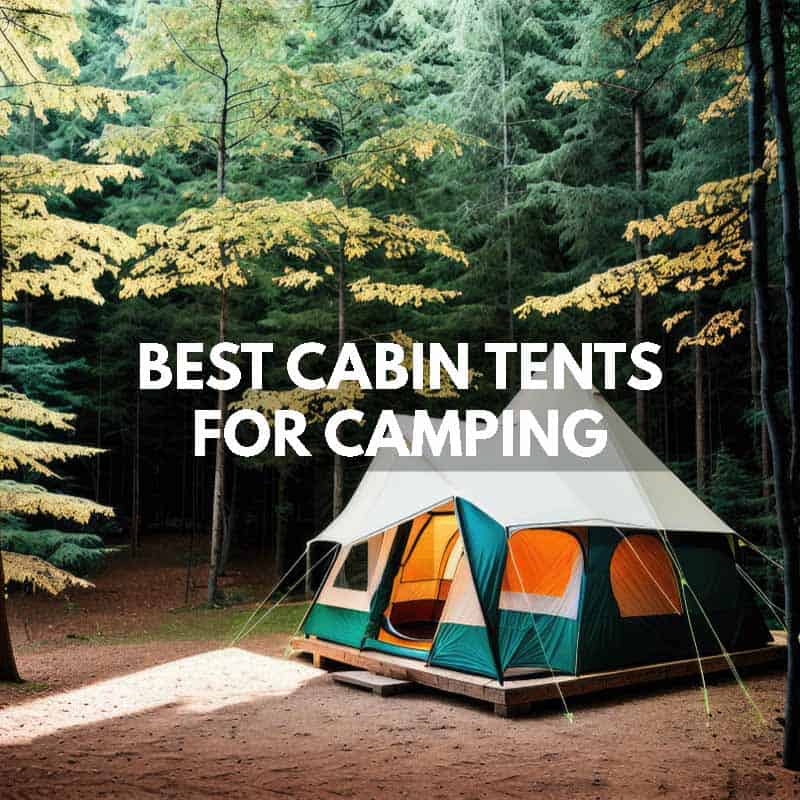
In this guide to the best cabin tents, I share the most spacious and comfortable cabin-style tents I have used for family camping, group trips and longer stays at camp. The main reason to choose a cabin tent is simple: near-vertical walls give you far more usable living space than most dome tents, with enough headroom for proper beds, chairs, tables and, in some models, separate sleeping rooms.
Why are they called cabin tents? Because they are shaped like a cabin.
Cabin tents are spacious, full of useful features and bring a completely different level of comfort to car camping. Whether you’re planning a family holiday, a festival with friends or spending a couple of weeks at one campsite, being able to stand up, organise your gear and create separate living and sleeping areas makes a massive difference.
They are not lightweight tents and they are generally not what I would choose for exposed mountaintops or backpacking. But when weight doesn’t matter because the car is parked nearby, a good cabin tent is one of the most comfortable ways to camp.
QUICK PICKS
Best overall: Snow Peak Land Lock
Best canvas cabin tent: Kodiak Canvas 12 x 9 Cabin Tent
Best long-stay canvas tent: White Duck Prota 7 x 9
Best family cabin tent: Naturehike Village 13
Best value instant cabin tent: CORE 9-Person Instant Cabin Tent
Best blackout cabin tent: Coleman 10-Person Dark Room Instant Cabin Tent
Best instant cabin tent with screen room: Gazelle T4 Plus Hub Tent
Best huge budget cabin tent: Ozark Trail 12-Person Cabin Tent
8 Best Cabin Tents
Snow Peak Land Lock
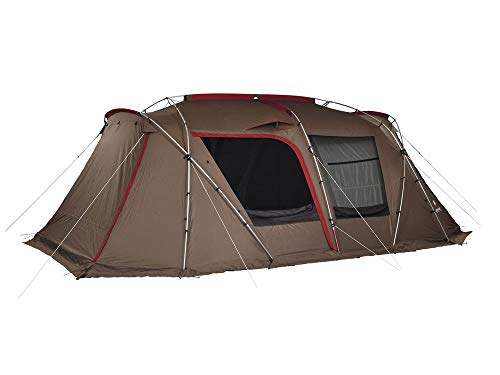

- CAPACITY: 4+ people
- WEIGHT: 54 lbs / 24.5 kg
- FLOOR SIZE: 20.5 x 13.3 ft / 6.25 x 4.05 m
- MAX HEIGHT: 6.7 ft / 204 cm
- PACKED BAG: 29.5 x 13 x 14.2 in
- ROOMS: Living area + private inner sleeping tent
- BEST FOR: Best overall cabin tent with a huge living area
The Snow Peak Land Lock is a luxury cabin-style tent designed to work more like a portable home than somewhere you simply crawl into at bedtime. It is one of the best large tents I have tested for combining a proper sleeping compartment with an enormous sheltered living area, and the build quality is exactly what I expect from Snow Peak. The obvious downside is the price.
The current Land Lock weighs around 54 lbs and measures roughly 20.5 x 13.3 feet when pitched, so this isn’t something you squeeze onto a tiny campsite pitch. The main body uses 150D polyester with separate waterproof specifications for the roof and walls: Snow Peak currently rates the roof at a minimum 3,000 mm water pressure resistance and the walls at 1,800 mm.
VENTILATION: The large living area has mesh-backed openings across multiple panels, so when everything is opened up you can create an excellent through-draft. There is also access at the rear around the sleeping section, which helps air move through the full length of the shelter instead of getting trapped in one huge warm room. This is one of the large tents I would be happiest using in hot weather.
SPACE: It is absolutely massive at over 20 feet long. Snow Peak doesn’t try to pretend that every square inch is another sleeping position either; the point of the Land Lock is having a comfortable private sleeping area plus a proper living space where you can put tables, chairs and all the other stuff that makes a long family camping trip enjoyable.
At around 6 feet 8 inches high at the tallest point, most people can walk around comfortably. The living section is large enough that if the weather turns bad, being stuck inside the tent doesn’t really feel like being stuck inside a normal tent.
FUNCTIONALITY: This is where I think the Land Lock earns its price more than anywhere else. During the day, the large central area works as a kitchen, dining room, lounge and bug-free shelter. At night, the separate inner gives you a darker, more enclosed sleeping area rather than having beds scattered throughout one enormous open shelter.
The expandable panels also let you create additional covered space outside. If I’m camping with family and know I’m going to spend a lot of time at the campsite, this type of layout makes far more sense than simply buying the biggest single-room tent I can find.
WEATHERPROOFING: The Land Lock isn’t just a fair-weather palace. The current 150D polyester roof has a minimum 3,000 mm waterproof rating while the walls and inner floor are rated to at least 1,800 mm. The frame has enough flex to deal with weather without the huge panels feeling completely loose, although with any shelter this large I pay close attention to getting every guyline and peg properly tensioned.
VERDICT: The Snow Peak Land Lock is still my favourite luxury cabin-style tent if budget isn’t the main concern. During the daytime you can open it up and create an enormous airy living area; at night you can close everything down and have a proper private sleeping compartment. It feels less like camping in a giant nylon box and more like taking a small portable cabin with you.
VIEW ON SNOW PEAK
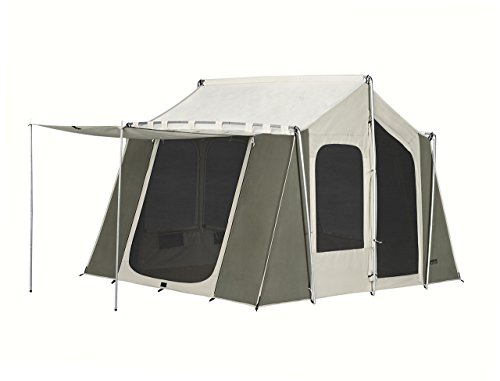
Kodiak Canvas 12 x 9 Cabin Tent
- CAPACITY: 6 people maximum
- WEIGHT: 92 lbs / 41.7 kg
- FLOOR SIZE: 12 x 9 ft
- MAX HEIGHT: 7.5 ft / 2.28 m
- PACK SIZE: Tent 32 x 15 in diameter; poles 46 x 7 in diameter
- MATERIAL: Hydra-Shield cotton duck canvas
- BEST FOR: Best traditional canvas cabin tent
The Kodiak Canvas 12 x 9 Cabin Tent is an amazing tent for spending a week or two camping with your partner or family. It is the right size for two to four camping cots with plenty of space for gear, or up to six people if you are prepared to use most of the floor for sleeping.
Kodiak still makes the 12 x 9 model, and the current version uses its Hydra-Shield 100% cotton duck canvas with 10 oz canvas on the ceiling, 8.5 oz walls and a heavy 16 oz reinforced vinyl floor. It is properly substantial camping equipment rather than something I would ever want to carry far from the car.
There is a large D-shaped front entry and a side entry, while the side wall can roll up or extend out on poles to make a small awning. Kodiak also sells a version with a much larger deluxe awning if you want to turn the area outside into another proper living space.
SPACE: The 12 x 9 floor feels just right for four people, very spacious for two and increasingly cosy as you approach the official six-person maximum. The real advantage is the shape: you get a 7.5-foot peak ceiling with steep walls rather than a dome roof curving into your head and swallowing usable space around the edges.
That lets me push bedding and furniture closer to the walls and keep a decent central walkway. It also means camping cots make much more sense in here than they do in many low tents.
FUNCTIONALITY: The front door is the obvious everyday entrance, while the side opening becomes really useful once the awning is deployed. The five large windows use no-see-um mesh, so you can get plenty of airflow without opening the whole tent up to insects.
The current floor is a seamless polyester-reinforced vinyl rather than a thin sheet of tent fabric. That is exactly what I want in a heavy canvas cabin tent because cots, boxes, chairs and boots all put far more punishment through the floor than you get in a lightweight backpacking tent.
WEATHERPROOFING: Kodiak’s Hydra-Shield canvas doesn’t need a conventional hydrostatic-head figure to prove its worth. The tightly woven cotton canvas is treated to be watertight while remaining far more breathable than a typical coated synthetic flysheet.
Kodiak describes the tent as suitable for year-round use, but it also specifically says this isn’t designed for extreme winter mountaineering or heavy snow accumulation. That is a much more sensible description than simply slapping “4 season” onto a huge vertical-sided tent.
VERDICT: The Kodiak Canvas 12 x 9 is fit for a king compared with a normal family tent. It is heavy and it takes up serious space in the car, but once it is standing you get excellent headroom, breathable canvas, a heavy-duty floor and a structure that feels designed for repeated long camping trips rather than a handful of summer weekends.
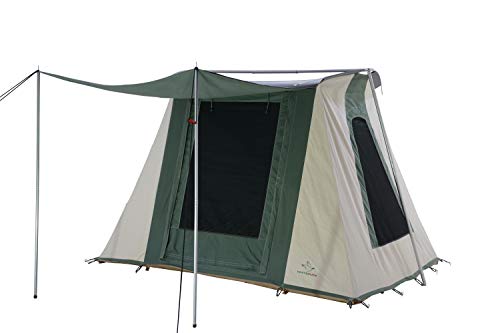
White Duck Prota 7 x 9 Canvas Tent
- CAPACITY: 4 people maximum
- WEIGHT: 49.6 lbs / 22.5 kg
- PACK SIZE: 45 x 13 x 10 in
- FLOOR SIZE: 7 x 9 ft / 63 sq ft
- HEIGHT: 6 ft 3 in / 192 cm
- MATERIAL: DYNATEK cotton canvas
- EXTRA: Stove jack, awning and electrical cable outlet
- BEST FOR: Long-term compact canvas camping
The White Duck Prota 7 x 9 Canvas Tent is one of the most substantial small cabin tents I have used, and White Duck has updated it quite a bit since the original version of this guide. The current 7 x 9 Prota is considerably lighter at around 49.6 lbs, uses aluminum main poles and now has a built-in stove jack.
We have also used the much larger Prota in my canvas wall tent guide, but I like the little 7 x 9 because it gives you the feel and toughness of a serious canvas shelter without needing a campsite the size of a football pitch.
SPACE: At 63 square feet, the smallest Prota isn’t enormous, but the near-vertical walls mean you can use almost all of that footprint. Four sleeping pads will fit, although for a comfortable glamping setup I think it makes much more sense for two people with a proper bed or a couple of cots and some furniture.
The whole structure is around 6 feet 3 inches high, so it doesn’t have the huge peaked roof of the Kodiak, but the straight walls make the internal volume feel much bigger than the dimensions suggest.
FUNCTIONALITY: The current 7 x 9 uses one main door rather than the two-door arrangement I described on the older version. You still get five no-see-um-mesh windows, a large awning and an electrical cable outlet.
The biggest addition is the stove jack. That changes what the tent can realistically be used for, especially for longer cold-weather camps, although obviously I would only use a compatible stove and chimney setup exactly as intended rather than improvising a hole through the canvas.
WEATHERPROOFING: White Duck now calls the material DYNATEK weatherproof canvas, and the current tent uses a 10 oz silver-coated cotton canvas ceiling with weatherproof canvas walls. Canvas doesn’t behave like a thin polyurethane flysheet: it is heavy, relatively quiet, breathable and extremely pleasant to live inside for extended periods.
The new T6 aluminum poles also cut a lot of weight compared with the older version without turning the frame into something flimsy. Properly pitched and guyed, this is one of the cabin tents here I would be most comfortable using for a long stay.
VERDICT: The White Duck Prota is built much more like a semi-permanent little cabin than a disposable family tent. The current 7 x 9 has become lighter and more useful than the older version, particularly with the stove jack and aluminum frame. If you want a compact canvas tent for repeated longer trips, hunting camps or cold-weather base camps, this is one of my favourites.
Naturehike Village 13 Instant Cabin Tent
- CAPACITY: 4-6 people
- WEIGHT: 48.5 lbs / 22 kg
- PACK SIZE: 43.3 x 9.8 x 11.8 in
- FLOOR SIZE: 155.5 x 106.3 in / 395 x 270 cm
- MAX HEIGHT: 72 in / 183 cm
- WATERPROOF RATING: 3,000 mm outer and floor
- BEST FOR: Best modern family cabin tent
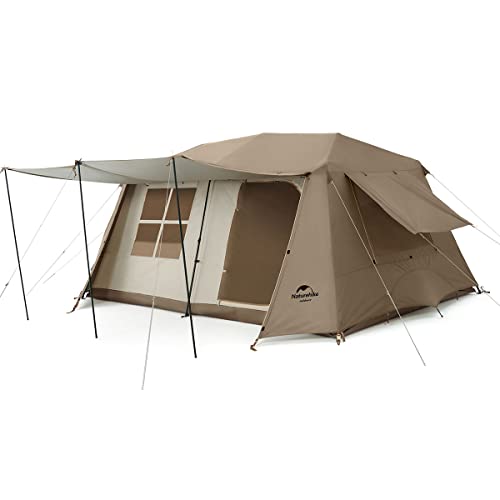
The Naturehike Village 13 Instant Cabin Tent has one of the more interesting modern designs in this guide. The entire front opens up to create a large sheltered awning, and the near-vertical rectangular body gives you the kind of usable indoor space that makes cabin tents so much nicer for family camping.
Naturehike has continued developing the Village 13 since I originally reviewed it. The current six-person version uses 150D Oxford outer fabric with its TiBLACK coating, a 300D Oxford groundsheet and a claimed 3,000 mm waterproof rating on both outer and floor.
There are also newer Flagship versions with additional side panels and larger claimed capacities, but I still like the standard Village 13 because the 4-6 person format is big without becoming completely ridiculous to transport.
SPACE: Walk through the front and you immediately notice how much usable interior volume there is. The tent measures roughly 395 x 270 cm with a maximum height of 183 cm, so taller campers won’t have unlimited standing room, but most people can move around comfortably through the centre.
The wall shape is what makes the difference. Beds, bags and storage boxes can sit much closer to the edges than they can in a strongly curved dome tent, leaving more clear floor in the middle.
FUNCTIONALITY: The one-piece pole design makes pitching much faster than you might expect for something this big, although Naturehike itself currently recommends two people for setup. The front awning is one of my favourite features because it gives you somewhere to put chairs outside while still being protected from sun and light rain.
There are five mesh windows, plenty of ventilation and enough internal space to organise the tent properly rather than living out of one giant pile of bags. The current TiBLACK coating also makes the interior darker and reduces the amount of direct solar radiation coming through the fabric compared with the earlier version.
WEATHERPROOFING: The current outer and floor are rated at 3,000 mm, which is a decent waterproof specification for a family camping tent. I still wouldn’t look at the big upright panels and think “mountain storm tent,” but for ordinary campsite rain it gives me far more confidence than the vague weatherproof claims you see on many cheap cabin tents.
As with most large awnings, I take the front panel down if strong wind or heavy rain is coming. A huge flat sheet held horizontally makes a fantastic rain catcher if water is allowed to pool on it.
VERDICT: The Naturehike Village 13 is made in China, but it isn’t some cheap throwaway tent. It is thoughtfully designed, well finished and now has considerably better fabric technology than the version I first used. If you want a modern family cabin tent with a huge front awning and lots of usable living space, this is excellent value.
CORE 9-Person Instant Cabin Tent
- CAPACITY: 9 people maximum; around 5 + gear comfortably
- WEIGHT: 37 lbs / 16.7 kg
- PACK SIZE: 48 x 11 x 11 in
- FLOOR SIZE: 14 x 9 ft
- MAX HEIGHT: 78 in / 6.5 ft
- WATERPROOF RATING: 1,200 mm fabric
- ROOMS: 2 with divider
- BEST FOR: Best value instant cabin tent
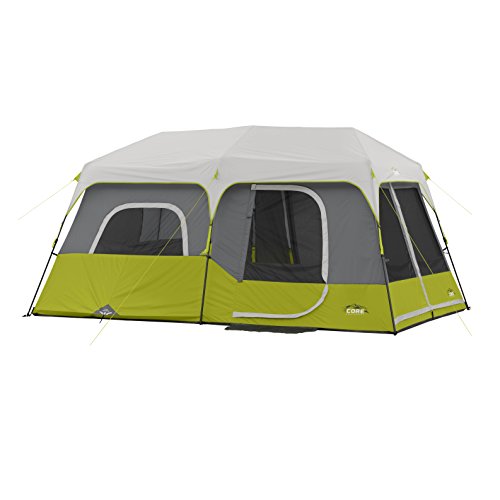
The CORE 9-Person Instant Cabin Tent is still one of the easiest recommendations here if you want a massive family tent without spending canvas-tent money. CORE has kept the standard 14 x 9 instant cabin in its current range, and the basic formula hasn’t changed much because it works.
You get pre-attached poles, a room divider, two doors, an electrical port, adjustable ventilation and enough floor space for two queen air mattresses. CORE calls it a nine-person tent, although the company now sensibly says around five people plus gear is a more comfortable setup.
SPACE: The near-vertical walls and 78-inch centre height create a huge amount of usable space. You can technically squeeze nine sleeping positions onto the floor, but I wouldn’t choose to camp like that unless I was at a festival and everyone had run out of money.
For a family of four or five, the tent feels completely different. You have room for proper mattresses, bags and a clear walkway, and the divider can create two separate sleeping areas when you want some privacy.
FUNCTIONALITY: The instant frame is the whole point. All the main poles remain attached to the tent, so setup is basically unfold, extend and lock. CORE currently claims around two minutes with two people, which is realistic once you know what you’re doing.
There are two doors, large windows, storage pockets and an E-port for running a power cable inside. CORE also now sells versions of the same 14 x 9 format with BlockOut fabric, built-in lighting or a full rainfly, so if one of those features matters more to you there are several upgrades without changing the basic layout.
WEATHERPROOFING: The current standard model uses 68D polyester rated at 1,200 mm with sealed seams and CORE’s H2O Block construction. CORE also says the tent is tested for winds up to 35 mph when properly anchored.
I still think the standard short rainfly makes this more of a normal three-season campsite tent than something I would deliberately take into horrible weather. If bad-weather performance is a priority, the current full-rainfly version makes more sense.
VERDICT: The CORE 9-Person Instant Cabin Tent remains a bargain for the amount of usable living space you get. It sets up in minutes, has enough room for a proper family camping setup and costs a fraction of the premium tents above. For summer holidays, festivals and normal campsite use, it is difficult to complain about the value.
Coleman 10-Person Dark Room Instant Cabin Tent
- CAPACITY: 10 people maximum
- WEIGHT: 44.6 lbs / 20.2 kg
- FLOOR SIZE: 14 x 10 ft
- MAX HEIGHT: 6 ft 7 in / 201 cm
- ROOMS: 2 with room divider
- SETUP: As fast as 1 minute
- EXTRA: Dark Room fabric and E-port
- BEST FOR: Best blackout cabin tent
The Coleman 10-Person Dark Room Instant Cabin Tent replaces the Oak Canyon 4 from the original version of this guide. I still like the Oak Canyon, but Coleman officially describes it as a tunnel tent, so it doesn’t make much sense to keep pretending it is one of the best cabin tents when Coleman makes an actual Dark Room instant cabin tent.
The 10-person Dark Room model has a 14 x 10-foot floor, a 6-foot-7 centre height and enough nominal floor space for four queen air mattresses. That is a lot of tent, and like most “10-person” ratings, I think it is much nicer when you use some of that theoretical sleeping capacity for clothes, bags and somewhere to actually walk.
DARK ROOM: This is the reason I would choose it over a normal instant cabin. Coleman says the current Dark Room material blocks around 90% of sunlight compared with a comparable Coleman tent, which makes the interior noticeably darker after sunrise.
I really like blackout bedrooms for family camping. They don’t magically turn a hot tent into an air-conditioned room, but not having full-strength morning sunlight blasting through the fabric makes sleeping in far easier and can help the interior stay more comfortable.
SPACE: At 14 x 10 feet, there is plenty of room to create two separate sleeping zones using the included divider. The 6-foot-7 centre height gives most campers enough standing room, and because this is a proper cabin-style structure rather than the Oak Canyon tunnel tent, the usable volume around the walls is much better.
FUNCTIONALITY: The instant frame uses pre-attached poles and Coleman claims setup can be completed in as little as a minute. In practice, any giant tent is easier with another person helping, but it is dramatically simpler than feeding a pile of loose poles through sleeves.
There is also an E-port for power and enough room for actual furniture rather than just airbeds. For family holidays where I’m spending a lot of time at the campsite, this is exactly the type of layout I want.
WEATHERPROOFING: Coleman uses its WeatherTec system with welded corners and inverted seams, plus an included rainfly. This isn’t the tent I would choose for serious exposed winter camping, but that isn’t what a 10-person vertical-wall instant cabin is designed for.
VERDICT: If you specifically want a large cabin tent that stays darker in the morning, this is the Coleman I would buy. The old Oak Canyon is still a good tent, but this is a much better fit for the actual subject of this guide and gives you far more true cabin-tent living space.
Gazelle T4 Plus Hub Tent
- CAPACITY: 4-8 people
- WEIGHT: 56 lbs / 25.4 kg
- PACK SIZE: 64 x 12 x 12 in
- FLOOR SIZE: Approx. 110 sq ft
- MAX HEIGHT: 78 in / 198 cm
- WATERPROOFING: 2,000 mm shell, 5,000 mm floor
- ROOMS: Main room + convertible screen/sleeping room
- BEST FOR: Best instant cabin tent with a screen room
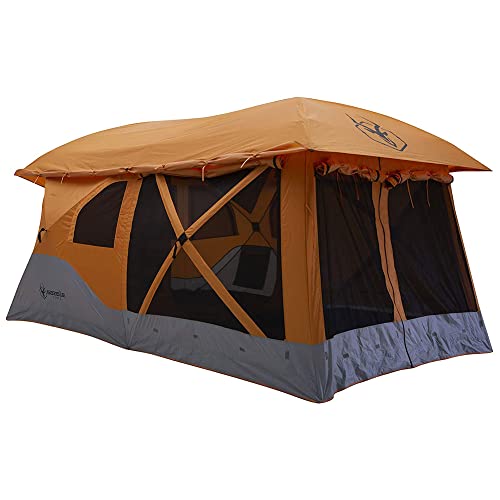
The Gazelle T4 Plus Hub Tent is the extended version of the standard T4 Hub Tent I have reviewed elsewhere, with a second large screen-room section attached to the main sleeping area. The way Gazelle’s hub frame pushes the walls outwards makes the inside feel incredibly spacious and also gives the walls far more tension than a floppy conventional cabin tent.
The T4 Plus remains available through retailers, while Gazelle’s current line has expanded with newer T4 Tandem and Overland versions based around the same 110-square-foot, 78-inch-high concept. The basic reason I like it hasn’t changed: it is one of the quickest enormous tents to put up.
SETUP: If you want a cabin tent that requires almost no patience to erect, this is it. Once it is out of the bag and unfolded, you pop the wall hubs out and push the roof section into position. Gazelle advertises around a 90-second setup, and the hub system really does make conventional pole-and-sleeve tents feel primitive afterwards.
SPACE: The main sleeping pod fits four people very comfortably, while the second section can function as a screen room or additional sleeping space. Gazelle quotes capacity up to eight, but I like it much more as a four-person tent with a ridiculous amount of living space.
The outward-pushed walls create far more usable volume than the footprint alone suggests. At 78 inches high, most people can stand up and walk around without thinking about where the highest point of the roof is.
FUNCTIONALITY: The convertible screen room is the feature that makes the Plus worthwhile. During the day it gives you a bug-free place for chairs and gear; at night you can close the privacy panels and use it as another sleeping area.
There are multiple storage pockets and gear lofts, and the floor is removable, which is one of those features I didn’t think much about until I had to clean one. Being able to separate a filthy floor from a huge tent is genuinely useful.
WEATHERPROOFING: The T4 Plus uses 210D Oxford polyester rated to around 2,000 mm, while the heavy removable floor is 300D Oxford polyester with a much higher 5,000 mm rating. The hub walls look incredibly boxy but stay under more tension than a basic cabin frame, which helps stop them flapping and collapsing inward in gusty weather.
I still wouldn’t deliberately choose a giant hub tent for alpine storms, but compared with many traditional square cabin tents, the structure feels remarkably solid.
VERDICT: The Gazelle T4 Plus is for anyone who wants a huge cabin tent with a proper screen room but hates setting tents up. Pop the wall and roof hubs into place, stake it properly and you have a massive freestanding shelter in a fraction of the time most tents this size require.
KTT Extra Large 12-Person Family Cabin Tent
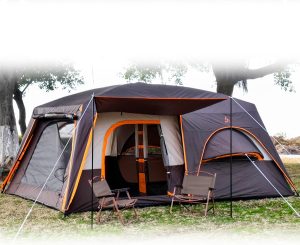
- CAPACITY: 10-12 people maximum
- WEIGHT: Approx. 34 lbs / 15.4 kg
- FLOOR SIZE: 14.1 x 10 ft / 4.3 x 3.05 m
- MAX HEIGHT: 6.58 ft / 79 in
- ROOMS: 2 with removable divider
- DOORS: 3
- WINDOWS: 3 mesh windows + mesh roof
- SEASON RATING: 3 season
- BEST FOR: Best huge budget cabin tent
The KTT Extra Large 12-Person Family Cabin Tent is the replacement I would use for the Ozark Trail. More importantly for this guide, it is actually shaped like a cabin, with tall straight walls rather than simply being a massive dome tent.
The 14.1 x 10-foot floor gives you around 141 square feet of space, and the walls stay almost vertical up to a 6.58-foot maximum height. That means you can push mattresses, bags and furniture much closer to the edges without losing half the usable floor to a sloping roof.
SPACE: KTT rates it for up to 12 people and says it can fit four full-size air mattresses. As usual, I wouldn’t actually want to live in it with twelve adults unless I had no other option. For six to eight people with bags and a bit of living space, however, it is enormous.
A removable curtain divides the interior into two rooms, which is particularly useful for mixed groups or families who don’t want everyone sleeping in one giant open bedroom.
FUNCTIONALITY: There are three doors and three large mesh windows, plus plenty of mesh higher up for ventilation. One of the door panels can also be supported on poles to create a small awning, giving you somewhere shaded to sit or leave shoes outside the main living area.
Unlike the CORE and Gazelle, this isn’t an instant tent. You need to build the frame properly, and KTT itself makes that very clear. The advantage is a relatively compact packed size for such a huge shelter; the disadvantage is that this isn’t the tent I would choose if I wanted to arrive at camp and have everything standing in 90 seconds.
WEATHERPROOFING: This is a three-season family camping tent rather than something I would deliberately pitch somewhere exposed in horrible weather. KTT itself advises against using this particular model in strong wind, heavy rain or snow.
I actually appreciate them saying that instead of sticking a ridiculous “4 season” label on a huge straight-wall family tent.
For ordinary spring and summer campsite use, the double-layer polyester construction and rainfly are perfectly sensible. If I knew several days of genuinely bad weather were coming, I would choose one of the more weather-focused tents higher up this list.
VERDICT: The KTT is all about getting a huge amount of proper cabin-style space without spending Snow Peak or canvas-tent money. The vertical walls, two rooms, three entrances and massive floor make it particularly good for large families and groups, provided you understand that it is designed for normal car camping rather than storms.

What Is a Cabin Tent?
A cabin tent is a large camping tent designed with steep or near-vertical walls and a high roof to maximise usable internal space. Instead of the strongly curved sides you get with a dome tent, the shape is closer to a small cabin or portable room.
That extra volume makes cabin tents particularly useful for family and group camping because you can fit proper beds, cots, chairs and storage against the walls without everything being forced towards the centre. Large doors, big mesh windows and removable room dividers are also common.
The trade-off is weight, packed size and wind resistance. Cabin tents are primarily car-camping shelters, not something I would carry into the mountains.
Cabin Tents vs Dome Tents
Dome tents are generally lighter, more aerodynamic and easier to use when you’re moving camp frequently. Curved poles distribute wind loads nicely and the smaller surface area makes a dome much more sensible for hiking, backpacking and exposed campsites.
Cabin tents sacrifice most of those advantages in exchange for comfort. The near-vertical walls create far more standing room and usable floor space, which makes a huge difference if several people are sharing the tent for more than a night or two.
For me, the choice is straightforward. If I’m carrying the shelter any meaningful distance, I want a dome or tunnel tent. If I’m parking beside the pitch and living there with several people for a week, I would rather have the cabin.
Canvas Cabin Tents vs Polyester Cabin Tents
One of the biggest decisions is whether to buy canvas or synthetic fabric. Neither is automatically better; they suit different types of camping.
- Festivals: I normally choose synthetic because it is cheaper and easier to transport.
- Family camping holidays: I like both, although canvas feels better to live in for longer trips.
- Backpacking and hiking: Neither. I would carry a much lighter dome or tunnel tent.
- Hot weather: Canvas can feel much nicer because the fabric is more breathable, but large synthetic tents often compensate with enormous mesh panels.
- Cold weather: Heavy canvas tends to feel less draughty and some models can be used with purpose-designed stove systems.
- Strong wind: Tent shape, frame and guying matter more than whether the fabric is canvas or polyester.
- Heavy rain: Both can keep you dry when properly designed and maintained.
- Weekend trip: Synthetic usually wins for quicker setup and lighter packed weight.
- Extended camp: Canvas starts making much more sense because comfort and long-term durability become more important than setup effort.
One major difference is moisture management. Cotton canvas absorbs and releases moisture differently from coated polyester and generally feels less clammy inside, but it also becomes extremely heavy if you pack it away soaked.

Guide to the Best Cabin Tents
To find the best cabin tent for camping, I pay most attention to internal space, weather protection and ventilation. Privacy, packed size and ease of setup become more or less important depending on whether I’m camping with a family, a large group or just two people who want far more room than they actually need.
Capacity
One of the main reasons people choose cabin tents is the amount of space available. Manufacturers regularly advertise capacities of eight, ten or twelve people, but those numbers usually describe how many sleeping mats can theoretically be arranged across the floor rather than how many people will enjoy living there.
I almost always go larger than the official capacity I need. If there are eight people, I would rather have a ten or twelve-person tent and leave space for bags, shoes and a walkway than spend the whole trip stepping over everyone.
Weight and Pack Size
Cabin tents are not designed to be carried for long distances. They compromise heavily on weight so they can maximise living space, standing height and frame strength.
Once I’ve accepted that I’m camping close to the vehicle, I stop worrying about whether a tent weighs 35 lbs or 50 lbs and start asking whether I can actually lift the bag and whether it will fit in the boot. Canvas models weighing 90 lbs or more are a different matter, particularly if you’re loading them alone.
Floor Space
Floor dimensions give you a much better idea of real-world capacity than the number printed on the box. Think about the actual size of your camping mattresses or cots and then add room for bags and a walkway.
Near-vertical walls also make the quoted floor dimensions more useful than they are in a dome tent. If a cabin tent says it is nine feet wide, much more of that nine feet can actually be occupied by furniture without the roof pressing down onto it.

Ceiling Height
Standing height is one of the biggest reasons I use a cabin tent in the first place. Not having to crouch every time I change clothes, find something in a bag or walk to the door completely changes the experience on a long trip.
Pay attention to more than the maximum peak height, though. Some tents might technically reach 7 feet in the middle but drop quickly towards the walls. A true cabin shape with high sidewalls usually feels much bigger than a peaked tent with the same maximum measurement.
Weatherproofing
This is where cabin-tent marketing can get silly. A marketplace listing calling a huge square tent “4 season” doesn’t magically make it suitable for winter mountaineering.
For synthetic tents, hydrostatic-head figures can be useful. Around 1,200-1,500 mm is enough for many normal campsite tents when the seams and construction are good, while 2,000-3,000 mm and above gives more margin for sustained rain.
But waterproof fabric is only one part of the problem. I also look at:
- Sealed or taped seams
- Floor construction
- Rainfly coverage
- Guyline positions
- Frame design
- How much flat wall area faces the wind
A 5,000 mm fabric attached to a terrible frame can still make a terrible storm tent.
Room Dividers
Room dividers are one of the features cabin tents can offer that smaller shelters simply don’t have space for. They are especially useful for families because children and adults can have separate sleeping areas, or you can divide sleeping space from the part of the tent where everyone leaves muddy gear.
I prefer removable dividers that can be tied away during the day. That lets you use the entire interior as one huge living area when privacy isn’t needed.
Ventilation
I probably pay more attention to ventilation than most people, but I hate a stuffy tent. Ventilation matters both for staying cooler in summer and for reducing condensation on cold or humid nights.
I like large mesh windows combined with lower vents that pull cooler air in and higher openings where warm damp air can escape. The best huge tents let you open opposite doors or windows and create a proper through-draft.
Windows and Doors
Cabin tents are known for enormous windows, and that is one of the reasons they feel so pleasant during the day. Ideally, every window has fine insect mesh plus a solid panel that can be closed from inside when the weather changes.
I also strongly prefer two doors when several people are sharing a tent. It reduces the amount of climbing over beds and bags, improves ventilation and means everyone isn’t queuing for one opening. Doors that convert into awnings are even better because they add useful shade without carrying another shelter.
Bug Mesh
If you’ve ever camped somewhere full of mosquitoes, midges or no-see-ums, you’ll know why mesh quality matters. I want mesh fine enough that tiny flying insects stay outside while still allowing reasonable airflow.
A screen room is particularly useful because it lets everyone sit around in the evening without needing to completely seal themselves inside the sleeping section.
Ease of Setting Up
Some enormous cabin tents are horrible to pitch alone. There is simply too much fabric and too much height to control easily, particularly when you are trying to get a huge rainfly over the top.
Instant tents like the CORE and Gazelle solve a lot of that frustration by keeping the frame attached or using hub systems. Canvas tents normally take longer, but if I’m setting one up for two weeks rather than two nights, another fifteen minutes of pitching hardly matters.
10 Benefits of Cabin Tents
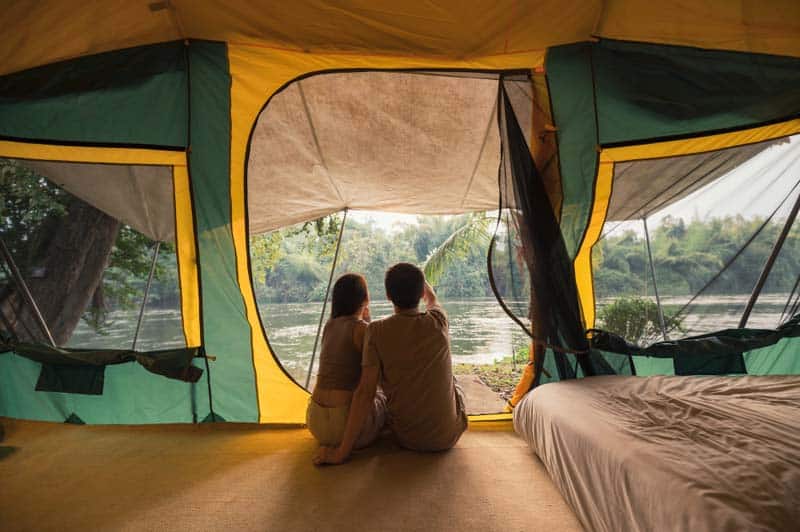
- Huge amount of usable floor space
- Lots of standing headroom
- Large walk-through doors
- Room dividers for privacy
- Large windows and ventilation
- Space for cots and proper mattresses
- Vertical walls make furniture easier to position
- Excellent for groups and families
- Some have screen rooms and large awnings
- They feel much more like living spaces on long trips
3 Disadvantages of Cabin Tents
- Heavy and bulky compared with dome tents
- Large vertical walls are generally less aerodynamic in strong wind
- The biggest models can be difficult to pitch alone
What Are the Best Cabin Tent Brands?
Some of my favourite cabin-tent brands specialise in very different things. Kodiak Canvas and White Duck are the obvious names if I want heavy canvas and long-term durability, while Snow Peak goes further on build quality and living-space design. Gazelle is one of my favourites for hub-style instant pitching, and CORE and Coleman offer a lot of family-friendly space and features for much less money.
For me, the standout brands are:
- Snow Peak
- Kodiak Canvas
- White Duck Outdoors
- Gazelle
- Coleman
- CORE Equipment
What Is the Best Cabin Tent?
If money isn’t the main concern, I still think the Snow Peak Land Lock is the best overall combination of living space, ventilation, weather protection and build quality. It gives you a genuine separate sleeping section and an enormous communal area rather than just one huge bedroom.
For long-term canvas camping I would choose between the Kodiak Canvas 12 x 9 and White Duck Prota. If setup speed matters most, the Gazelle T4 Plus is hard to beat, while the CORE 9-Person Instant Cabin offers ridiculous value for a normal family camping holiday.
If sleeping past sunrise matters, the current Coleman 10-Person Dark Room Instant Cabin is a far better cabin-tent recommendation than the Oak Canyon I previously had in this guide.
I hope this guide helps you find the best cabin tent for the way you actually camp, whether that means a giant budget family shelter for a week in summer or a heavy canvas cabin you expect to keep using for years.






[…] designed to mimic the shape of a small cabin and offer many of the same benefits. Check out these luxury cabin tents. Near vertical walls and a high ceiling provides maximum internal space for the size of the […]